Best Water Filter to Remove PFAS, Microplastics, Lead and Fluoride (2026)
The 30 Second Summary
- Carbon does not touch fluoride or nitrates, and standard pitchers miss almost everything. Activated carbon is excellent on chlorine, taste and many organics. It is not a universal filter, and no packaging tells you that. Section 3 maps every contaminant to what actually removes it.
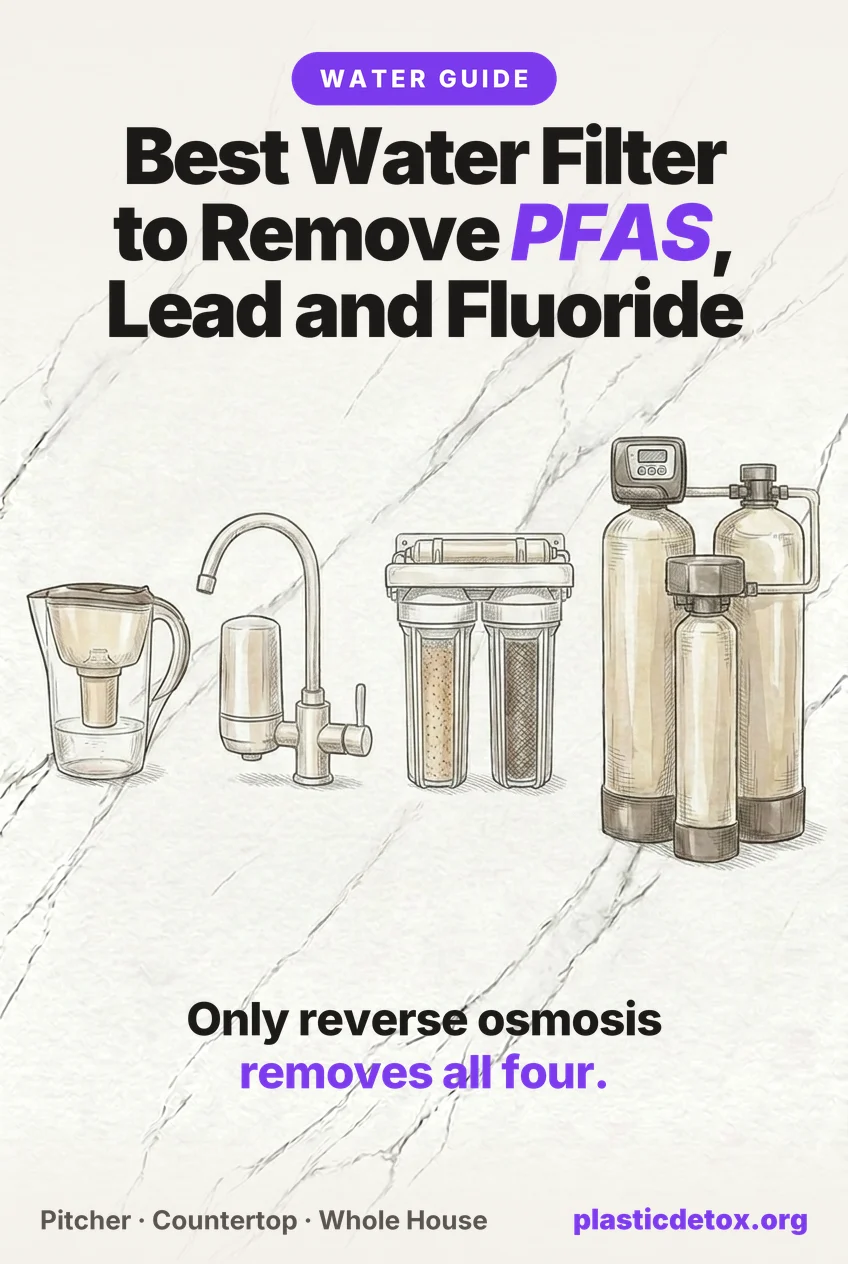
- Reverse osmosis is the only household technology that removes all four. PFAS, microplastics, lead and fluoride all come out at the membrane, along with nitrates, arsenic and chromium 6. Everything else covers a subset, which is fine once you know which subset you need.
- Our top pick is the Bluevua RO100ROPOT, a countertop reverse osmosis system that needs no plumbing and collects filtered water in a borosilicate glass carafe rather than a plastic reservoir.
- The 2026 rule changes moved the deadline, not the contamination. In May the EPA proposed keeping the 4 parts per trillion limits for PFOA and PFOS while letting utilities push compliance to 2031, and rescinding the limits for four other PFAS entirely. Lead service line replacement runs to 2037.
- Certified is a claim. Tested to is not. NSF/ANSI 401 covers microplastics, 53 covers lead and PFAS on carbon, 58 covers reverse osmosis, P473 covers PFOA and PFOS. A filter certified only to 42 has been checked for chlorine taste and nothing else.
- Three popular categories do almost nothing for health contaminants: standard pitcher filters, refrigerator filters and bottled water. Section 9 covers what each one actually does.
The short answer is reverse osmosis. It is the only household technology that removes PFAS, microplastics, lead and fluoride together, because it separates by membrane exclusion rather than adsorption. A certified carbon block covers lead, PFAS and microplastics but leaves fluoride and nitrates untouched. Standard pitcher and refrigerator filters cover chlorine taste and very little else. Which of those you actually need depends on your own water, so this guide starts there.
Every water filter roundup has the same structural flaw. It ranks products against an imaginary average tap, then hands you a winner. But water is the most local thing you consume. Lead does not come from the treatment plant, it comes from the service line under your own front garden. Nitrates track the farmland upstream of you. Chromium 6 tracks local geology and local industry. Two neighbours on different pipe runs can have measurably different water.
So this guide runs in the other order. First find out what is in your supply, which takes about ten minutes and costs nothing. Then match a technology to it. The product list comes last, because by the time you reach it you will already know which section applies to you.
1. Start With Your Water, Not With a Product
There are three sources of truth, and they answer different questions.
Your utility's annual report
The Consumer Confidence Report is free, and every community water system is legally required to publish one by July each year. Search your utility's name plus "consumer confidence report". It tells you what was in the water when it left the plant.
The EWG Tap Water Database
Enter your zip code at ewg.org/tapwater. It reformats the same utility data against health based guidelines rather than legal limits, so it surfaces contaminants your utility can legally report as fully compliant.
A certified home test
The only option that captures what your own pipes and fixtures add after the water leaves the main. This is where lead shows up. Use a lab that is certified by your state, and run a first draw sample after the tap has sat unused overnight.
The gap between the second and third sources is the one people miss. A Consumer Confidence Report describes water at the plant and at sampling points across the network. It cannot describe your house. If your home was built before 1986, or you have brass fixtures of unknown age, or your city's lead service line inventory lists your address as "unknown material", then the only number that means anything is the one from your own tap.
On a private well, none of this applies. Roughly 43 million people in the US drink from private wells, and the EPA does not regulate them at all. No annual report exists, no action level applies, and nobody is testing on your behalf. Well water also skews toward a different contaminant profile: nitrates from agricultural runoff, arsenic and uranium from geology, and bacteria after heavy rain. Annual testing is not optional here, it is the entire safety system.
2. What Changed in 2026
Three regulatory facts are worth knowing before you spend money, because together they explain why the filter is the part of this you actually control.
The PFAS deadline moved. In May 2026 the EPA proposed keeping the federal limits of 4 parts per trillion for PFOA and PFOS, while allowing water systems to request two additional years to comply, pushing the deadline from April 2029 to April 2031. The same proposal would rescind the drinking water limits for four other PFAS entirely: PFHxS, PFNA, HFPO-DA (GenX) and the Hazard Index for mixtures. Several states keep their own standards, but at federal level those four compounds would have no limit at all.
Lead pipe replacement runs into the 2030s. The Lead and Copper Rule Improvements, finalized in late 2024, require utilities to replace lead and galvanized service lines at a minimum of 10 percent per year, with full replacement due by 2037 and initial compliance in November 2027. Lead pipes still connect up to 9 million US homes, and the EPA's own inventory lists more than 24 million additional service lines as "unknown material".
Wells were never covered. As above, the 43 million people on private supplies sit outside all of it.
None of this is a reason to panic about tap water, which in most of the US is genuinely well treated for the things it is regulated for. It is a reason to understand that "compliant" and "clean" are different words, and that the timeline for the difference closing is measured in years.
3. Match the Contaminant to the Technology
This is the table the rest of the article hangs on. Find your contaminants in the left column, and read across.
| Contaminant | Usual source | What removes it | What does not |
|---|---|---|---|
| Lead | Service lines, solder, brass fixtures | Reverse osmosis, carbon block certified to NSF/ANSI 53 | Standard pitcher carbon, boiling |
| Chlorine and chloramine | Municipal disinfection | Activated carbon (NSF/ANSI 42), KDF media for chloramine | Sediment filters, softeners |
| Disinfection byproducts (THMs, HAA5) | Chlorine reacting with organic matter | Carbon block certified to NSF/ANSI 53, reverse osmosis | Granular carbon, partially |
| PFAS | Firefighting foam, industry, landfills | Reverse osmosis, carbon block certified to 53 or P473, anion exchange | Standard pitchers, fridge filters, boiling |
| Microplastics | Source water, distribution pipes | Reverse osmosis, carbon block certified to NSF/ANSI 401 | Standard pitcher carbon, fridge filters |
| Nanoplastics | Same, plus plastic packaging | Reverse osmosis, nanofiltration | All carbon filtration, including 401 certified |
| Nitrates | Agricultural runoff, septic, wells | Reverse osmosis, anion exchange | Carbon of any kind, boiling |
| Arsenic | Geology, mostly wells and the Southwest | Reverse osmosis (NSF/ANSI 58 for arsenic V) | Carbon, softeners |
| Chromium 6 | Industrial discharge, natural geology | Reverse osmosis | Carbon, softeners |
| Fluoride | Added by utility, or natural | Reverse osmosis, activated alumina, bone char | Activated carbon of any grade |
| Hardness (calcium, magnesium) | Geology | Ion exchange softener, reverse osmosis | Carbon |
| Bacteria and parasites | Wells, main breaks, boil notices | UV, filters certified to NSF P231, boiling | Carbon, softeners |
Two patterns fall out of that table. The first is that reverse osmosis appears in the "removes it" column of every row except bacteria, which is why it is the default recommendation when you do not want to think about it. The second is that activated carbon, which is what the overwhelming majority of filters sold in supermarkets contain, appears in the "does not" column far more often than people expect. Carbon is excellent at chlorine, taste, odor and organic chemicals. It is not a universal filter, and nothing about the packaging tells you that.
4. The Six Filter Types, and What Each One Really Does
Standard pitcher and faucet filters. Granular activated carbon, pore sizes in the tens of microns. Built to make chlorinated water taste better, and very good at that. Not particle filters, not PFAS filters, and no help with fluoride or nitrates. Cheapest to buy, most expensive per gallon over time.
Certified carbon block pitchers. A denser, compressed carbon medium with pore sizes down to 0.5 microns, which is a genuinely different product from the one above despite looking identical on a shelf. The good ones carry NSF/ANSI 53 for lead, 401 for microplastics and P473 for PFOA and PFOS. Slower flow is the tradeoff, and it is the honest signal that filtration is happening.
Countertop reverse osmosis. A full multi stage RO system that plugs into a wall socket and sits next to the kettle. No plumbing, no drilling, moves house with you. You fill a tank by hand and the filtered water collects in a carafe. The best fit for renters and the most common recommendation we make.
Under sink reverse osmosis. The same membrane, plumbed in, with a dedicated faucet. Tank versions store filtered water in a pressurized bladder, which is convenient but means the water waits in a polymer bladder before you draw it. Tankless versions filter on demand and skip that step. Highest capacity, lowest cost per gallon, needs cabinet space and an installer or a confident afternoon.
Gravity countertop systems. Stainless canisters with ceramic or carbon elements, no power and no plumbing. Popular for off grid and emergency use. The category's problem is that certification is patchy and the strongest marketing claims often sit on the least certified products, which is exactly the situation Berkey is currently in.
Whole house systems. Installed at the point where water enters the building, so every tap, shower and appliance is covered. Excellent for chlorine, sediment and iron. Usually not the right tool for PFAS, because the contact time needed to strip parts per trillion is hard to achieve at whole house flow rates. The standard sensible setup is whole house for volume plus a certified system at the kitchen sink for drinking.
5. How We Chose
Every product below cleared the same five checks we run before anything gets recommended:
- Filtration performance. What the technology physically removes, verified against the contaminant table above rather than against marketing copy.
- Materials in the water path. What filtered water contacts between the membrane and your glass. A system that cleans water and then stores it in plastic has done part of a job.
- Independent certification. WQA or IAPMO certification against the relevant NSF/ANSI standards, or published third party lab results where certification is absent.
- Lawsuits. We checked for class actions, consumer protection actions and regulatory actions against every brand.
- Recalls. We checked for open recalls on every model listed.
Among the systems that passed all five, owner reviews broke the tie. Certification tells you a unit performed in a lab. Several thousand owners tell you whether it still works in a kitchen after a year.
6. The Best Water Filters for 2026

Bluevua RO100ROPOT
Five stage countertop reverse osmosis, 0.0001 micron membrane, no plumbing. Borosilicate glass carafe, remineralization stage. WQA certified to NSF/ANSI 372 for lead free materials, SGS tested.
View →
LifeStraw Home Glass, 7 Cup
Borosilicate glass body, silicone base, polysulfone membrane. Certified to NSF/ANSI 42, 53, 401 and P473, plus EPA and NSF P231. Microplastics 99.999 percent, PFOA and PFOS above 99 percent. Lid, reservoir and housing are plastic.
View →
APEC ROES-50
Five stage under sink reverse osmosis, 50 gallons per day. Butyl and polypropylene bladder storage tank. Requires cabinet space and a drilled faucet hole.
View →
AquaTru Glass Carafe
Four stage countertop reverse osmosis, no plumbing. IAPMO certified to NSF/ANSI 42, 53, 58, 401 and 372. Borosilicate glass carafe, 64 ounce capacity. Fill tank is plastic.
View →
Waterdrop G3P800
Tankless under sink reverse osmosis, 800 gallons per day, 3 to 1 pure to drain ratio. NSF/ANSI 58 certified. No storage tank. Requires a power outlet under the sink.
View →Bluevua RO100ROPOT, our top pick
This is the system we point most people to, because it is the only one that covers the entire contaminant table without asking you to call a plumber. Full reverse osmosis, sits on the counter, plugs into a wall socket, and pours into a borosilicate glass carafe so the filtered water never sits in plastic. There is a remineralization stage after the membrane, which answers the most common objection to reverse osmosis before it comes up.
It also has the strongest owner record here for a countertop unit by a wide margin, holding a 4.6 star average across more than 3,600 reviews. In a category where the common failure mode is a unit that quietly stops working in month eight, that volume of sustained feedback matters more than a spec sheet.
The honest caveat is certification. Bluevua is certified by the WQA against NSF/ANSI 372, which covers lead free contact materials, and the company publishes SGS laboratory testing. What it does not carry is full IAPMO or NSF certification for contaminant reduction claims the way AquaTru does. The physics of a 0.0001 micron membrane do not change by brand, but if you want an independent body to have signed off on the removal percentages specifically, buy the AquaTru instead.
LifeStraw Home Glass, if a countertop appliance is not happening
The one pitcher worth owning. The body is borosilicate glass on a silicone base, and the certification list is genuinely deep for the category: NSF/ANSI 42 and 53, NSF/ANSI 401 for microplastic reduction at 99.999 percent, NSF P473 for PFOA and PFOS above 99 percent, and EPA and NSF P231 for bacteria and parasites. Very little else in the pitcher category carries that combination.
Be precise about what is and is not glass. The vessel holding your filtered water is borosilicate glass. The lid, the top fill reservoir and the filter housing are plastic, and the membrane is polysulfone. Unfiltered water sits in plastic and passes through plastic on the way down, then rests in glass. Better than an all plastic pitcher, not a plastic free product.
The tradeoffs show up in the 3.8 star rating and they are real. Independent testers clock over 20 minutes to fill the 7 cup pitcher. Owners report seam leaks and drips at the spout, the fill lid is awkward to clean, and glass plus two liters of water is heavy. Being a carbon block, it also leaves fluoride and nitrates untouched. If those are on your list, you need reverse osmosis rather than any pitcher.
APEC ROES-50, best under sink and best value
If you own your home and have cabinet space, this is the most filtration per dollar available. A five stage reverse osmosis system that has sold in very large numbers for over a decade, holding a 4.5 star average across more than 9,400 reviews, which is more owner validation than everything else here combined.
The tradeoff is the storage tank. Filtered water sits in a butyl and polypropylene bladder inside the steel shell before you draw it. It is inert and food grade, and a much smaller exposure than unfiltered tap water, but it is there and no manufacturer mentions it. There is also a category wide consumer class action investigation into under sink filter housings that crack and leak. APEC is not a named defendant and we found no recall on the ROES-50, but check your fittings after installation and again after a week, and do not install over an unprotected cabinet base.
AquaTru Glass Carafe, the most certified
AquaTru is the certification leader. The Glass Carafe model is certified by IAPMO against NSF/ANSI 42, 53, 58, 401 and 372, the most complete set on this list, covering taste and odor, lead and cysts, reverse osmosis performance, microplastics and lead free materials in one package. It also uses borosilicate glass for the filtered water carafe.
Two things keep it out of the top slot. It costs meaningfully more than the Bluevua, and its owner reviews are weaker at 4.3 stars across a much smaller base of around 240. There is a visible thread of Better Business Bureau complaints about early failures, leaks and wrong models arriving. No recall and no class action against the company, and the certification is genuinely best in class, but the reliability picture is less settled. The carafe is glass, the fill tank is not.
Waterdrop G3P800, if you want no storage tank at all
The tankless design is the point. It filters on demand and sends water straight to a dedicated faucet, so there is no bladder and no reservoir, and filtered water has essentially no dwell time in any polymer. It runs a 3 to 1 pure to drain ratio, where older systems waste considerably more, and pushes 800 gallons per day so there is no waiting for a tank to refill.
It is by a distance the most expensive option here, and it needs a power outlet under the sink alongside the plumbing connection. Worth it if the storage tank is the specific thing bothering you and you are already committed to an under sink install.
7. Which One for Your Situation
You rent, or you do not want to drill anything. Countertop reverse osmosis. The Bluevua RO100ROPOT is our pick. It needs nothing but a socket and it moves with you.
You own your home and want the most filtration per dollar. The APEC ROES-50 under sink system, accepting the bladder tank.
You want certification above everything. The AquaTru Glass Carafe.
Small kitchen, small budget, or month to month tenancy. The LifeStraw Home Glass pitcher, with the flow rate caveat and the knowledge that it does not touch fluoride or nitrates.
You are on a private well. Test first, then build the system around the results, because well profiles vary too much for a default recommendation. Most well setups need a sediment prefilter ahead of anything else, reverse osmosis for nitrates and arsenic, and UV if bacteria have ever shown up. The Waterdrop G3P800 handles the volume well if your flow rate supports it.
You want minerals put back after the membrane. The Bluevua has a remineralization stage, and AquaTru sells a separate alkaline version of the Glass Carafe that does the same. For an under sink system, the iSpring RCC7AK adds a sixth alkaline stage that returns calcium and magnesium.
You are mixing infant formula. Reverse osmosis, without much debate. Formula water is the one case where fluoride, nitrates and lead all matter at once and the drinker is a few kilograms. Our baby formula guide covers which powder to mix into it, and the full preparation sequence.
One thing worth saying plainly whichever you buy: filtering your water and then pouring it into a plastic bottle gives back a good share of what you just paid for. Pair any of these with glass or stainless steel. Our water bottle and tumbler picks cover the vessels that keep plastic out of the drink path entirely, and the same logic applies to your coffee setup and your tea, both of which are mostly filtered water by volume.
8. Beyond the Kitchen Tap: Shower, Fridge, Whole House
Shower filters
A ten minute hot shower is a real exposure route, and not the one people assume. You absorb some chlorine through skin, but the larger share arrives as inhaled disinfection byproducts, because hot water volatilizes them into a small enclosed room. If your water smells of chlorine at the tap, your bathroom is concentrating it.
Shower filters are also the one category where expectations should stay low. There is no certified option for chloramine, which is what many US utilities now use instead of free chlorine, and chloramine needs KDF or vitamin C media rather than plain carbon. Nothing at this price point handles PFAS.

KDF-55 is the reason this one is on the list rather than a cheaper carbon only head: it is the medium that does something about chloramine. Note that Aquasana's brand record needs a caveat, covered in section 10.
Refrigerator filters
Keep it, replace it on schedule, and do not count it as your water filter. Most are certified to NSF/ANSI 42 for chlorine and some to 53 for lead, which is a real if narrow benefit. Pore sizes in the 10 to 20 micron range mean no microplastic reduction, and PFAS certification is close to nonexistent in the category. The practical risk is that fridge cartridges are the ones everyone forgets, and an expired filter can release accumulated contaminants back into the water.
Whole house systems
Worth it in three situations: chlorine or chloramine heavy water that irritates skin and hair throughout the house, well water with sediment or iron that damages fixtures and appliances, or a documented lead service line where you want every tap covered rather than one.
The category's honest limitation is PFAS. Whole house carbon tanks are excellent at chlorine and sediment but generally lack the contact time to strip PFAS at parts per trillion, so most whole house systems that claim PFAS reduction are not certified for it. The exception worth knowing is the Aquasana OptimH2O, which is IAPMO certified to NSF/ANSI 53 for over 99 percent lead and cyst reduction and to NSF P473 for 98 percent PFOA and PFOS, alongside about 90 percent chlorine and chloramine. At roughly $1,799 it is a serious commitment, it needs professional installation, and the brand caveat in section 10 applies. We link it directly rather than through an affiliate program.
Even with a whole house system, keep a certified filter at the kitchen sink. Whole house handles volume, point of use handles the water you actually swallow.
9. What Does Not Work
Standard pitcher and faucet filters. Granular carbon built for chlorine taste. Pore sizes in the tens of microns, no meaningful PFAS reduction, no fluoride, no nitrates. A genuine taste upgrade, not a contaminant filter, and the filtered water sits in plastic.
Refrigerator filters. As above, with the added problem that people rarely change them on schedule.
Bottled water. A 2024 Columbia University study using laser microscopy counted roughly 240,000 plastic particles per liter in popular brands, around 90 percent of them nanoplastics, which is far more than typical treated tap water. PET bottles shed faster under heat and time, so a case in a warm garage is worse again. Full detail in microplastics in bottled water.
Boiling, mostly. A 2024 study found that boiling hard water forms limescale that traps plastic particles, allowing removal up to around 90 percent when the water is calcium rich. In soft water the effect largely disappears. Boiling does nothing for PFAS, lead, nitrates or fluoride, and because it reduces water volume it slightly concentrates all four.
Alkaline drops, structured water devices and mineral sticks. No particle filtration and no contaminant removal.
Water softeners, as a health filter. Ion exchange softeners swap calcium and magnesium for sodium. Good for scale and appliances, irrelevant for every contaminant in section 3 except hardness.
10. Brands People Ask About
Berkey
The EPA classified the original Black Berkey elements as pesticide devices under FIFRA, and those elements remain unavailable in the US while Berkey International's appeal proceeds through the First Circuit, with oral argument heard in October 2025 and no ruling yet. The replacement Phoenix elements introduced in November 2025 carry NSF/ANSI 42 and 372 certification, which covers taste, odor and lead free materials, not the broad contaminant reduction the original elements were marketed on. A 2022 consumer class action over those marketing claims is also still unresolved. We are not recommending it until the certification and the litigation settle.
Brita and PUR
Widely assumed to filter far more than they do. Brita's Elite and Longlast filters are certified under NSF/ANSI 53 for lead, which is real, and the standard filter is not. No Brita or PUR filter carries NSF/ANSI 401 certification for microplastics, none removes fluoride, and Brita's own published testing shows the standard and Elite filters do not significantly reduce PFOA or PFOS. Check the exact model number rather than trusting the brand, and treat both as taste filters.
Aquasana
The OptimH2O whole house system carries certification nothing else in its category matches, and the AQ-4100 shower filter is our pick. The caveat sits on a different product line: consumer attorneys ran a class action investigation into the Claryum under sink filters, where owners reported the plastic filter housing cracking and causing property damage. The investigation closed in February 2026 without a filed lawsuit and there has been no recall, but we would not buy the Claryum under sink units, and any Aquasana install belongs over a protected cabinet base with fittings checked after a week.
Culligan
The Aquasential reverse osmosis system is WQA certified to NSF/ANSI 42, 53, 58 and 401, including certified reduction of total PFAS and over 99 percent of microplastics, which is a strong package. The rest of the business earns caution: bottled water delivery arrives in reusable plastic jugs, a 2025 California Prop 65 settlement covered lead in an RV inline filter, and dealer pricing and service vary widely by franchise. Buy the certified RO system if the quote makes sense, skip the water delivery.
ZeroWater and Epic Pure
Both are a real step above standard granular carbon pitchers. ZeroWater's five stage ion exchange reduces total dissolved solids further than carbon does and is certified for PFAS reduction. Epic Pure is a solid carbon block with independent testing showing over 98 percent PFOA and PFOS and over 97 percent microplastic reduction. Neither reaches nanoplastics, both hold filtered water in plastic, and ZeroWater cartridges exhaust quickly in high TDS areas. Reasonable pitchers, not replacements for reverse osmosis.
You can look up any of these, plus around 780 other brands, in our Product Check tool.
11. Reading the Certifications
Filter marketing leans hard on numbers that sound official and are not. These are the ones that mean something:
- NSF/ANSI 42. Aesthetic effects: chlorine, taste and odor. On its own this tells you nothing about health contaminants.
- NSF/ANSI 53. Health effects, including lead, cysts, VOCs and, on some filters, PFAS.
- NSF/ANSI 58. Reverse osmosis system performance, including arsenic V.
- NSF/ANSI 401. Incidental contaminants, and the standard under which microplastic reduction in the 0.5 to 1 micron range is verified. Look for this on any microplastics claim. It does not cover nanoplastics.
- NSF P473. PFOA and PFOS reduction specifically. The one to look for on PFAS claims from carbon filters.
- NSF P231. Microbiological purification: bacteria, viruses, cysts. Relevant for wells and travel.
- NSF/ANSI 177. Shower filter chlorine reduction. The only certification that exists for the shower category.
- NSF/ANSI 372. Lead free contact materials. A materials standard, not a performance one. A filter certified only to 372 has been checked for what it is made of, not for what it removes.
Certification is issued by different bodies. WQA and IAPMO both certify against NSF/ANSI standards, and either is legitimate. What is not legitimate is the phrase "tested to NSF standards", which appears on a great many product pages and means the manufacturer ran a test itself. Certified and tested to are different claims, and the gap between them is where most of this category's marketing lives.
12. When to Change Your Filter
An expired filter is worse than no filter, because accumulated contaminants can begin releasing back into the water. Set a calendar reminder rather than waiting for a taste change, which is a lagging indicator at best and absent entirely for lead and PFAS.
| Component | Typical life | What tells you it is late |
|---|---|---|
| Standard pitcher cartridge | About 40 gallons, or 2 months | Taste returns, flow slows |
| Certified carbon block pitcher | 2 to 6 months by volume | Flow slows noticeably |
| Sediment and carbon pre filters | 6 to 12 months | Pressure drop at the faucet |
| Reverse osmosis membrane | 2 to 3 years | Rising TDS reading, slower fill |
| Shower filter cartridge | 10,000 gallons, or 6 months | Chlorine smell returns |
| Refrigerator filter | 6 months | Indicator light, taste |
| Whole house carbon tank | Years, rated by total gallons | Chlorine smell at every tap |
A $20 total dissolved solids meter is the cheapest way to monitor a reverse osmosis system. Take a reading when the membrane is new, then check every few months. A steady climb toward your unfiltered tap reading means the membrane is finished, regardless of what the calendar says.
13. Frequently Asked Questions
What water filter removes PFAS, microplastics, lead and fluoride?
Reverse osmosis removes all four, and it is the only widely available household technology that does. Its membrane rejects PFAS, microplastics and nanoplastics, lead, fluoride, nitrates, arsenic and chromium 6 in one step. A carbon block certified to NSF/ANSI 53 and 401 covers lead, PFAS and microplastics but not fluoride or nitrates, because activated carbon does not adsorb either. Our top pick is the Bluevua RO100ROPOT countertop system, which needs no plumbing and collects filtered water in a borosilicate glass carafe. If you want the most complete third party certification instead, the AquaTru Glass Carafe is certified by IAPMO to NSF/ANSI 42, 53, 58, 401 and 372. If you only need chlorine, lead and taste handled, a certified carbon block filter costs far less and is enough.
How do I find out what is in my tap water?
Three sources, in order. First, your utility's annual Consumer Confidence Report, which is free and legally required to be published every July. Second, the EWG Tap Water Database, which reformats the same utility data against health based guidelines rather than legal limits, so it flags contaminants your utility can legally report as compliant. Third, a certified home test kit, which is the only option that captures what your own pipes and fixtures add after the water leaves the main. If you are on a private well, no utility report exists and testing is the only option.
Do water filters remove PFAS?
Some do, most do not. Reverse osmosis rejects PFAS at the membrane and is the most reliable option. Certain carbon block filters adsorb them well enough to earn NSF/ANSI 53 or NSF P473 certification for PFOA and PFOS, and anion exchange resin also works. What does not work: standard granular carbon pitchers, faucet attachments, refrigerator filters and boiling. Boiling actually concentrates PFAS slightly, because the chemicals do not break down at boiling point while the water volume shrinks. Our PFAS filtration guide covers testing and technology in more depth.
What water filter removes fluoride?
Reverse osmosis removes roughly 85 to 95 percent of fluoride and is the most practical whole diet option. Activated alumina and bone char filters also work and are used in dedicated fluoride cartridges. Regular activated carbon does not remove fluoride at all, which means standard pitcher filters, faucet attachments and refrigerator filters leave it untouched. Check the certification rather than the marketing, because fluoride reduction is one of the most commonly overstated claims in the category.
Does a Brita filter remove lead, microplastics or fluoride?
Partly, no, and no. Brita's Elite and Longlast filters are certified to reduce lead under NSF/ANSI 53, so lead is genuinely covered on those specific models, though not on the standard filter. Microplastics are not covered: no Brita filter carries NSF/ANSI 401 certification for microplastic reduction. Fluoride is not removed by any Brita filter, because activated carbon does not adsorb it. Brita's own published testing also shows the standard and Elite filters do not significantly reduce PFOA or PFOS.
Are Berkey filters still worth buying in 2026?
We would not buy one right now. The EPA classified the original Black Berkey elements as pesticide devices under FIFRA, and those elements remain off the US market while Berkey International's appeal works through the First Circuit. The replacement Phoenix elements introduced in late 2025 carry NSF/ANSI 42 and 372 certification only, which covers taste, odor and lead free materials, not the broad contaminant reduction the original elements were marketed on. A separate consumer class action over those marketing claims is still unresolved. A certified reverse osmosis system does more, with paperwork you can check.
Do I need a whole house filter or is a kitchen filter enough?
For most people a kitchen filter is enough, because drinking and cooking water is where the dose is. A whole house system earns its keep in three situations: chlorine or chloramine heavy water that irritates skin and hair, well water with sediment or iron that damages fixtures, or a documented lead service line where you want every tap covered. Whole house carbon is excellent for chlorine and sediment but usually lacks the contact time to handle PFAS at parts per trillion, so the standard setup is whole house for volume plus a certified drinking water system at the kitchen sink.
Does reverse osmosis strip out healthy minerals?
Yes, reverse osmosis removes dissolved minerals along with contaminants. In practice this matters far less than it is made to sound, because drinking water is a minor mineral source next to food. If it concerns you, the Bluevua RO100ROPOT adds a remineralization stage that puts calcium and magnesium back after the membrane, AquaTru sells a separate alkaline version of the Glass Carafe that does the same, and six stage under sink systems such as the iSpring RCC7AK do the same.
Do refrigerator water filters do anything?
They improve taste and most are certified to reduce chlorine under NSF/ANSI 42, with some also certified for lead under NSF/ANSI 53. That is the whole story. Pore sizes sit in the 10 to 20 micron range, so they do nothing for microplastics or nanoplastics, and almost none carry PFAS certification. The bigger problem is behavioral: fridge filters are the cartridge people forget, and an expired filter can release accumulated contaminants back into the water.
How often should I replace a water filter?
Sediment and carbon pre filters run 6 to 12 months. Reverse osmosis membranes last 2 to 3 years. Certified carbon block pitchers run 2 to 6 months depending on volume, and standard pitcher cartridges are shorter still at around 40 gallons. Shower filters are typically 10,000 gallons or 6 months, and whole house carbon tanks run for years rather than months. Replace on the schedule rather than waiting for a taste change, because an expired filter is worse than no filter once accumulated contaminants begin releasing back into the water.
The Bottom Line
Filtering your water is the highest leverage change most households can make on chemical exposure, because it is the one contaminated thing you consume liters of every day and the one where the fix is entirely under your control. The regulatory timeline for PFAS now runs to 2031 and for lead pipes to 2037. A filter takes an afternoon.
Spend ten minutes on your Consumer Confidence Report and the EWG database before you spend anything else. If the answer is chlorine and taste, a certified carbon block is enough and costs very little. If lead, PFAS, nitrates or fluoride appear, you need reverse osmosis, and the Bluevua RO100ROPOT is the one we would buy. Every product here is listed in our store.
Related Articles
- Water Detox 101
The whole water pathway in order, from your tap to your bottle, in five steps. - Best Water Filters for Microplastics and PFAS
The same picks ranked on one extra test: what your clean water touches after the membrane. - How to Filter PFAS and Microplastics From Water
Why the two contaminants need filtering together, and how to test your own supply. - How to Remove Microplastics From Drinking Water
Filter types compared head to head, plus cooking water and whole house questions. - Can Nanoplastics Be Filtered From Water?
The pore size science behind why carbon stops at 0.5 microns and a membrane does not. - How to Remove Microplastics From Bottled Water
240,000 particles per liter, and why switching to bottled makes it worse. - Best Non Toxic Water Bottles and Tumblers
Filtering then pouring into plastic undoes the work. Plastic free and lead free vessels. - What Are PFAS?
The forever chemicals your filter needs to handle, and where else they turn up. - Kitchen Detox 101
Where the filter fits alongside cookware, storage and the rest of the kitchen.