How to Remove Microplastics from Drinking Water

The 30 Second Summary
- Bottled water is not safer. A 2018 study found microplastics in 93% of 259 bottled brands (avg 325 particles per liter, some over 10,000). Tap water averages 5 to 15 particles per liter.
- Reverse osmosis is the gold standard. RO removes 99.9% of microplastics plus 95 to 99% of PFAS, lead, arsenic, and chloramine.
- Best under sink RO: APEC ROES-50 (~$190, NSF certified, the best long term value).
- Best countertop RO: Bluevua RO100ROPOT (~$200, no plumbing, fills by hand, sits on your kitchen counter).
- Best budget option: LifeStraw Home glass pitcher (a pitcher filter with a glass body, so the water is not stored in a plastic jug the way it is in a Brita or PUR).
- Skip standard Brita, fridge filters, and faucet attachments. Granular activated carbon improves taste but barely touches microplastics or PFAS.
- Filter your cooking water too, and store filtered water in glass. Boiling concentrates microplastics rather than removing them, and plastic pitchers undo the work of your filter.
Microplastics have been found in 93% of bottled water brands tested and in tap water systems across every continent. A 2019 study (Cox et al.) estimated that the average American ingests approximately 50,000 microplastic particles per year from food, water, and air combined. Of that total, water accounts for roughly 4,000 particles, and that number jumps significantly for people who drink exclusively from plastic bottles.
The good news is that the right water filter can remove the vast majority of microplastics from your drinking water. The bad news is that most popular filters don't do nearly as much as people assume. This guide breaks down exactly which filtration technologies work, which don't, and how to choose the best system for your home and budget.
What's Actually in Your Water
Before choosing a filter, it helps to understand what you're filtering out. Tap water can contain:
- Microplastics (particles larger than 1 micron, from pipe degradation, water treatment plants, and environmental contamination)
- Nanoplastics (particles smaller than 1 micron, harder to filter, and potentially more harmful because they can cross cell membranes)
- PFAS ("forever chemicals" from industrial contamination, found in 97.5% of American blood samples)
- Heavy metals (lead from old pipes, arsenic, mercury)
- Chlorine and chloramine (disinfection chemicals added by water utilities)
- Pharmaceutical residues (trace amounts of medications that pass through wastewater treatment)
Your specific water contamination depends on where you live. The EWG Tap Water Database at ewg.org/tapwater lets you enter your zip code and see exactly what's been detected in your local water supply. Start there before buying any filter.
Data based on Mason et al. (2018) and Ziajahromi et al. (2021). Values are approximate averages.
Filter Types Compared
Not all water filters are created equal. Here's how the main technologies perform against microplastics specifically, based on published filtration research.
| Filter Type | Microplastic Removal | PFAS Removal | Cost Range | Best For |
|---|---|---|---|---|
| Reverse Osmosis (RO) | $150-$500 | Most comprehensive filtration | ||
| Nanofiltration (NF) | $200-$600 | High removal, less water waste than RO | ||
| Ultrafiltration (UF) | $100-$300 | Microplastic removal without PFAS needs | ||
| Carbon Block (solid) | $50-$200 | Budget-friendly good performance | ||
| Granular Activated Carbon (GAC) | $20-$80 | Basic taste improvement | ||
| Standard Brita/Pitcher | $20-$40 | Chlorine taste only | ||
| Fridge Filter | $20-$50 | Basic sediment and chlorine |
The Best Option: Reverse Osmosis
Reverse osmosis is the gold standard for microplastic removal. RO systems force water through a semipermeable membrane with pores as small as 0.0001 microns. For context, the smallest microplastics are about 1 micron, so RO filters catch essentially all of them, including many nanoplastics.
Beyond microplastics, RO systems also remove:
- 95 to 99% of PFAS ("forever chemicals")
- 95 to 99% of lead, arsenic, mercury, and other heavy metals
- 95 to 99% of fluoride (if you prefer to remove it)
- 90 to 99% of chlorine and chloramine
- Pharmaceutical residues
- Bacteria and viruses
Under-Sink RO Systems (Recommended)
An under-sink RO system connects to your cold water line and has its own dedicated faucet on your countertop. Installation is straightforward and most handy homeowners can do it in an hour.
Top picks:

APEC ROES-50
Five stage system, NSF certified, stainless steel pressure tank. ~$190. The best long term value for most families.
View →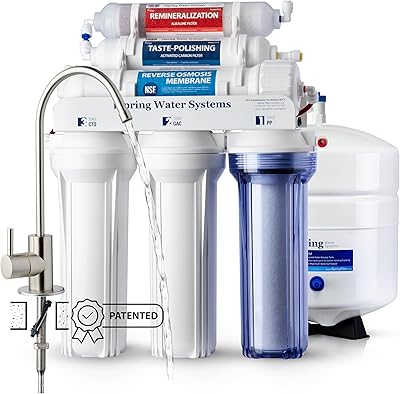
iSpring RCC7AK
Six stage system with an alkaline remineralization stage that adds calcium and magnesium back after filtration. ~$210.
View →
Waterdrop G3P800
Tankless design saves cabinet space. Faster flow rate, smart filter life monitoring. ~$380.
View →Countertop Systems
If you rent or don't want to modify your plumbing, countertop systems sit on the counter and require zero installation. Some plug into your existing faucet, others fill by hand, and some use gravity alone.
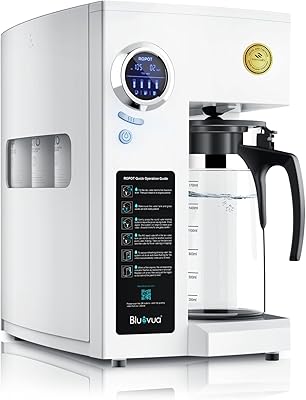
Bluevua RO100ROPOT
Fill by hand, no plumbing or faucet adapter. Five stage RO with remineralization. ~$200. Borosilicate glass carafe option keeps filtered water off plastic.
View →
AquaTru Glass Carafe
Four stage countertop RO, no plumbing. IAPMO certified to NSF/ANSI 42, 53, 58, 401 and 372, removing 84 contaminants. Filters into a 64 ounce borosilicate glass carafe. Fill tank is plastic. ~$375.
View →The Budget Option: Carbon Block Filters
If reverse osmosis is beyond your budget right now, a quality carbon block filter is a significant upgrade over no filter or a basic pitcher. The key word is block, not granular. Solid carbon block filters have much smaller pore sizes than loose granular carbon.
Top picks:

Epic Pure Pitcher
High performance pitcher with independent lab testing showing strong microplastic and PFAS removal. ~$65.
View →
LifeStraw Home Glass Pitcher
Glass body, so filtered water is stored in glass, not plastic. No installation.
View →What Doesn't Work Well
Many common filters give people a false sense of security:
- Standard Brita and PUR pitchers use granular activated carbon (GAC). They improve taste by reducing chlorine but have limited effectiveness against microplastics and minimal PFAS removal. The newer Brita Elite filter is better than the standard, but still not comparable to carbon block or RO.
- Refrigerator filters are typically basic GAC filters. They reduce sediment and chlorine taste but are not designed for microplastic removal.
- Faucet-mount filters (like Brita or PUR faucet attachments) are a small step up from pitchers but still use GAC technology with limited microplastic filtration.
- Boiling water does not remove microplastics. In fact, some research suggests it may concentrate them by reducing water volume.
Don't Forget Cooking Water
This is the step most people miss. You filter your drinking water but then boil pasta, rice, and soups in unfiltered tap water. All the contaminants you're filtering out of your glass end up in your food.
If you have an under-sink RO system, use filtered water for all cooking. If you use a pitcher or countertop system, keep enough filtered water on hand for cooking too. It takes a bit more planning but makes your filtration investment much more effective.
Whole-House vs. Point-of-Use
Point-of-use systems (under-sink, countertop, pitcher) filter water at the tap where you drink. These are the most cost-effective for microplastic removal because they only need to filter the water you actually consume.
Whole-house systems filter all water entering your home, including showers, laundry, and toilets. These are significantly more expensive ($1,000 to $5,000+) and primarily make sense if you have serious well water contamination or want to reduce chlorine exposure during showering. For microplastics specifically, a point-of-use system at your kitchen tap is more practical and effective.
If shower water concerns you (chlorine and chemical additives from plastics can absorb through skin, though microplastic particles themselves are too large to penetrate), a separate shower filter ($30 to $60) with KDF media is a reasonable addition.
Filter Maintenance Matters
A neglected filter can be worse than no filter at all. Bacteria can colonize old filters, and saturated carbon loses its ability to adsorb contaminants. Follow these guidelines:
- RO membranes: Replace every 2 to 3 years (pre-filters every 6 to 12 months)
- Carbon block pitchers: Replace cartridges every 2 to 4 months or as the manufacturer specifies
- GAC filters: Replace every 2 to 3 months
- Track your replacement dates. Set a calendar reminder. Don't wait until water tastes different because many contaminants are tasteless
What About the Plastic in the Filter Itself?
This is the question nobody talks about. You buy a water filter to remove microplastics, but the filter housing, tubing, and cartridges are almost always made of plastic. Are you solving one problem and creating another?
The short answer: the tradeoff is still overwhelmingly in your favor, but it's worth being intentional about.
The reality of filter plastics
Most under-sink RO systems use polypropylene housings, polyethylene tubing, and plastic filter cartridges. Pitcher filters are made of Tritan or polypropylene. Even "stainless steel" systems like Berkey use plastic spigots and internal components. The water you drink passes through these plastic parts before it reaches your glass.
The key difference is that static contact with food-grade plastic at room temperature releases far fewer particles than heating, cutting, or pressurizing plastic. A plastic cutting board being sliced with a knife releases millions of particles. A BPA-free filter housing sitting under your sink at ambient temperature releases comparatively very little.
How to minimize filter-related plastic exposure
- Choose systems with stainless steel tanks over plastic tanks when possible. Most quality RO systems (including the APEC ROES-50) already use steel pressure tanks.
- Flush new filters thoroughly. Run 2 to 3 gallons through a new system before drinking. New plastic components release the most particles during initial use.
- Keep filters out of heat. Under-sink systems in a cool cabinet are ideal. Never place filter systems near a stove, dishwasher, or in direct sunlight, as heat accelerates plastic degradation.
- Replace cartridges on schedule. Degrading, old filter cartridges can shed more plastic particles than fresh ones.
- Store filtered water in glass, not plastic. Once your water is filtered, don't put it back into a plastic pitcher or bottle. Use glass or stainless steel containers.
- Consider glass carafe options. The Bluevua RO100ROPOT (a countertop reverse osmosis system, not a gravity pitcher) uses a borosilicate glass carafe instead of plastic, reducing contact between filtered water and plastic surfaces.
The math still works
Unfiltered tap water contains roughly 5 to 15 microplastic particles per liter. An RO system removes 99.9% of those. Even if the plastic housing adds back a tiny fraction of particles, you're still drinking dramatically cleaner water than before. The net reduction is massive. Don't let perfect be the enemy of good. Filter your water, store it in glass, and you've eliminated the vast majority of waterborne microplastic exposure.
Look for These Certifications
When shopping for any water filter, look for independent testing certifications rather than relying on marketing claims:
- NSF/ANSI 42: Aesthetic effects (chlorine taste and odor, particulates)
- NSF/ANSI 53: Health effects (lead, cysts, VOCs)
- NSF/ANSI 58: Reverse osmosis systems
- NSF/ANSI 401: Emerging contaminants (pharmaceuticals, PFOA)
- NSF P473: PFAS reduction specifically
A filter with NSF 53 + NSF 58 or NSF P473 certification has been independently verified. Claims without third-party certification should be treated with skepticism.
Testing Your Water at Home
Before investing in a filtration system, it helps to know what you're actually dealing with. Your water quality depends on your location, your pipes, and your municipal treatment process. Testing gives you a baseline so you can choose the right filter and verify that it's working.
Free starting point: EWG Tap Water Database
The Environmental Working Group maintains a free database at ewg.org/tapwater where you can enter your zip code and see contaminants detected in your local water supply. This won't tell you about microplastics specifically (most municipalities don't test for them yet), but it will reveal PFAS levels, lead, chlorine byproducts, and other contaminants. It takes 30 seconds and costs nothing.
TDS meters: useful but limited
A TDS (Total Dissolved Solids) meter is an inexpensive device ($10 to $20) that measures the concentration of dissolved solids in your water, reported in parts per million (ppm). TDS meters are popular because they give you an instant number, and they are useful for verifying that an RO system is working (RO water should read 0 to 50 ppm compared to typical tap water at 100 to 400 ppm).
However, TDS meters do not detect microplastics. They measure dissolved ions like calcium, magnesium, and sodium. Microplastics are suspended particles, not dissolved solids, so they won't register on a TDS meter at all. A TDS meter is a good tool for confirming your RO membrane is intact, but don't rely on it to tell you whether your water contains microplastics.
Mail-in lab tests: the gold standard
For a comprehensive picture of your water quality, a mail-in lab test is the most reliable option.
- Tap Score by SimpleWater is the most thorough home water test available. Their Advanced City Water Test (~$290) screens for over 100 contaminants including heavy metals, PFAS, chlorine byproducts, and more. You collect a sample, mail it in, and receive a detailed report with health risk assessments. If you want to know exactly what's in your water, this is the way to do it.
- SimpleLab offers targeted testing panels, including a dedicated PFAS test (~$200). If PFAS contamination is your primary concern (and it should be on your radar, given that PFAS have been detected in water supplies serving over 100 million Americans), this focused test makes sense.
Testing your water before and after installing a filter also lets you confirm that your system is performing as advertised. If you spend $200 on an RO system, a follow-up test can verify it's actually removing what it claims to remove.
Water on the Go
Filtering water at home is a great first step, but most people spend a significant portion of their day away from home. At work, at the gym, at restaurants, and while traveling, you're likely drinking unfiltered water unless you plan ahead.
The gap in most people's filtration strategy
If you drink eight glasses of water a day and four of those are consumed outside your home, you're only filtering half your water intake. That gap matters, especially if your workplace uses an old building's plumbing or your gym fills water coolers from unfiltered tap lines.
Portable filter bottles
A few companies make water bottles with built-in filtration:
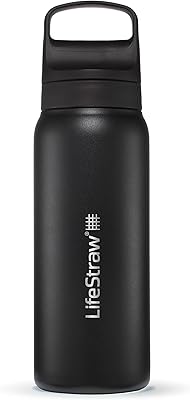
LifeStraw Go
Hollow fiber membrane designed for bacteria and parasites. Best for hiking and international travel, less optimized for everyday microplastic reduction. ~$45.
View →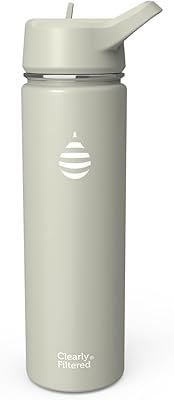
Clearly Filtered Insulated Bottle
Same affinity filtration as their pitcher in an insulated stainless steel bottle. Removes 200+ contaminants including PFAS and microplastics. ~$40.
View →The simplest solution: fill from home
The most reliable and cost-effective approach is to fill a stainless steel bottle with your home filtered water each morning. No extra filters to maintain, no replacement cartridges to buy, and you know exactly how well the water was filtered because you control the system. A quality stainless steel bottle ($20 to $40) pays for itself almost immediately if it replaces buying bottled water.
Eating and drinking out
At restaurants and cafes, you have less control over water quality, but a few small habits help:
- Ask for water without ice. Ice machines in restaurants are rarely connected to filtered water lines, and the machines themselves can harbor bacteria and contaminants. Requesting no ice is a small but practical step.
- Bring your own bottle. Many restaurants are happy to let you drink from your own water bottle, especially if you explain your preference. It's not unusual, and most servers won't question it.
- Choose glass over plastic when given the option. If a restaurant serves water in plastic cups or from plastic pitchers, that water has been sitting in contact with plastic. Ask for a glass instead.
Storing Filtered Water
Filtering your water is only half the equation. How you store it afterward determines whether contaminants make their way back in.
Glass is the best storage material
Once water has been filtered, transfer it to glass containers whenever possible. Glass is chemically inert and does not leach any substances into water, regardless of temperature or how long the water sits. A glass water pitcher in the fridge is the ideal way to keep filtered water cold and ready to drink.
Look for borosilicate glass pitchers (like those made by Bormioli Rocco or JoyJolt), which are more durable and resistant to thermal shock than standard soda lime glass.
Stainless steel for portability
For water you carry with you, food grade stainless steel (18/8 or 304 grade) is the next best option. It's durable, doesn't leach chemicals, and keeps water cold for hours if insulated. Avoid painted or coated interiors, as some coatings can contain plastics or PFAS.
Avoid storing filtered water in plastic
Many filter pitchers have plastic reservoirs where filtered water sits for hours at a time. While the contact is minimal compared to a plastic water bottle in a hot car, it's still worth being mindful about. Some practical steps:
- Don't let filtered water sit in a plastic pitcher reservoir for more than a few hours. Filter what you need and transfer it to glass promptly.
- Never leave any water container in a hot car or in direct sunlight. Heat dramatically accelerates leaching from plastic, but it also encourages bacterial growth in any container.
- Keep stored water cool. Room temperature is acceptable for short periods, but refrigeration is better for water you plan to drink over the course of a day. Heat accelerates chemical interactions in any container material, even glass and stainless steel, though the effect is far less significant than with plastic.
Quick Action Plan
If you're feeling overwhelmed, here's what to do in order of priority:
- Check your water. Look up your zip code at ewg.org/tapwater to see what's in your local supply.
- Stop using plastic water bottles immediately. They contain more microplastics than most tap water.
- Get the LifeStraw Home glass pitcher today. This is the fastest, cheapest meaningful upgrade. Use it for drinking and cooking water.
- Plan for an under-sink RO system. When budget allows, an APEC ROES-50 (~$190) is the best long-term investment. This is the "set it and forget it" solution.
- Use filtered water for cooking. Not just drinking. This is the step that most people skip.
- Set filter replacement reminders. A dirty filter is worse than no filter.
The Bottom Line
You don't need to spend thousands of dollars to dramatically reduce microplastics in your drinking water. A quality carbon block pitcher ($70) removes the majority. An under-sink reverse osmosis system ($200) removes essentially all of them. Either option is a massive improvement over unfiltered water or plastic bottles.
The most important thing is to start. A good filter today is better than a perfect filter you're still researching six months from now.
Frequently Asked Questions
Does boiling water remove microplastics?
No. Boiling water kills bacteria but does not remove microplastic particles. Research suggests boiling may actually concentrate microplastics by reducing the water volume while the particles remain. You need a physical filter like reverse osmosis or carbon block to remove them.
Do Brita filters remove microplastics?
Standard Brita pitchers use granular activated carbon (GAC), which has limited effectiveness against microplastics. They mainly improve taste by reducing chlorine. The Brita Elite filter is slightly better, but for serious microplastic removal, a carbon block pitcher like Clearly Filtered or a reverse osmosis system is far more effective.
Is bottled water safer than tap water for microplastics?
No. A 2018 study tested 259 bottled water brands from 11 countries and found microplastics in 93% of them, with an average of 325 particles per liter. Some brands had over 10,000 particles per liter. Bottled water in plastic typically contains more microplastics than tap water, not fewer.
What is the best water filter for removing microplastics?
Reverse osmosis (RO) systems remove 99.9% of microplastics and are the most effective option. For an under-sink system, the APEC ROES-50 (~$190) is the best value. If you can't modify plumbing, the AquaTru Glass Carafe (~$375) requires no installation. For a budget option, the LifeStraw Home glass pitcher stores filtered water in glass rather than plastic.
How many microplastics are in tap water?
Studies have found an average of 5 to 15 microplastic particles per liter in tap water, though this varies significantly by location. A 2019 study estimated that Americans who drink tap water ingest about 4,000 microplastic particles per year from water alone, compared to 90,000 additional particles for those who drink bottled water.
Do refrigerator water filters remove microplastics?
Most refrigerator filters use basic granular activated carbon, which is not designed for microplastic removal. They reduce sediment and chlorine taste but leave most microplastics, PFAS, and heavy metals in your water. An under-sink RO system connected to your fridge line would be a significant upgrade.
Can microplastics be absorbed through skin in the shower?
Microplastic particles themselves are generally too large to penetrate skin. However, chemical additives in plastics (like phthalates and BPA) and co-contaminants like chlorine can be absorbed through skin during showering. A shower filter with KDF media can reduce chlorine exposure, which is the primary shower-related concern.
What are the best ways to avoid microplastics in drinking water?
The most effective approach combines several steps. First, filter your tap water with a reverse osmosis system (99.9% removal) or a carbon block filter like Clearly Filtered (up to 99.5% removal). Second, stop buying water in plastic bottles, which contain an average of 325 microplastic particles per liter. Third, store filtered water in glass or stainless steel containers, never plastic. Fourth, use filtered water for cooking, not just drinking, since boiling unfiltered water concentrates contaminants. Finally, check your local water quality at ewg.org/tapwater so you know what specific contaminants to target with your filtration setup.
Related Articles
- Best Water Filter to Remove PFAS, Lead and Fluoride
Every contaminant, not just plastic. Lead, PFAS, nitrates and fluoride matched to the filter that removes them. - Best Water Filters for Microplastics and PFAS (2026)
Our ranked picks, scored on what they remove and whether your clean water ends up back in plastic. - The Complete Guide to Plastic Free Coffee: Beans, Brewers, and Beyond (2026)
Water quality affects your coffee too. Learn how to brew without plastic at every step. - How to Avoid Microplastics in Tea: The Complete Guide to Safer Brewing (2026)
Tea bags can release billions of microplastics per cup. Here is how to switch to safer brewing. - How to Avoid BPA and Phthalates in Everyday Products: A Room by Room Guide (2026)
Your water is just the beginning. Learn where BPA and phthalates hide in every room of your home. - How to Start Reducing Plastic Exposure: A Practical Priority Guide (2026)
A step by step guide to reducing your total microplastic exposure, starting with the biggest sources.