Best Plastic Free Salt and Pepper Grinders (2026): What the Mill Puts in the Salt

The 30 Second Summary
- The grinder is a source, not just the salt. We have written before that sea salt carries microplastics from the water it came from. A February 2026 study shows the mill on top of the jar adds its own, and in larger numbers: 1,091, 2,420 and 15,743 fragments per 50 g of salt at three retailers, against blanks of zero and one.
- Buy a grinder with nothing to hide a polymer in. Our pick is the Elevated Damsko solid stainless grinder, two machined parts with the teeth cut into the steel itself, bare and uncoated inside, and rated for sea salt as well as pepper.
- For pepper and spices, iron and wood do the same job. The Zassenhaus cast iron grinder set is a cup, an inner grinder and a beech lid. Keep salt out of it, because salt rusts iron.
- Or own no mechanism at all. A granite mortar and pestle has nothing to wear, and a ceramic mortar is what the Dublin team ground against as their control.
- If you want a table mill that pours, there is one. The Iron-Mills stainless model runs an uncoated 316 stainless burr for salt and 420 for pepper, so the whole path the salt takes is steel.
- Judge a mill on what it names, not on its burr. The burr is almost never the problem. Ask what the adjustment knob, the collar and the rotor housing are made of, and treat a maker who will not say as a maker with plastic in there. Metal is no guarantee either: one pepper mill was recalled in 2023 for shedding shards into food, and brass solves plastic by introducing an alloy that routinely carries lead.
We have told readers for a while that sea salt is the most microplastic contaminated salt on the shelf, because it is made by evaporating water that already carried the particles. That is still true, and it is only half the story. In February 2026 a team at University College Dublin ground salt through the grinder heads that supermarkets fit to their own salt jars, and counted what came out the bottom. The mill turned out to contribute more particles than the sea ever had.
This changes what to buy rather than what to eat. The fix is not a different salt, it is a different mechanism, and it is a one time purchase you refill afterwards. Below is what the study found, why grinding is a different problem from the heat and fat migration we usually write about, and what happened when we stopped reading materials copy and started checking the makers' own photographs of their own mechanisms. Fewer mills survived that than we expected, including one we had recommended ourselves.
What the Dublin team actually measured
The paper is Investigating microplastic release from plastic grinder heads during salt grinding, by Cihang Yang, Kangti Li, Aoife Gowen and Jun Li Xu of the School of Biosystems and Food Engineering at University College Dublin. It appeared in Science of the Total Environment, volume 1021, dated 15 March 2026 and published online on 24 February 2026. The team bought salt products from three local retailers, each sold with a plastic grinder head fitted, and used three separate heads from each retailer. A ceramic mortar served as the control they ground against.
Every head shed, and the counts are not close together. Per 50 g of salt ground, Retailer A released 1,091 particles plus or minus 239, Retailer B released 2,420 plus or minus 1,805, and Retailer C released 15,743 plus or minus 1,858. The procedural blanks, which measure what the laboratory itself contributes, found zero, one and zero particles. That gap between a blank of nearly nothing and a count in the thousands is what makes the result readable at all, and it is why the authors ran spiked recovery samples alongside.
The identification is the part that ties the particles to the grinder rather than to the salt. The researchers analysed fragments with optical photothermal infrared spectroscopy and matched the spectra against the Hummel polymer library. The heads at Retailers A and B were polyethylene terephthalate and the head at Retailer C was polycarbonate, and the majority of fragments released matched the polymer of the head they came from. The particles are also not the invisible kind: mean sizes came in at 49.6 micrometres plus or minus 18.2 for Retailer A and 55.3 plus or minus 12.7 for Retailer B. All spectra and the quality control data were published openly on Zenodo.
What the study does not do is tell you what reaches a person over a year. It is three products, three heads each, one laboratory, and it measures release into ground salt rather than absorption into a body. The authors draw the narrow conclusion the data supports, which is that everyday food contact plastics introduce microplastics into food under high mechanical stress, and that the wear resistance of those plastics deserves attention. We think the useful consumer reading is narrower still: the part doing the grinding should not be the part made of plastic.
Why a grinder sheds when a jar does not
Most of what we write about plastic in food is migration. A plasticiser leaves a jar lid gasket and enters the oil underneath it, and the levers are fat, heat and time, which is the model we built in the piece on jar lid gaskets. A grinder is a different mechanism entirely. Nothing is dissolving. A salt crystal is harder than polyethylene terephthalate and harder than polycarbonate, and a mill works by dragging those crystals across the burr under load. The polymer loses material the way a brake pad does.
That puts grinding alongside the other abrasion cases on this site rather than alongside the migration ones. We have already covered the loudest of them in the ranking of kitchen appliances: a blender blade turning at tens of thousands of revolutions a minute against a plastic jar wall. The measurement there is startling in the same way. A 2023 paper in the Journal of Hazardous Materials by Luo, Awoyemi, Naidu and Fang at the University of Newcastle used Raman imaging on a single kitchen blender and estimated roughly 0.36 to 0.78 billion micro and nanoplastic particles released from the plastic container in a thirty second run.
Two honest notes on that blender figure, because it gets quoted loosely. It is one blender, chosen because the authors owned it, and the paper is mainly a methods paper advancing Raman imaging rather than a survey of products. The number is an estimate from an imaged area, not a count of particles in a glass of juice. We cite it because it points the same way as the Dublin work and because the mechanism is identical, not because one machine settles the category. We still have no blender pick for exactly this reason, and said so before this study existed.
The four checks we ran on every mill here
A grinder is a durable good, so it has no ingredient list and the materials question does the work the formula question does elsewhere. What we looked at, for every mill below: what the maker says each part of the grind path is made of, whether any part touching the salt is left unnamed, whether an independent laboratory has tested the product, and what sits on the recall and litigation record for the brand. The results are on each brand page, and the short version is that disclosure separated the field more cleanly than price did.
One pattern is worth stating before the picks. A mill is sold on its burr, and the burr is almost never the problem. Plenty of mills pair a genuine ceramic rotor with an acrylic chamber or with plastic carriers holding that rotor in place, and those are the parts that wear under load. When you read a listing, the question is not what the grinding element is. It is what every other part the salt touches is made of, and whether the maker is willing to say.
The grinders we recommend
We set out to list the mills with a clean grind path and nearly failed. Reading the materials copy, the category looks healthy: ceramic rotors, stainless caps, glass bodies. Looking instead at each maker's own photographs of its own mechanism, most of those mills set the burr in a moulded plastic carrier, under a plastic knob, behind a plastic collar, and name none of it. One of them was our own first pick, corrected below.
What does work is the designs that have nowhere to put a polymer: the grinding surfaces cut straight into solid metal, or stone, or nothing but iron and wood. They are less convenient than the mill you already own and they are the only ones that can show you the whole path.

Elevated Damsko Solid Stainless Grinder
Two machined parts of solid stainless with the grinding teeth cut into the metal. Bare and uncoated inside, so there is no carrier, collar or knob to be plastic. Takes salt.

Zassenhaus Cast Iron Spice Grinder Set
An outer cast iron cup, an inner cast iron grinder and a beech lid, pre seasoned with oil. Three parts, no mechanism to hide a polymer in. Not for salt.
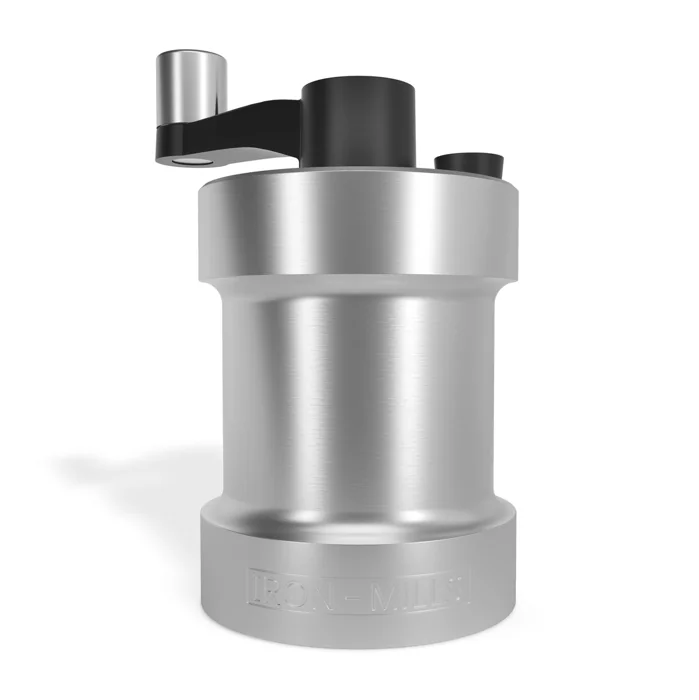
Iron-Mills Stainless Mill
Brushed stainless body, uncoated 316 stainless salt burr and 420 for pepper. The only polymer is a silicone stopper at the filling hole, away from the grind path.

ChefSofi Granite Mortar and Pestle
Unpolished natural granite, bowl and pestle, with no burr and no glaze. Cure it with raw rice before first use, because new granite sheds stone grit.
Elevated Damsko, the one that solves the actual problem
Every other mill in this article has a burr set into something. This one has no burr at all in that sense: the grinding teeth are cut directly into solid stainless steel, and the whole grinder is two machined parts that twist against each other. There is no carrier, no collar, no adjustment knob and no spring, which happens to be the exact list of parts that turned out to be plastic everywhere else. Its own listing says the interior is bare, uncoated food grade stainless with nothing hollow, coated or plated to wear or flake into food, and the photographs of it open show precisely that. It is rated 4.6 across 198 owners, and unlike cast iron it is listed for sea salt as well as pepper.
The honest limits are about form, not materials. It is a 2.5 inch puck rather than a table mill, so you grind into your hand or over the pan and lift off the base, and the capacity suits a meal rather than a week. The maker says it is not for large quantities of very hard spices. The lid shuts on a rare earth magnet set into the metal of the lid, outside the grinding chamber. If you want something that stands on the table and pours, this is not it, and the next two entries are the alternatives.
Zassenhaus, if you want iron and wood
Zassenhaus has been making spice and coffee mills in Germany since 1867, and this is the plainest tool on the list: an outer cast iron cup, an inner cast iron grinder that crushes against it, and a beech wood lid, arriving pre seasoned with oil the way a pan does. There is no burr carrier, no collar and no knob, so there is nothing for an unnamed polymer to be. The photographs of the open set show bare iron and bare wood. At 4.5 across more than 1,600 owners it is also the best established thing here.
One limit decides how you use it, and we would rather say it plainly than bury it. Cast iron and salt are a poor pair, because salt pulls moisture out of the air and rusts iron. Treat this as a pepper, herb and seed grinder, hand wash it and re season it occasionally, and keep salt for the stainless grinder or the mortar. It is also a crushing action rather than an adjustable grind, so you control coarseness by how long you work it.
A mortar, because it has nothing to put in your food
The simplest answer has no mechanism at all. A mortar and pestle has no burr, no rotor and no collar, so there is no part under load to wear and no part a maker can decline to name. That is not a rhetorical dodge: a ceramic mortar is what the Dublin team ground against as their control group. ChefSofi's set is unpolished natural granite, which also sidesteps the lead question we ask of glazed ceramic, because bare stone carries no glaze to leach from. It is the most owned set of its kind at 4.7 across more than 24,000 ratings.
It asks something back. New unpolished granite sheds stone grit, so it has to be cured before first use by grinding raw rice until the flour comes out white, repeating until no grey appears. It is heavy, it is slow, and it is the wrong tool for seasoning at the table. For whole spices, peppercorns in quantity and anything you want cracked rather than powdered, it is better than any mill, and it will outlast everything else in the kitchen.
Iron-Mills, if you want a proper table mill
This is the one conventional mill on the page, and it got here by answering the question. Iron-Mills is a small maker in Cheltenham founded by a former Rolls-Royce engineer. We held it back at first because its own safety page mentioned a corrosion resistant coating on the salt grinding components without saying what it was. We asked, and the founder replied the same day: there are no coatings or plating on the current mechanisms at all, the salt burr is solid 316 stainless steel throughout rather than coated carbon steel, and the coating wording describes an earlier Swiss sourced mechanism that used a tin coated salt part, which is outdated copy he is correcting. The pepper burr is hardened 420 stainless.
He also volunteered the thing we would have asked next. The only polymer anywhere in the mill is a food grade silicone stopper sealing the filling hole on top, sitting away from the grinding mechanism. Silicone is inert against dry spice, which is how we score it everywhere on this site, so on the stainless bodied model the entire path the salt takes is steel. Nothing else we examined in this category can say that. It is a premium tier and sold direct, with shipping and duties to the United States included.
One caveat, and it comes from his answer rather than from the website. He mentioned that the bodies have moved from cast iron to duplex 2205 stainless, which removed a protective coating the cast iron bodies previously needed, while the coloured range still reads as cast iron on the product pages. So we recommend the stainless model and hold the coloured cast iron ones a step back until we know whether one shipping today has a duplex body or a coated cast iron chamber. We have asked, and will update this when he answers.
Peugeot, the closest call on the page
Peugeot's Paris Chef is the best of the conventional mills on paper. The body and the salt mechanism really are stainless steel, milled in France under a lifetime mechanism guarantee, and we had it as a pick. Then you look at Peugeot's own photograph down into the open body and there is a black moulded collar at the mouth of the salt chamber, around the shaft, that no Peugeot copy accounts for and no spare parts listing names. It may well be an inert seal. We asked Iron-Mills a question and got a straight answer within hours; until Peugeot accounts for that part the same way, we are not going to print that its grind path is plastic free. Peugeot also says to use dry rock salt rather than sea salt, which is what most of its weaker reviews are about.
The mills we would not buy
Each of these gets named once here with the finding that put it on the list, and we hold a full record on each brand.
We published this article on 19 October 2026 with the Home EC Original as the top pick, on the strength of a listing that names only glass and stainless steel and a maker's image reading "ceramic grinding mechanism". A reader asked about the spring. Home EC's own exploded diagram, image 51PrPUwnhDS on the same listing, labels the protective lid, adjustment knob, ceramic grinder, spring, cap and bottle, and shows the knob, the collar beneath it and the housing the rotor seats in as moulded plastic. The ground salt leaves through that assembly. Home EC names no polymer for any of it. Where a listing's text and its own photographs disagree, the photograph wins, and we should have opened every image before recommending it.
These deserve a fair hearing, because on plastic they win outright: a solid brass body, a steel grinding mechanism and no polymer anywhere the pepper goes. The trouble is the alloy. Free machining brass, the kind used for turned parts, carries lead deliberately, commonly two to three percent by weight, and because lead barely dissolves in brass it gathers in pockets at the machined surface rather than spreading evenly. Independent XRF work on kitchen items has read brass components in the tens of thousands of parts per million, and in August 2025 the FDA warned about imported brass and aluminium cookware shown to leach lead in tests designed to mimic food contact. None of that is a measurement of any particular mill, and no maker we found publishes one. Swapping a plastic problem for a lead problem is not a win, which is the same reasoning our salt guide applies to mined salts.
This is the exact product the study measured, and it is the mill most people own without ever choosing it. A plastic head is fitted to a jar of salt, you grind until the jar is empty, and you buy another. All three retailer samples were this format, and all three shed. Refilling a mill you chose costs less over a year than replacing the mechanism every time the salt runs out.
The ceramic rotor is real, and the material row underneath reads acrylic, ceramic and stainless steel. The acrylic is the chamber the salt sits in, and the pieces carrying the burr are plastic too. Amazon's own aggregated review summary on the listing reports that those plastic pieces break internally after about two years and that the clear plastic parts separate, with buyers describing the result in the terms this whole category turns on.
A glass body and a stainless mechanism would be the right answer, and the material field names a third thing beside them: plastic. Nothing on the listing says which part that is, and on this style of mill the candidates are the parts that matter, the collar carrying the burr and the nut the salt passes on its way out. Until the maker places it, we treat it as an unnamed polymer in the grind path.
The parts Ebaco describes are the right ones: food grade glass, a stainless cap, a removable ceramic rotor. The problem is the parts it does not. The material field reads glass alone, no parts list is published, and owners repeatedly describe a small plastic ring working loose inside the head. Ebaco also sells a visually similar model with a carbon steel rotor, and buyers confuse the two, so the model number matters.
A metal burr is not automatically a clean one
The obvious conclusion from the Dublin paper is to buy metal, and mostly that is right. It is not a guarantee, and there is a recall on the public record that makes the point better than we could. On 18 May 2023 the Consumer Product Safety Commission announced recall 23-758, covering about 9,340 Cole and Mason 505WEG pepper mills, item number H50501PWE, imported by DKB Household USA and sold only at Wegmans between January 2021 and January 2023.
The notice says the mills contain a metal grinding mechanism that lets off metal shards for the first ten grinds, which it classes as a laceration hazard, and it records three incidents of metal shards entering food with no injuries reported. The remedy was a full refund. Read it next to the salt study and the lesson is not that metal is worse than plastic, because it plainly is not. It is that any mechanism grinding something hard loses material early in its life, and the polymer is what makes that material worth worrying about rather than merely gritty.
Practically, that is an argument for a habit rather than a different purchase. Run the first grinds of any new mill into the bin rather than onto dinner, whatever it is made of. It costs a few turns of the handle. The one recall in this category and the curing instruction on a new granite mortar both point at the same early wear window, and both are closed by the same thirty seconds of care.
How to use a mill so it sheds less
Buy once and refill. The disposable grinder is the measured problem, and a refillable mill removes it permanently while costing less across a year. Keep salt dry, because damp salt makes any mechanism work harder and a steel one clog. Grind what the mill was built for: a salt mechanism and a pepper mechanism are cut differently, and forcing peppercorns through a salt mill or wet flaky salt through a steel one is how you accelerate the wear this article is about. Run the first grinds of anything new into the bin.
If you want to go further, the same abrasion logic applies to every machine in the kitchen that turns against plastic under load. Our kitchen appliance ranking covers blenders, food processors and immersion blenders, including the categories where we still have no pick because nothing on the market has a clean path. For coffee specifically, where the grinder question is the same but the answers are different, the coffee guide covers the manual steel burr grinders we do recommend.
Questions people ask
Do salt and pepper grinders really shed microplastics?
The ones with plastic grinder heads do. The February 2026 University College Dublin study ground 50 g of salt through heads taken from supermarket salt products at three retailers, three heads each, and counted 1,091, 2,420 and 15,743 fragments against procedural blanks of zero, one and zero. The heads were polyethylene terephthalate at two retailers and polycarbonate at the third, and most fragments matched the polymer of the head they came from, which is what ties the particles to the grinder rather than to the salt itself.
Is a ceramic burr better than a plastic one?
Yes, for this problem. A ceramic grinding rotor is an engineering ceramic with no glaze and no pigment, so there is no polymer to abrade and nothing for lead to live in, which is why we treat a grinder burr differently from a glazed bowl. The part to check is not the burr but everything around it. Several mills pair a genuine ceramic rotor with an acrylic chamber or with plastic carriers holding the burr in place, and those are the parts that wear under load.
Is a metal grinding mechanism automatically safe?
No, and there is a recall on the record to prove it. In May 2023 the CPSC recalled about 9,340 Cole and Mason 505WEG pepper mills because the metal grinding mechanism let off metal shards for the first ten grinds, with three reports of shards entering food. Moving from a plastic burr to a metal one removes the polymer, not the wear. That is the argument for running the first grinds of any new mill into the bin rather than onto a plate.
Should I stop buying salt that comes in a grinder?
That is the product the study actually measured. All three samples were salt bought from a retailer with a plastic grinder head fitted, which is the disposable mill most people own without choosing it. The better move is also the cheaper one: buy a mill once with a grind path of glass, stainless steel or unglazed ceramic, and refill it from a bag or a box. The part doing the grinding is then no longer the part made of plastic.
Does this change what salt I should buy?
Not on its own, but the two findings stack. Sea salt still carries the most microplastics of any salt because it is made by evaporating water that already held them, and several of the mineral salts carry lead and arsenic questions instead. Our guide to salt and pantry staples covers which salt to buy on contamination grounds. This article covers the mill you put it in, which is a separate purchase and a separate source.
Related Articles
- Microplastics in Salt, Sugar and Pantry Staples, which salt to buy and what the testing found
- Toxic Kitchen Appliances, Ranked, the same abrasion problem in blenders and food processors
- The Plastic Inside Your Glass Jar Lid, the migration model this article is the exception to
- How to Enjoy Coffee Without Plastic, including the manual steel burr grinders we recommend
- Best Plastic Free Food Storage Containers, glass with glass lids