Best Glass Food Storage Containers With Glass Lids (2026): Plastic Free, Plus Stainless and Silicone
The 30 Second Summary
- Glass with glass lids beats every plastic container. Even BPA free plastic still sheds microplastics, especially when reheated. Our top pick: Urban Green glass containers with glass lids.
- Stainless steel is best for kids and travel. A LunchBots Trio bento box survives being dropped at school in a way glass cannot.
- For hot lunches, use insulated stainless steel. A Klean Kanteen Insulated Food Canister keeps soup hot 5 plus hours with zero plastic touching food.
- Replace zip top plastic bags with platinum silicone. Stasher bags are oven, microwave, and freezer safe.
- Watch out for plastic lids. Plenty of "glass containers" still seal with plastic, which is exactly the part that touches your food when stacked or shaken.
- Start by replacing your 3 to 5 most used containers. You do not need to ditch everything overnight. Address daily contact items first.
1. Why Plastic Food Containers Are Harmful
Every time you store food in a plastic container, that container is slowly breaking down and releasing chemicals into your food. This is not speculation. It is well documented science. Plastic food containers leach endocrine disrupting chemicals including BPA, BPS, phthalates, and thousands of other compounds that have never been fully tested for safety.
The problem is worse than most people realize. A landmark 2024 study published in the Proceedings of the National Academy of Sciences found that a single liter of bottled water contained an average of 240,000 nanoplastic particles. These particles are small enough to cross cell membranes, enter the bloodstream, and accumulate in organs. Food storage containers made from polypropylene and polyethylene release similar particles, especially when heated, scratched, or exposed to acidic foods.
Here is what the science tells us about plastic food container exposure:
- Microplastic shedding: Plastic containers release millions of micro and nanoplastic particles into food, especially when microwaved or used with hot food. A 2023 study in Environmental Science & Technology found that microwaving plastic baby food containers released over 2 billion nanoplastics per square centimeter.
- Endocrine disruption: BPA, BPS, and phthalates mimic estrogen in the body, disrupting hormonal balance. This is linked to reproductive issues, thyroid dysfunction, and metabolic disorders.
- Chemical migration increases with heat: Storing hot leftovers in plastic, microwaving in plastic, or running plastic through the dishwasher dramatically increases the rate of chemical transfer into food.
- Degradation over time: Even "safe" plastics degrade with use. Scratches, stains, and cloudiness are visible signs that the surface is breaking down and releasing more particles into your food.
- Children are most vulnerable: Pound for pound, children consume more food relative to body weight and their developing systems are more sensitive to endocrine disruptors. If you are storing baby food or children's meals, switching away from plastic is especially important.
The good news is that excellent alternatives exist. Glass, stainless steel, and food grade silicone offer safe, durable, and increasingly affordable options for every food storage need.
2. Glass Containers: The Gold Standard
Glass is the safest and most inert material you can use for food storage. It does not leach any chemicals into food regardless of temperature, acidity, or storage duration. There are zero microplastics, zero endocrine disruptors, and zero chemical interactions. Glass is also the only common container material that is completely transparent, making it easy to see exactly what is stored inside.
Borosilicate Glass vs Soda Lime Glass
Not all glass containers are created equal. The two main types used for food storage are borosilicate glass and tempered soda lime glass. Understanding the difference matters for durability and performance.
Borosilicate glass (used by brands like Glasslock and some Pyrex lines) contains boron trioxide, which gives it exceptional thermal shock resistance. You can take a borosilicate container from the freezer and place it in a hot oven without cracking. It is also lighter and more resistant to scratching than soda lime glass. European Pyrex (branded as PYREX in all capitals) still uses borosilicate glass.
Tempered soda lime glass (used by American Pyrex, branded in lowercase "pyrex") is more impact resistant than borosilicate and less likely to shatter if dropped. However, it has lower thermal shock resistance, meaning you need to be more careful with rapid temperature changes. It is also slightly heavier.
Best Glass Container Picks
Many popular glass container brands (including Pyrex and Glasslock) use plastic lids. While your food mostly touches glass, hot steam rises and contacts the lid, and over time plastic lids can degrade and shed microplastics. For truly plastic free food storage, choose containers with glass lids or bamboo lids. We have added our top plastic free lid picks below.
Urban Green Glass Containers with Glass Lids (Top Pick)
Our top recommendation for truly plastic free food storage. Urban Green makes borosilicate glass containers with silicone framed glass lids that are 100% plastic free. Nothing touches your food except glass. Microwave safe with the lid on (leave the air vent open), oven safe, freezer safe, and dishwasher safe. The silicone frame creates an airtight and leak proof seal.
Price: $30 to $40 for a 3 pack
- 100% plastic free, glass lids
- Borosilicate glass (thermal shock resistant)
- Airtight and leak proof
- Microwave safe with lid on
- Heavier than plastic lid alternatives
- Glass lids can chip if dropped
- Smaller pack sizes
EcoEvo Glass Containers with Glass Lids (4 Pack, 35oz)
The best value way to kit out your whole fridge in one go. You get four large 35oz glass containers with matching glass lids, so nothing but glass ever touches your food, even when you reheat. The lids seal airtight and leak proof, and the whole set is microwave, oven, freezer, and dishwasher safe. Because all four are the same generous size, this is ideal for batch meal prep where you want uniform, stackable portions.
Price: $25 to $35 for a 4 pack
- Glass lids, nothing plastic touches food
- Four large 35oz containers in one set
- Airtight and leak proof
- Microwave, oven, freezer, dishwasher safe
- All one size, not varied
- Glass lids can chip if dropped
- Heavier than plastic lid sets
Urban Green Glass Containers with Glass Lids (2 Pack, 87oz)
The extra large version of our top pick, for anyone who cooks in big batches or feeds a family. Each container holds a full 87oz with the same 100% plastic free glass on glass construction, so a whole casserole, soup pot, or salad bowl stores under a single glass lid. The lids use an air vent so you can microwave with the lid on, and they seal airtight and leak proof for the fridge and freezer.
Price: $30 to $40 for a 2 pack
- 100% plastic free with glass lids
- Huge 87oz capacity per container
- Airtight leak proof air vent lid
- Microwave, oven, freezer, dishwasher safe
- Very large for small fridges
- Only two containers per set
- Glass lids can chip if dropped
Glass Containers with Bamboo Lids
Another excellent plastic free option. Borosilicate glass containers with natural bamboo lids that double as small cutting boards. The bamboo lids are not airtight for liquids, but they work perfectly for dry goods, snacks, and solid food storage. A beautiful and eco friendly option for pantry and fridge storage.
Price: $20 to $30 for a 4 pack
- 100% plastic free, bamboo lids
- Borosilicate glass
- Oven and microwave safe (without lid)
- 4 varied sizes in set
- Bamboo lids not dishwasher safe
- Not airtight for liquids
- Lids need hand washing
3. Stainless Steel Containers: Unbreakable and Versatile
If you have kids, commute with your lunch, or simply want something that will never shatter, stainless steel is the way to go. Like glass, food grade stainless steel (typically 18/8 or 304 grade) does not leach harmful chemicals or microplastics into food. It is also lighter than glass, completely unbreakable, and naturally resistant to stains and odors.
Stainless steel containers are the preferred choice in many countries around the world, especially in India and South Korea where steel tiffin boxes and lunch containers have been used for generations. The Western world is finally catching up to what these cultures have known all along: stainless steel is the most practical and durable food storage material available.
The one trade off is visibility. You cannot see what is inside a stainless steel container without opening it. For fridge organization, this means labeling your containers or choosing brands that offer clear silicone lids.
Best Stainless Steel Container Picks
LunchBots Stainless Steel Containers
LunchBots makes some of the best designed stainless steel food containers on the market. Their lineup includes bento style containers with compartments, classic round containers, and thermal insulated jars. All products use food grade 304 stainless steel with no plastic linings. The bento boxes are especially popular for packing school lunches without any plastic touching the food.
View LunchBots Trio Stainless Steel Container on Amazon
- Excellent build quality
- Multiple compartment options
- 100% food grade 304 steel
- Great for kids lunches
- Not leak proof (dry foods only)
- Higher price point
- Cannot microwave
Klean Kanteen Food Canisters
Klean Kanteen brings the same quality they are known for in water bottles to their food canisters. These insulated containers keep food hot for up to 5 hours or cold for up to 14 hours. Made from 18/8 food grade stainless steel with no plastic interior lining. The leak proof lid uses a silicone gasket for a clean seal. Available in 16 oz and 32 oz sizes.
View Klean Kanteen Insulated Food Canister on Amazon
- Vacuum insulated (hot and cold)
- Leak proof design
- No plastic interior
- Trusted brand with strong track record
- Only round shapes available
- Higher price for insulated models
- Narrow opening on some sizes
U Konserve Stainless Steel Containers
U Konserve focuses specifically on plastic free lunch and food storage solutions. Their stainless steel containers feature optional clear silicone lids (so you can see inside), nesting designs for compact storage, and a range of sizes from small snack boxes to large divided lunch containers. Everything is 304 grade stainless steel with no plastic linings or coatings.
View U Konserve Stainless Steel Container Set on Amazon
- Clear silicone lids available
- Nesting design saves space
- Focused on plastic free mission
- Variety of sizes and shapes
- Silicone lids sold separately on some models
- Not insulated
- Can dent if dropped on hard surfaces
4. Silicone Containers and Bags: The Flexible Option
Silicone occupies a unique middle ground in the plastic free food storage world. It is not glass. It is not metal. It is a synthetic polymer made from silica (sand), oxygen, carbon, and hydrogen. Unlike plastic, silicone is chemically stable, heat resistant up to 500°F, and does not leach endocrine disrupting chemicals or microplastics under normal use.
That said, silicone is not entirely without controversy. Some researchers have raised questions about whether silicone can release trace amounts of siloxanes (cyclic silicone compounds) when heated to very high temperatures. The current consensus is that food grade platinum cured silicone is safe for food contact use, but it is worth understanding the nuances.
What to Look for in Silicone Food Storage
- Platinum cured (not peroxide cured): Platinum cured silicone is purer and less likely to impart odors or release byproducts. Most premium brands use platinum curing.
- 100% silicone: Some cheap products mix silicone with plastic fillers. Pure silicone will not change color when you twist or pinch it. If you see white showing through at stress points, it likely contains fillers.
- FDA food grade certification: Look for products explicitly rated as food grade and FDA compliant.
- No strong smell: Quality silicone should have little to no odor. A strong chemical smell indicates lower quality manufacturing.
Best Silicone Storage Picks
Stasher Reusable Silicone Bags
Stasher is the most recognized name in silicone food storage. Their bags are made from 100% platinum cured food grade silicone with a pinch press seal. They are microwave, dishwasher, freezer, oven, and even boiling water safe. Available in sandwich, snack, half gallon, and stand up sizes. Stasher bags are the closest one to one replacement for single use plastic bags.
View Stasher Reusable Silicone Bag Bundle on Amazon
- Replaces single use plastic bags
- Microwave and oven safe
- Self sealing pinch press design
- Wide range of sizes and colors
- Higher upfront cost than plastic bags
- Can be hard to dry inside
- Seal can weaken over time
5. Head to Head Material Comparison
Here is how glass, stainless steel, and silicone stack up across every factor that matters for food storage. We also include plastic as a baseline so you can see exactly what you are leaving behind.
| Factor | Glass | Stainless Steel | Silicone | Plastic |
|---|---|---|---|---|
| Chemical Safety | ||||
| Microplastics | ||||
| Microwave Safe | ||||
| Freezer Safe | ||||
| Oven Safe | ||||
| Durability | ||||
| Weight | ||||
| Stain Resistance | ||||
| See Contents | ||||
| Lifespan | ||||
| Price (set) |
6. Best Container for Each Use Case
Different situations call for different materials. Here is a detailed breakdown of the best plastic free container for every common food storage scenario.
Meal Prep and Weekly Batch Cooking
Best choice: Glass containers with glass lids. When you are cooking a week's worth of meals on Sunday, glass is the clear winner. You can portion food directly into glass containers, see what is in each one without opening it, microwave individual servings at work, and clean them in the dishwasher. A set of rectangular glass containers in 2 to 3 cup sizes covers most meal prep needs. Urban Green Glass Containers with Glass Lids is our top pick because the lids are also glass, so nothing touches your food except glass, even when microwaving.
Leftovers and Fridge Storage
Best choice: Glass containers with leak proof lids. For storing last night's soup, stew, or casserole, you want containers that seal well and let you see what is inside so nothing gets forgotten at the back of the fridge. Urban Green glass containers with glass lids are ideal because nothing touches your food except glass.
Kids Lunches and School
Best choice: Stainless steel bento boxes. Glass is too heavy and too breakable for kids. Stainless steel bento style containers from LunchBots are lightweight, virtually indestructible, and have separate compartments so sandwich, fruit, and snacks do not touch. They are also easy for small hands to open and close. For more on reducing plastic exposure for children, see our guide to microplastics in baby food.
Freezer Storage
Best choice: Glass containers or silicone bags. Both work well for freezing soups, sauces, and batch cooked meals. Glass containers should be left with headspace (at least one inch) to allow for expansion, and you should avoid extreme temperature swings. Stasher silicone bags are excellent for freezing flat items like marinated meats, berries, and pre portioned smoothie ingredients because they lay flat and stack efficiently.
Pantry and Dry Goods
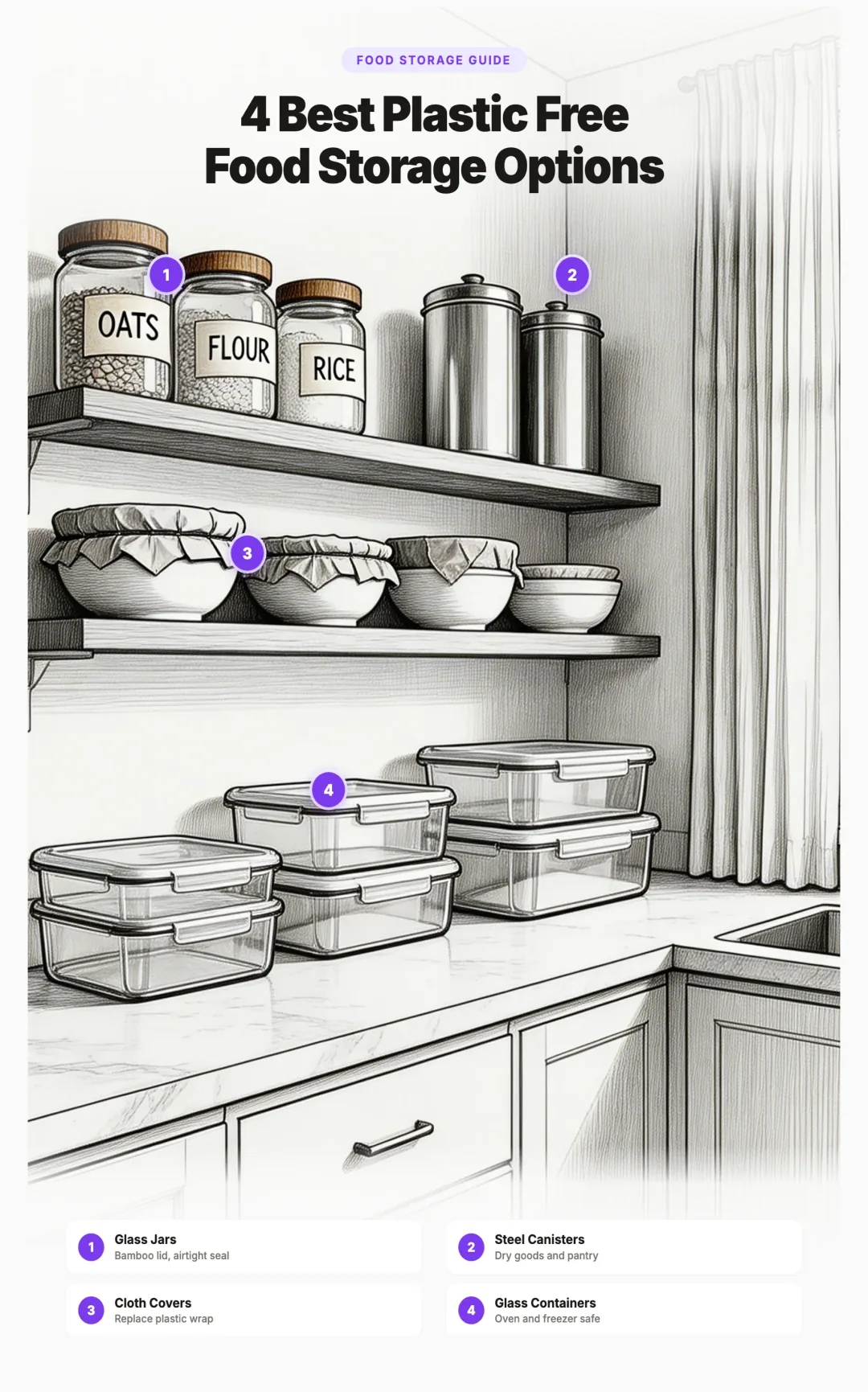
Best choice: Glass jars with bamboo or stainless steel lids. For flour, rice, pasta, nuts, seeds, spices, and other dry goods, glass jars are unbeatable. They keep food fresh, let you see exactly how much you have left, and look great on open shelves. Mason jars are the most affordable option. For a more polished look, choose glass canisters with bamboo lids and silicone gaskets.
Hot Food on the Go
Best choice: Insulated stainless steel canisters. If you pack hot soup, oatmeal, or stew for lunch, an insulated stainless steel food canister from Klean Kanteen keeps food hot for hours without any plastic touching your meal. This is also the safest option for keeping food at safe temperatures outside the fridge.
7. Our Top Product Picks for 2026
After testing dozens of products and reading thousands of reviews, here are our top picks across all categories for 2026.
Best Overall Glass Set (100% Plastic Free)
Urban Green Glass Containers with Glass Lids is our top pick for most households. Urban Green uses silicone framed glass lids for 100% plastic free food storage. The borosilicate glass handles extreme temperature changes, and the lids are airtight and leak proof. Nothing touches your food except glass.
Best Budget Glass Set
Glass Containers with Bamboo Lids (4 Pack) is the best affordable entry point for plastic free food storage. The bamboo lids are completely plastic free and look beautiful in the kitchen. They work perfectly for dry goods, snacks, and solid foods, though they are not airtight for liquids. For under $25, you get four varied sizes.
Best Stainless Steel for Kids
LunchBots Trio is the gold standard for plastic free school lunches. The three compartment design keeps food separated, the stainless steel body will survive being dropped in the cafeteria, and it fits perfectly into standard lunch bags. LunchBots also offers two and five compartment versions for different packing styles.
Best Insulated Container
Klean Kanteen Insulated Food Canister is unmatched for keeping hot food hot without any plastic interior. The vacuum insulation keeps soup, stew, or oatmeal at eating temperature for 5+ hours. The wide mouth makes it easy to eat from directly. If you regularly pack hot lunches, this is a must have.
Best Silicone Bags
Stasher Reusable Silicone Bag Bundle is the best replacement for single use plastic bags. The pinch press seal is intuitive, the bags are safe for microwave, oven, dishwasher, and freezer, and they come in a range of sizes. Start with a bundle pack that includes sandwich, snack, and half gallon sizes to cover all your needs.
Best for Plastic Free Everything
U Konserve Stainless Steel Set is the pick for people who want absolutely zero plastic in their food storage. The optional clear silicone lids replace plastic lids entirely, and the nesting design means the containers take up minimal cabinet space. U Konserve is also a certified B Corporation committed to reducing single use plastic.
8. How to Transition Away From Plastic
You do not need to throw out every plastic container in your kitchen today. In fact, a gradual transition is more sustainable and more affordable. Here is a practical plan for making the switch without overwhelming your budget or creating unnecessary waste.
Phase 1: Stop Buying New Plastic (Week 1)
The single most impactful step is simply deciding that the next container you buy will not be plastic. When a plastic container cracks, warps, or loses its lid, replace it with glass or stainless steel instead of buying more plastic.
Phase 2: Replace Your Most Used Containers (Month 1)
Identify the 3 to 5 containers you reach for most often and replace those first. For most people, this means buying a set of glass containers in your most used sizes (typically 2 cup and 4 cup rectangular containers). An Urban Green glass set with glass lids covers this need for around $35 with zero plastic contact.
Phase 3: Tackle Specific Needs (Months 2 to 3)
Address your other storage needs one at a time. Replace plastic sandwich bags with Stasher silicone bags. Switch kids' lunch containers to stainless steel bento boxes. Move dry pantry goods into glass jars. Each swap removes one more source of plastic from your daily food contact.
Phase 4: Repurpose or Recycle Old Plastic (Month 3+)
Once you have replaced your food storage plastic, repurpose old plastic containers for non food uses like organizing craft supplies, storing hardware, or collecting small items in drawers. If containers are too damaged to reuse, check your local recycling program for accepted plastic types. The goal is to get plastic out of food contact, not necessarily out of your home entirely.
For a comprehensive approach to reducing plastic in your kitchen beyond food storage, see our guide on how to start reducing plastic exposure. If you are also looking to upgrade your cookware, our cookware comparison guide covers the safest PFAS free options.
9. What to Avoid When Shopping
Not every product marketed as "eco friendly" or "BPA free" is actually a good choice. Here are the red flags to watch for when shopping for plastic free food storage.
- "BPA free" plastic containers: They almost certainly contain BPS or other bisphenol replacements that are equally harmful. "BPA free" is a marketing term, not a safety guarantee.
- Cheap unbranded stainless steel: Low quality steel may not be food grade 304 and can contain higher levels of heavy metals. Stick with brands that specify their steel grade.
- Silicone with plastic fillers: Do the pinch test. If white shows through when you flex the material, it contains fillers. Only buy 100% pure silicone.
- "Ceramic coated" plastic containers: Some products spray a thin ceramic layer over plastic and market it as ceramic. Check the base material, not just the coating.
- Bamboo fiber containers: Many bamboo containers use melamine resin as a binder, which can leach formaldehyde when heated. The EU has banned melamine bamboo products for food contact.
- Containers with attached plastic components: Some glass containers have plastic vent tabs, lock mechanisms, or dividers that come into direct food contact. Check what materials actually touch your food.
When in doubt, apply this simple rule: check what material will actually come into contact with your food. The body of the container matters most. A glass container with a plastic lid is still far better than an all plastic container, because food sits on and touches the glass, not the lid. Focus on eliminating plastic from the surfaces that directly contact your food first.
10. Care and Maintenance
Proper care extends the life of your plastic free containers and keeps them performing at their best. Here are maintenance tips specific to each material.
Glass Container Care
- Dishwasher safe: Glass bodies can go in the dishwasher every time. Check lid instructions separately, as some lids are top rack only.
- Avoid extreme temperature swings: Do not move glass directly from the freezer to a hot oven or microwave. Let it temper at room temperature for 10 to 15 minutes first. This is especially important for soda lime glass.
- Remove stains naturally: Baking soda paste removes stubborn food stains from glass. For discoloration, soak in a mixture of water and white vinegar.
- Inspect for chips: A chipped glass container should be retired. Chips can grow into cracks and the container may shatter unexpectedly.
- Store with lids off: Keeping lids slightly ajar or stored separately prevents trapped moisture and odors.
Stainless Steel Container Care
- Hand wash insulated containers: Vacuum insulated containers should never go in the dishwasher, as it can damage the vacuum seal. Wash with warm soapy water and a bottle brush.
- Non insulated containers are dishwasher safe: Single wall stainless steel containers can go in the dishwasher without issue.
- Remove water spots: Dry stainless steel immediately after washing to prevent water spots. A microfiber cloth works best.
- Avoid bleach and chlorine cleaners: These can pit and corrode stainless steel over time. Use baking soda for tough stains instead.
- Do not use steel wool: Abrasive scrubbers scratch stainless steel. Use a soft sponge or nylon brush.
Silicone Container Care
- Dishwasher safe: Most silicone containers and bags are dishwasher safe. Place bags upside down on the top rack or over prongs so they dry properly.
- Remove odors with baking soda: Silicone can absorb strong food odors over time. Soak in a baking soda solution (one tablespoon per cup of water) overnight to neutralize odors.
- Avoid sharp utensils: While silicone is durable, sharp knives can cut through it. Use silicone or wooden utensils when scooping food from silicone containers.
- Deep clean in boiling water: Every few weeks, boil silicone bags and containers in water for 5 to 10 minutes to release absorbed oils and odors. Add a splash of vinegar for extra cleaning power.
- Air dry thoroughly: Silicone bags can trap moisture inside. Prop them open on a drying rack or hang them upside down on a bottle drying rack to ensure complete drying.
For tips on plastic free beverage preparation, including how to avoid microplastics in your daily coffee, see our article on enjoying coffee without plastic. And if you are concerned about your drinking water, our guide to removing microplastics from drinking water covers the best filtration options.
11. Frequently Asked Questions
Is it safe to microwave glass food containers?
Yes. Both borosilicate and tempered soda lime glass are microwave safe. Always remove metal lids before microwaving. Let glass temper briefly if moving from the fridge to the microwave. The glass will not leach anything into your food at any microwave temperature.
Do stainless steel containers leach anything into food?
Food grade 304 stainless steel leaches negligible amounts of nickel and chromium, well within safety limits set by regulatory agencies. For cold food storage (fridge and pantry), leaching is essentially zero. Stainless steel does not leach endocrine disruptors, microplastics, or BPA. If you have a nickel allergy, choose 18/0 stainless steel, which is nickel free.
Is silicone food storage really plastic free?
Silicone is a synthetic polymer made from silica (sand), not petroleum. It does not contain BPA, BPS, phthalates, or other endocrine disruptors found in plastic. Food grade platinum cured silicone does not shed microplastics. While it is technically a synthetic material, its chemical behavior is fundamentally different from plastic and it is considered safe for food contact by the FDA and European food safety agencies.
Can I put glass containers in the freezer?
Yes, but follow three rules: leave at least one inch of headspace for liquid expansion, let hot food cool to room temperature before freezing, and avoid moving glass directly from the freezer to a hot oven (let it temper first). Borosilicate glass handles freezing better than soda lime glass, but both work if you follow these precautions.
What is the best plastic free container for kids lunches?
Stainless steel bento boxes are the best choice for children. They are unbreakable, lightweight, and easy for small hands to open. Brands like LunchBots and PlanetBox make compartmented containers that keep foods separated. Avoid glass for young children due to the weight and breakage risk. Silicone containers are also a good option for snacks and soft foods.
How long do glass food storage containers last?
The glass bodies last indefinitely with proper care. You may need to replace lids every 3 to 5 years as silicone gaskets wear out or plastic lids crack. The glass itself does not degrade, stain permanently, or absorb odors. A quality set of glass containers purchased today should still be functional 20 or more years from now, making them far more economical than plastic over time.
Microplastics Released from Food Containers (Environmental Science & Technology, 2023)
BPS Disrupts Estradiol Induced Gene Expression (Environmental Health Perspectives)
Stainless Steel Leaches Nickel and Chromium into Foods (PMC)
FDA: BPA Use in Food Contact Applications
Migration of Siloxanes from Silicone Baking Moulds (Food Additives & Contaminants)
Related Articles
- Best Non Toxic Pumping Setup
Rank the setup by how long milk sits in each part, and the storage container beats the flange. Glass collection bottles and the silicone flange sizes that exist. - Best Non Toxic Bakeware: Plastic Free Baking From Sheet Pan to Spatula
What the food bakes on before it gets stored: uncoated stainless, cast iron and glass bakeware. - The Plastic Inside Your Glass Jar Lid
The gasket is 25 to 45 percent plasticizer. Which foods it matters for, and the cheap swap. - Toxic Kitchen Appliances, Ranked by Leaching Risk
Air fryers, blenders, kettles, and coffee makers ranked by how much they leach into your food. - Cast Iron vs Stainless Steel vs Carbon Steel Cookware
Compare the safest cookware materials and find the right fit for your kitchen. - Best Non Toxic Cutting Boards
Wood, bamboo, and rubber alternatives that keep microplastics off your plate. - How to Avoid BPA and Phthalates in Everyday Products
A room by room guide to reducing harmful chemical exposure at home. - Microplastics in Baby Food: What Parents Need to Know
Understand the risks and set up the safest feeding routine for your child.