Best Non Toxic Dishwasher Detergent (2026): The Residue Problem
Every other cleaning product you buy gets rinsed away down a drain. A dishwasher detergent gets rinsed onto the plate you eat off twenty minutes later. That single difference is why this category deserves a closer look than the aisle suggests, and it points at two things most roundups miss: the film holding a pod together is a synthetic polymer, and the rinse aid most people add without thinking is the one dishwasher product with real evidence of harm attached to its residue.
The 30 Second Summary
- The pod film is a polymer. Pods are sealed in polyvinyl alcohol, written on labels as PVA or PVOH. It dissolves, which is why pods get sold as plastic free, but dissolving is not degrading, and the EPA declined in April 2023 to force the testing that would settle it. A pressed tablet or a loose powder has no film at all.
- Rinse aid is the thing to drop. A 2023 Journal of Allergy and Clinical Immunology study found the damage to gut barrier cells came from rinse aid rather than detergent, at dilutions up to 1:20,000, and pinned it on alcohol ethoxylates. If you want one anyway, buy a formula built on a sugar surfactant.
- Best overall: Blueland Dishwasher Tablets, Free & Clear. A bare pressed tablet with no film of any kind, in a compostable paper pouch, EPA Safer Choice certified, and the most reviewed film free option on the market.
- Best powder: Dirty Labs 2-in-1 Bio Enzyme Dishwasher Detergent, ten named ingredients in a paperboard canister, none of them ethoxylated. Most reviewed powder: Molly's Suds Dishwasher Powder, built on a sugar surfactant rather than an ethoxylate. Note that the top pick is also the cheapest per load of anything here, so there is no money saved by going down this list.
- Best rinse aid, if you use one: Nature Clean Dishwasher Rinse Aid. Four ingredients, with decyl glucoside doing the job alcohol ethoxylates do everywhere else.
1. Why Residue Is the Whole Question
Run the five checks we run on everything and most of them come back quiet on this category. There is no credible independent lab screening of dishwasher detergents for heavy metals or PFAS, because nobody has done one. There is no pattern of safety recalls. The ingredients are, for the most part, minerals: washing soda, citrate, silicates, an oxygen bleach, a couple of enzymes. On paper this should be one of the duller aisles in the shop.
What makes it interesting is the exposure route. A laundry detergent leaves residue on cloth, which touches skin. A surface spray leaves residue on a counter, which touches a chopping board. A dishwasher detergent leaves residue on the inside of a glass and the face of a plate, which is about as direct a path into a person as a cleaning product gets. So the questions worth asking are narrow and specific: what stays behind, and what is it made of.
Judge a dishwasher product by what survives the final rinse, not by what cleans the hardest. That reframing changes the answer twice in this article: it is why the pod film matters, and it is why rinse aid, the product nobody thinks about, turns out to carry more evidence against it than the detergent does.
2. The Pod Film Is a Polymer
A pod is not a shape of detergent. It is a dose of detergent sealed inside a thin wrapper, and that wrapper is polyvinyl alcohol, printed on labels as PVA or PVOH. It is a synthetic polymer made from petroleum feedstock. It dissolves in warm water, which is why the whole category gets marketed as plastic free, and it is worth being precise about why that claim is doing more work than it should. Sugar dissolves in water and is still sugar. What matters is what happens to those polymer chains once they leave the machine.
What the research actually says
The paper everyone cites is Rolsky and Kelkar, 2021, in the International Journal of Environmental Research and Public Health. Surveying US consumption and modeling degradation through conventional treatment plants, they estimated 17,200 metric tons of PVA used each year in laundry and dish detergent pods, of which about 10,500 tons reach wastewater treatment, and concluded that roughly 61 percent ends up in the environment through sludge spread on farmland and another 16 percent through the water itself.
In January 2023 Blueland and the Plastic Pollution Coalition petitioned the EPA to require safety testing on PVA and to downgrade it on the Safer Chemical Ingredients List. The EPA denied the petition in April 2023, finding that the petitioners had not shown existing information and experience to be insufficient. The agency's objection to the Rolsky and Kelkar work was that it modeled emissions rather than measuring them, borrowing degradation rates from studies on other materials. Industry bodies went further and characterised the petition as a marketing exercise by a brand that does not use PVA.
That leaves an honest and slightly unsatisfying position, which is the same one we take in our laundry detergent guide: PVA is unambiguously a synthetic polymer, its real world fate depends heavily on the specific grade and the specific treatment plant, the strongest study arguing it persists was modeled rather than measured, and the federal regulator declined to force the measurement. Nobody has proven harm. Nobody has proven safety either. A pressed tablet costs about the same and is not waiting on anybody.
3. Rinse Aid, and the Compound Inside It
This is the part of the aisle with real evidence attached, and almost nobody writes about it. In 2023, Ogulur and colleagues published a study in the Journal of Allergy and Clinical Immunology that did something unusually direct: instead of asking what detergent does in a test tube, they asked what is left on a plate and what that residue does to the cells lining a human gut.
They built human intestinal epithelial cultures, organoids and gut-on-a-chip models, and exposed them to professional and household dishwasher detergent and to rinse aid. The headline result is a split. The toxicity tracked to the rinse aid, not to the detergent, in a dose dependent way at dilutions up to 1:20,000. Taking the rinse aid apart component by component, alcohol ethoxylates were the ingredient doing it. Cells died at higher doses; at lower doses the barrier itself came apart, with falling electrical resistance, rising leakage between cells, and inflammatory genes switching on.
Those limits are real and we are not going to overstate the finding. This is laboratory work on cells, the concentrations came from commercial machines, and a professional dishwasher finishes a cycle in about two minutes with no rinse afterwards, which is precisely why the residue was measurable on plates. Your machine at home does rinse. But the mechanism is identified, the compound is named, and the compound is on labels you can read.
Which makes this the easiest decision in the whole article. Rinse aid is optional. It does one job, breaking surface tension so water sheets off the glass instead of beading into spots, and a dishwasher works perfectly well without it. If your water is hard enough that you want one, buy a rinse aid whose surfactant is a sugar based glucoside rather than an ethoxylate, which is what separates our pick below from the bottle most people have under the sink.
4. The One Warning That Does Not Apply Here
Search this topic and you will be told, repeatedly, that your dishwasher detergent is contaminated with 1,4-dioxane, a byproduct of ethoxylation that never appears on a label because it is not an ingredient. It is a real problem in cleaning products generally. It is largely not a problem in this one, and the best data saying so comes from the state that regulates it hardest.
The New York State Pollution Prevention Institute, based at Rochester Institute of Technology and funded by the state Department of Environmental Conservation, tested 313 household and personal care products ahead of New York's limits taking effect. Hand dish soap was the worst category in the survey, with 69 percent over the limit at a mean of 2.5 parts per million. Body washes came in at 62 percent, shampoos at 59, laundry detergents at 53. Automatic dishwasher detergent was one of only two categories with no detections at all.
We are including this because a gap is not a finding and neither is a borrowed one. If we only ever reported the bad numbers we would be doing the thing we criticise other people for. The useful version of this warning is the one aimed at the right bottle: the liquid soap next to your sink is where ethoxylated surfactants and their dioxane residue actually live, and a solid dish block sidesteps both.
5. What You Load Matters More Than What You Pour
Here is the awkward finding for a site about plastic. On the evidence available, the biggest plastic exposure in your dishwasher is probably not the detergent at all. It is the containers and utensils you put on the top rack.
University of Queensland researchers, led by Elvis Okoffo, published a study in ACS ES&T Water in 2025 measuring what plastic articles shed during machine washing, where they meet detergent, mechanical abrasion and water at up to 70 degrees Celsius all at once. A single cycle carrying a full load of common household plastic items released around 920,000 micro and nano sized particles into wastewater, which they scaled to roughly 33 million particles per household per year.
The researchers themselves are careful about what that means, and so should we be. The total mass is tiny, about 6 milligrams per person per year, which Okoffo compares to a quarter of a grain of rice and calls minor against other sources. It is a particle count story, not a mass pollution story. But it is a measurement of plastic breaking down under heat and abrasion, on items you then eat from, and it lines up with everything we have found about plastic food storage. Glass and stainless on the bottom rack, and no plastic at all in the places where you have a choice, does more here than any detergent swap.
The heating element sits at the bottom of most machines, which is why so many plastic items warp and cloud down there and why manufacturers tell you to put them up top. Warping and clouding are what surface degradation looks like at a scale you can see. Our glass storage picks have glass lids rather than plastic snap lids for the same reason.
6. What to Leave on the Shelf
- Alcohol ethoxylates, in any product that leaves residue. On a label they look like "alcohols, C12-16, ethoxylated", "C10-16 alcohols ethoxylated propoxylated", "isotridecanol ethoxylated", "lauryl alcohol ethoxylate", or anything with "pareth" or "laureth" in it. This is the family the gut barrier study named, and the family whose manufacture creates 1,4-dioxane.
- Any pod, on the film alone. It is the one format that cannot exist without a polymer wrapper. Tablets and powders are the same chemistry without it.
- Fragrance, written as fragrance or parfum. A single word can stand in for dozens of undisclosed compounds, including phthalates used as scent fixatives. There is no reason for a clean plate to smell of lemon, and a scent engineered to survive a hot wash is by definition engineered to stay on the plate.
- Rinse aid, unless you have decided you need one. It is the only product here with a mechanism of harm attached to its residue. Opening the door at the end of the cycle does most of what it does.
- A plastic tub as the default. Powder in a paperboard canister, a tin, or a paper pouch is now easy to find, and this is the one category where the packaging decision costs nothing in performance.
- "Plastic free" on the front of a pod bag. It usually means the outer bag, not the pod. Read it as a statement about the packaging and then go and check the ingredient list for the film.
7. Our Picks
Everything below has a complete published ingredient list with no ethoxylated surfactant, no fragrance and no dye, and we ran each brand through an adversarial search for lawsuits, recalls, CPSC actions and FDA warning letters before it earned a slot. Rankings among them come down to real ownership feedback, which is why the most purist option is not automatically first.

Blueland Dishwasher Tablets, Free & Clear
Bare pressed tablet with no film of any kind, in a compostable paper pouch. Sodium citrate, percarbonate and enzymes, no fragrance or dye. EPA Safer Choice certified. 4.3 stars, 10,963 ratings.
View →
Dirty Labs 2-in-1 Bio Enzyme Dishwasher Detergent
Hyper concentrated enzyme powder in a paperboard canister with a wooden scoop. Ten named ingredients, none ethoxylated, no fragrance. 48 loads. 4.3 stars, 3,028 ratings.
View →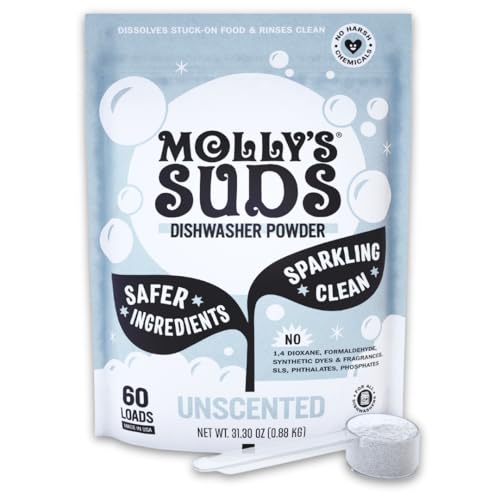
Molly's Suds Dishwasher Powder, Unscented
Alkyl polyglucoside sugar surfactant instead of an ethoxylate, with oxygen bleach and enzymes. Fragrance and dye free, 60 loads. Ships in a plastic pouch. 4.3 stars, 9,655 ratings.
View →
Branch Basics Dishwasher Tablets
Plant bound tablet with no PVA film, in a resealable pouch. Eleven named ingredients, no fragrance, essential oils, chlorine or dye. 60 loads. 4.4 stars, 554 ratings.
View →
Nature Clean Dishwasher Rinse Aid
Four ingredients: water, decyl glucoside, citric acid and a chelator. A sugar surfactant doing the job alcohol ethoxylates do elsewhere. No phosphates, dyes or fragrance. 4.4 stars, 883 ratings.
View →Why Blueland leads
It is the only option here where the film question does not arise at all, because there is nothing holding the dose together except pressure and a binder, and the pouch it arrives in is paper. The published list is sodium citrate, sodium carbonate, sodium percarbonate, a protease and amylase blend, microcrystalline cellulose, sorbitan caprylate, hydrated silica, water and a polymer anti scaling agent. Nothing ethoxylated, nothing hidden behind a fragrance umbrella. It also carries EPA Safer Choice certification and, at 10,963 ratings, more real ownership feedback than every other film free option in this article put together.
It is also the cheapest of the five per load, which is worth saying plainly because the opposite is usually assumed. Buying the large pack rather than the small one is what does it, and the gap over the two powders is wide enough that nothing further down this list saves you money. We had this backwards in an earlier version of this article, which labeled one of the powders the value pick on its sticker price without dividing by the number of loads in the box.
If you want the powder instead, Dirty Labs is the one we would take: a paperboard canister with a wooden scoop, ten ingredients, all named, and a concentration that gets 48 loads out of a container the size of a coffee tin. Molly's Suds does the same job with nearly ten thousand ratings behind it, more than three times Dirty Labs' sample, and it carries two honest marks on a plastics site: it ships in a plastic pouch rather than paper, and per load it costs more than the top pick rather than less.
| Product | Dose format | Surfactant | Scent | Verdict |
|---|---|---|---|---|
| Blueland Free & Clear | Pressed tablet, no film | Sorbitan caprylate | None | Best overall |
| Dirty Labs Free & Clear | Loose powder, paperboard | Sorbitan caprylate | None | Best powder |
| Molly's Suds Powder | Loose powder, plastic pouch | Alkyl polyglucoside | None | Most reviewed powder |
| Branch Basics Tablets | Pressed tablet, no film | Sodium lauryl sulfoacetate | None | Thinner review sample |
| Nature Clean Rinse Aid | Liquid, plastic bottle | Decyl glucoside | None | Best rinse aid |
| Nellie's Dishwasher Powder | Loose powder, tin or pouch | Cocamidopropyl betaine | None | See below |
| Finish Powerball tablets | Pressed tablet, no film | Not published | Fresh Scent | See below |
| Dropps UltraWash | Pod, PVA film | C10-16 alcohols ethoxylated propoxylated | None | Passes, not picked |
| Cascade Platinum ActionPacs | Pod, PVA film | Isotridecanol ethoxylated | Fragrance, colorants | See below |
Your own detergent is probably not one of the nine above. Type it into Product Check, on the site or in the app, for a verdict against the same ingredient standard, litigation records and materials rules used throughout this article.
8. Brands We Did Not Pick
Cascade Platinum ActionPacs
Every problem in this article appears on a single ingredient list: isotridecanol ethoxylated and a PEG/PPG ether as the surfactants, polyvinyl alcohol polymer as the film, plus fragrance and colorants that serve no cleaning function. There is also litigation. A South Carolina buyer filed suit against Procter & Gamble on 18 May 2023 after a Platinum ActionPac he was loading ruptured and sprayed concentrated detergent into his eye, alleging the company knew the pods could burst and did not warn.
That is a product defect claim rather than a chemistry claim, and it is one person's case, but it is a reasonable thing to know about a product sold as a convenience.
Finish Powerball tablets sold as plastic free
Credit where it is due: this is a mainstream tablet, the biggest seller in the aisle, and it really has dropped the wrapper. That is the single change we most wanted to see in this category and it has happened at the volume that actually matters. Two things keep it out of the picks. It is sold in Fresh Scent, so the thing engineered to survive the wash is a fragrance, and where the ingredient list should be the pack refers you to a website instead.
Our standard treats a list the maker will not print as a finding in itself, not as a blank. If Reckitt publishes a full list on a fragrance free version, this becomes an easy recommendation.
Dropps UltraWash Dishwasher Detergent Pods
This is the one where our own rules and our own picks standard part company, and it is worth saying so out loud. Dropps publishes a full ingredient list, uses no fragrance, and prints "polyvinyl alcohol (synthetic water soluble film)" on its own label rather than hiding it. Nothing on that list is a named hazard under our standard, so our checks do not warn about it and Product Check does not call it careful. We are not going to invent a downgrade to make an article tidier.
It is still not a pick here, for a reason you can weigh yourself. The plastic free claim on the box is about the box. The pod is sealed in PVA, and the surfactant is C10-16 alcohols ethoxylated propoxylated, the family the gut barrier study named. Our picks avoid both, at the same price. We also had Dropps recorded as a powder in cardboard, which was simply wrong, and this research corrected it.
Nellie's Dishwasher Powder
The formula we read is reasonable: sodium chloride, carbonate, citric acid, sulfate, percarbonate, metasilicate, cocamidopropyl betaine, silicate and a protease, with no ethoxylate and no fragrance, and the large size ships in a steel tin. What keeps it out of the grid is history and stock. A 2018 class action against Batten Industries alleged its "All-Natural" labeling was false, naming the Automatic Dish Powder and Dish Nuggets among eleven products, and specifically pointed to lauryl alcohol ethoxylate in a sister product.
The current list carries no ethoxylate, so the formula appears to have moved on. At 4.2 stars it also has the weakest ownership feedback here, and the tin size we would actually recommend keeps running thin on stock.
Conventional rinse aid, including Finish Jet-Dry
Alcohol ethoxylates are the active surfactant in mainstream rinse aid, and the point of a rinse aid is that it stays on the glass after the water has gone. That is the exact combination the 2023 gut barrier study examined. The study's limits are real and stated above, but of everything in this aisle, rinse aid is the one product with both a named mechanism and no cleaning function at all.
Open the door at the end of the cycle and let the steam out, which handles most spotting. If your water is hard enough to need help, a glucoside based rinse aid does the same job without the ethoxylate.
9. Frequently Asked Questions
Are dishwasher pods made of plastic?
The film around a pod is polyvinyl alcohol, written on labels as PVA or PVOH. It is a synthetic polymer manufactured from petroleum feedstock, and it dissolves in water, which is why brands describe pods as plastic free. Dissolving and degrading are not the same thing. A 2021 paper by Rolsky and Kelkar estimated that roughly 17,200 metric tons of PVA are used in US laundry and dish detergent pods each year and modeled that about 77 percent reaches the environment intact. Blueland and the Plastic Pollution Coalition petitioned the EPA in January 2023 to require safety testing; the EPA denied that petition in April 2023 on the grounds that the petitioners had not shown existing information to be insufficient. A pressed tablet or a loose powder has no film and avoids the argument entirely.
Is rinse aid bad for you?
The best evidence is a 2023 study in the Journal of Allergy and Clinical Immunology by Ogulur and colleagues. Testing on human gut cell cultures, organoids and gut-on-a-chip models, they found the toxicity came from rinse aid rather than from the detergent, in a dose dependent way at dilutions up to 1:20,000, and identified alcohol ethoxylates as the component responsible. They also measured rinse aid residue still present on washed, ready to use dishware from professional dishwashers. Two caveats matter: this is cell and organoid work, not a human exposure study, and the concentrations tested were those used in professional machines, which run a two minute cycle with no final rinse. A household machine does run a final rinse. The practical answer is that rinse aid is the one dishwasher product you can simply stop buying, and if you want one, pick a formula built on a sugar surfactant instead of an alcohol ethoxylate.
Does dishwasher detergent contain 1,4-dioxane?
Mostly no, and this is the one place where the usual detergent warning does not transfer. The New York State Pollution Prevention Institute, funded by the state Department of Environmental Conservation, tested 313 household and personal care products and found 1,4-dioxane in 69 percent of hand dish soaps, at a mean of 2.5 parts per million, along with 62 percent of body washes, 59 percent of shampoos and 53 percent of laundry detergents. Automatic dishwasher detergent was one of only two categories tested with no detections at all. Hand dish soap and machine detergent are different products with different chemistry, and most articles on this subject quietly move the hand dish soap number across.
What is the best non toxic dishwasher detergent?
Blueland Dishwasher Tablets in Free & Clear. The tablet is pressed with no film of any kind, so there is no PVA in the product, and it ships in a compostable paper pouch rather than a plastic tub. The published list is sodium citrate, sodium carbonate, sodium percarbonate, enzymes, microcrystalline cellulose, sorbitan caprylate, hydrated silica, water and a polymer anti scaling agent, with no ethoxylated surfactant, no fragrance and no dye. It is EPA Safer Choice certified and holds 4.3 stars across 10,963 ratings, which is by a wide margin the largest real world sample of any film free option.
Should I run plastic containers through the dishwasher?
No, if you can avoid it. University of Queensland researchers published a 2025 study in ACS ES&T Water measuring what plastic articles shed during a normal machine cycle, where they meet detergent, abrasion and water at up to 70 degrees Celsius. A single cycle carrying a full load of common household plastic items released roughly 920,000 micro and nano sized particles into wastewater. The researchers are careful that the total mass is small, around 6 milligrams per person per year, so this is a particle count story rather than a mass pollution story. It is still an argument for glass and stainless in the places where you have a choice.
Are dishwasher tablets better than pods?
For this question, yes. A pod is a dose of liquid or powder sealed inside a polyvinyl alcohol film; a tablet is the same chemistry pressed into a solid with a binder and no wrapper at all. Tablets also travel better in paper, because they do not need a moisture barrier around a liquid. The tablet still has to be judged on its ingredient list, though, because a film free tablet with an undisclosed fragrance and an ethoxylated surfactant is not an improvement on the two things this article is actually about.
Can I use white vinegar instead of rinse aid?
It does the same job of breaking surface tension so water sheets off instead of beading, and Molly's Suds recommends a splash of it for hard water on its own product page. The caveat is that several appliance makers advise against filling the rinse aid reservoir with vinegar, because the dispenser holds it against rubber and plastic seals between cycles rather than flushing it straight through. Adding it to a cup on the top rack avoids that, as does simply opening the door at the end of the cycle and letting the dishes air dry, which is what most spotting complaints actually come down to.
Which dishwasher detergents should I avoid?
The ones that combine the two problems this article is about with a third. Cascade Platinum ActionPacs list isotridecanol ethoxylated, a polyvinyl alcohol polymer film, fragrance and colorants on one label, and P&G is facing a suit filed in South Carolina in May 2023 by a buyer who says a pod ruptured and burned his eye. Dropps UltraWash is a different case: it discloses everything, carries nothing on our hazard list and is not one we warn about, but its plastic free claim is about the cardboard box while the pod is bound in polyvinyl alcohol and cleaned with C10-16 alcohols ethoxylated propoxylated, so it is not one of our picks either. Finish Powerball's film free tablet genuinely drops the wrapper, but it is scented and its label refers you to a website instead of printing the ingredients.
Do I still need a dishwasher cleaner or a booster?
Rarely, and the ones sold for it are usually citric acid at a premium. A cup of plain white vinegar on the top rack through an empty hot cycle, once a month, strips the film that builds up in the sump and on the spray arms, and plain citric acid powder does the same for hard water scale. Both of our powder picks are concentrated enough to handle ordinary hard water without a separate booster, and Dirty Labs sells its detergent as a two in one for exactly that reason.
Related Articles
- Best Non Toxic Laundry Detergent
The same PVA question in the other machine, plus the 1,4-dioxane numbers that do apply there. - Reduce Microplastics in Cleaning Products
Hand dish soap, where the ethoxylates and the dioxane actually live, and the solid bars that replace them. - Best Plastic Free Food Storage Containers
What to load instead, given what a hot cycle does to plastic on the top rack. - Kitchen Detox 101
Where dishwashing sits among every other plastic decision in the room. - Toxic Kitchen Appliances, Ranked
The machine itself, and why a plastic tub is a different question from a plastic container.