The Complete Parent's Guide to Replacing Toxic Baby and Toddler Products (2026)
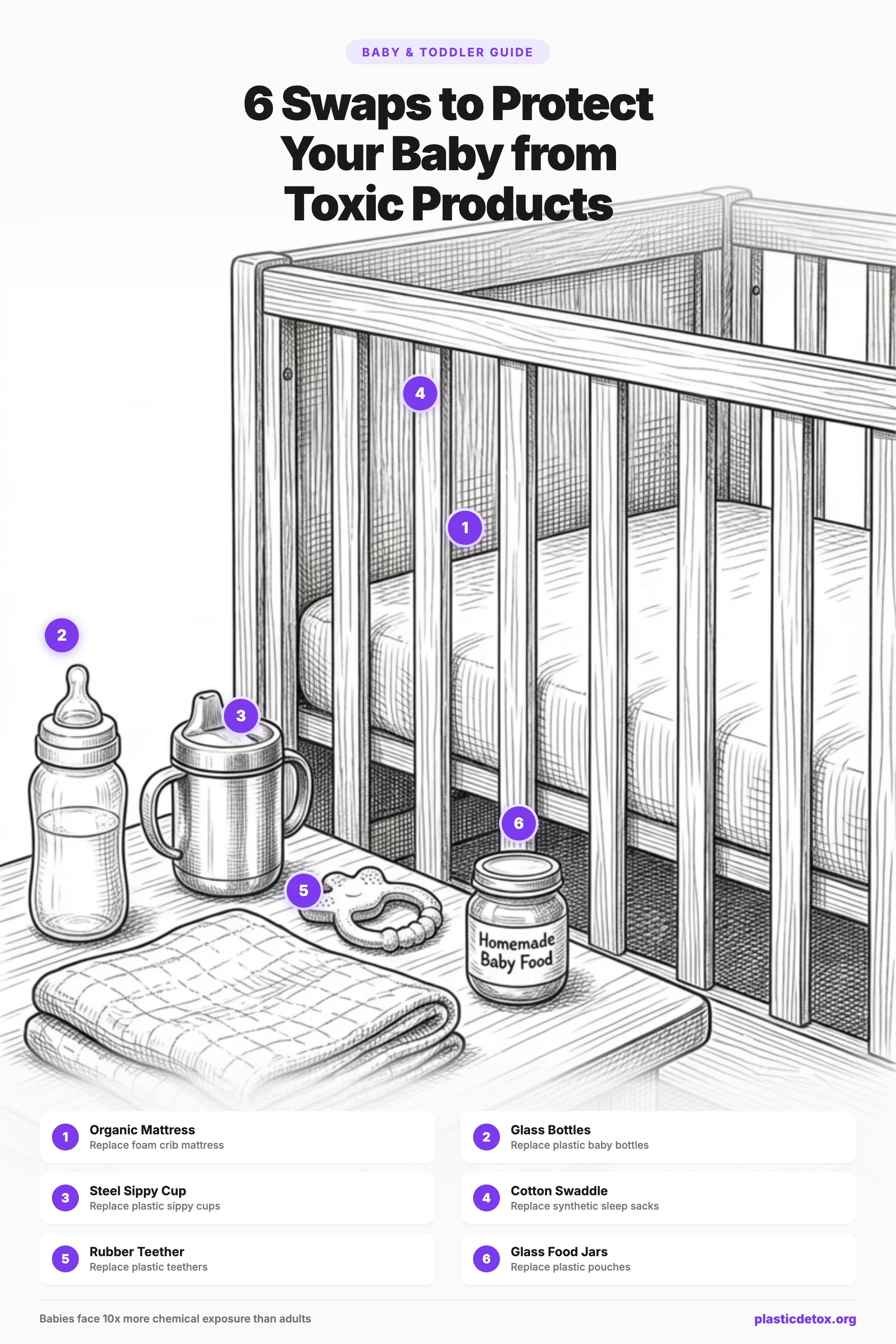
The 30 Second Summary
- Babies absorb up to 10x more chemicals than adults. Thinner skin, faster breathing, hand to mouth contact, and developing organs make even small exposures matter.
- Prioritize feeding gear and the mattress. Anything that touches food, milk, or 12 hours of sleep delivers the highest cumulative exposure.
- Best glass bottle pick: Lifefactory Glass Baby Bottles with medical grade silicone sleeves and nipples.
- Best stainless sippy: Pura Kiki Stainless Steel grows with baby from bottle to sippy to cup. Pick the non insulated model. The insulated version previously tested positive for lead in the bottom seal.
- Skip plastic teethers, plastic plates, and "BPA free" plastic. "BPA free" usually means BPS or BPF, both flagged as endocrine disruptors.
- Look for GOTS, OEKO TEX, or GOLS certifications. These verify organic textiles and natural latex without flame retardants or formaldehyde.
Building a registry? The picks in this guide are organized into a shoppable list on our Low Tox Baby Registry →
Introduction: Why Babies Are More Vulnerable
Babies are not small adults. Their bodies process chemical exposures in fundamentally different ways, and the science on this is not subtle. A newborn's liver enzymes, the primary system for breaking down and eliminating foreign chemicals, are operating at a fraction of adult capacity. Some detoxification pathways do not fully mature until age two or later. This means chemicals that an adult body can neutralize and excrete in hours may circulate in an infant's system for days.
Their skin is thinner and more permeable. Substances that sit on the surface of adult skin penetrate more readily into a baby's bloodstream. Their surface area to body weight ratio is roughly three times higher than an adult's, which means topical exposures (lotions, detergent residue on clothing, chemicals in diapers) deliver a proportionally larger dose.
Then there is the floor. Babies crawl, roll, and play at ground level where household dust accumulates. That dust is not just dirt. Studies have found it contains flame retardants from furniture foam, microplastics from synthetic carpets and textiles, PFAS from stain resistant treatments, and phthalates from vinyl flooring. A crawling baby inhales and ingests this dust all day long, and their hand to mouth behavior ensures a steady dose.
Mouthing is the final multiplier. Babies explore the world with their mouths. Every toy, teether, book corner, shoe, and piece of furniture they mouth is a direct chemical ingestion pathway. This behavior is developmentally normal and impossible to prevent, which makes the materials surrounding your baby all the more important.
- Microplastics and nanoplastics: Physical particles shed from plastic products. Found in baby bottles, food pouches, toys, and synthetic clothing. Babies ingest an estimated 10 times more than adults.
- Flame retardants: Added to foam in mattresses, car seats, strollers, and nursing pillows. Migrate into dust and are inhaled or ingested. Linked to thyroid disruption and neurodevelopmental effects.
- PFAS (forever chemicals): Used in stain resistant and waterproof treatments on clothing, bibs, high chair covers, and stroller fabrics. Do not break down in the body or the environment.
- Endocrine disrupting chemicals (EDCs): Includes BPA, BPS, phthalates, and parabens. Found in plastics, personal care products, and fragranced items. Interfere with hormone signaling during critical developmental windows.
How to Prioritize Swaps
You do not need to replace everything at once. That is expensive, overwhelming, and unnecessary. Instead, prioritize by two factors: exposure time and exposure route.
Exposure time means how many hours per day your baby is in contact with the item. A crib mattress (14 to 16 hours) ranks higher than a stroller (1 to 2 hours). Exposure route means how the chemical enters the body. Ingestion (bottles, food containers, mouthed toys) and inhalation (mattress off gassing, dust) are more direct than skin contact (clothing). Items that combine long contact time with a direct exposure route are the highest priority swaps.
The Picks at a Glance
Every recommendation in this guide, with the reasoning underneath each one in its own section below.

Motherlove Diaper Balm
USDA Organic olive oil and beeswax with Oregon grape root, myrrh, yarrow, and calendula. No zinc, petroleum, lanolin, or fragrance. Glass jar in the 1 oz and 2 oz sizes; the 4 oz may come in plastic. Not for active rash.
View →
Coterie The Wipe
EWG Verified formula of six ingredients on a VEOCEL lyocell and viscose cloth with no plastic fiber. No PFAS detected in Consumer Reports 2026 testing. Highest cost per wipe here.
View →
Caboo Tree Free Wipes
MADE SAFE certified on a bamboo viscose cloth with no plastic fiber. Unscented, 99.7 percent naturally derived. No PFAS detected in Consumer Reports 2026 testing. Lowest cost per wipe.
View →
Ahimsa Stainless Plate Set
18/8 stainless steel divided plate and bowl, no plastic, no melamine and no coating. Dishwasher safe and will not scratch into the food the way coated toddler plates do.
View →
Eco by Naty Diapers
Plant based topsheet with a totally chlorine free fluff core, no added fragrance or lotion. One of the few mainstream disposables with an ingredient list you can actually read.
View →Certification Cheat Sheet
Not all certifications are created equal. Some are rigorous third party standards with ongoing testing. Others are industry self certifications that mean very little. Here are the ones worth looking for on baby products:
| Certification | What It Means | Best For |
|---|---|---|
| GREENGUARD Gold | Product tested for low chemical emissions including VOCs and formaldehyde. Stricter than standard GREENGUARD. Specifically developed for sensitive populations including children. | Mattresses, cribs, furniture, car seats |
| GOTS (Global Organic Textile Standard) | Entire supply chain certified organic, from raw fiber to finished product. Bans toxic dyes, formaldehyde finishes, and heavy metals. Requires fair labor practices. | Clothing, bedding, swaddles, towels |
| OEKO-TEX Standard 100 | Finished textile tested for over 350 harmful substances. Tests the actual product, not just the raw material. Class I is the strictest level, designed for baby products. | Clothing, bedding, any fabric product |
| MADE SAFE | Screened against a database of known toxic chemicals. No animal testing. Covers personal care, baby, cleaning, and household products. | Personal care, cleaning products, mattresses |
| EWG Verified | Meets Environmental Working Group's strictest health criteria. No chemicals of concern. Full ingredient transparency required. | Baby wash, lotion, sunscreen, wipes, diapers |
| FSC (Forest Stewardship Council) | Wood sourced from responsibly managed forests. Relevant because solid wood toys and furniture are safer alternatives to plastic and particleboard. | Wooden toys, furniture, cutting boards |
"BPA free" only means the specific chemical BPA was removed, often replaced with equally problematic alternatives like BPS and BPF. "Natural" and "eco friendly" have no regulated definitions and are frequently used as marketing terms. "Dermatologist tested" means a dermatologist looked at it, not that it passed any safety standard. Always look for the specific third party certifications listed above rather than vague marketing language.
Part 1: Feeding
1.0 The Pumping System
The pumping system is the most overlooked source of microplastic exposure for breastfed babies. Most conversations about baby feeding safety focus on bottles, but by the time milk reaches the bottle, it has already passed through plastic flanges, sat in plastic collection containers, and been stored in plastic bags. Each of those steps introduces contamination that is entirely avoidable.
1.0a Pump Flanges and Connector Parts
Standard pump flanges are made from polypropylene or polycarbonate plastic, and milk runs through them on every cycle. Be precise about what is known here: no published study has measured particle release from a flange, a valve or a connector, and we searched for one. What is measured is adjacent. Polypropylene infant bottles released 1.3 to 16.2 million microplastic particles per liter at formula preparation temperature in a 2020 Nature Food study, and mechanical wear is a documented release mechanism for plastics generally. That makes the polymer worth avoiding where a silicone version exists, and it does not make the flange the first thing to change.
The fix is to switch to a silicone flange. Silicone is not a plastic. It is a synthetic polymer made from silica (sand), it sits in the inert column of our materials standard alongside glass and stainless steel, and what it can give up moves with heat and fat rather than at body temperature.
Corrected September 2026. This guide previously recommended Pumpin' Pal's angled flanges as a 100% silicone option across the range. Pumpin' Pal's own product page says something narrower: "Medium, Large and XL Flanges are made with Medical-Grade Polypropylene. 2XS, XS and Small Flanges made with BPA Free Silicone." Most pumps ship with a 24 or 27 mm flange, so for most people the Pumpin' Pal in their size is the polypropylene one. The small sizes are silicone and still pass. For a silicone flange in the larger fits, see our pumping setup guide.
LacTeck BabyMotion Flange
Soft silicone flange with a collapsing window at the base that flexes on each cycle, sold in six sizes from 12 to 27 mm and silicone in all of them. Fits Medela, Lansinoh and Hygeia directly and Spectra with an adapter. Sold direct rather than through a marketplace.
- Silicone in every size, including 24 and 27 mm
- Softer seal than a rigid flange
- Six sizes, 12 to 27 mm
- Sizing runs smaller than other brands, so you may need a size down
- Spectra needs a separate adapter
- No independent lab test of it exists, and the reviews are on the maker's own store
1.0b Pump Collection Bottles
This is the exposure point nobody talks about. During a pumping session, warm breast milk sits in a plastic collection bottle for 15 to 30 minutes. Warm liquid in plastic is one of the most well documented scenarios for microplastic release. The 2020 Trinity College Dublin study showed that hot liquid in polypropylene releases up to 16 million particles per liter, and while breast milk is not boiling, it is warm and contains fat, both factors that increase leaching.
The solution is to collect directly into glass, and on most pumps it needs no adapter at all. Wide neck glass bottles thread straight onto Spectra and other wide neck pumps, and standard neck glass bottles thread onto Medela and similar, so the bottle you pump into is also the bottle that freezes and the bottle you warm. Choose etched or unpainted glass, or a printed bottle with a clean lead result, because the paint on a glass bottle is a separate material from the glass. Our pumping setup guide has the XRF results for this category and the two bottles that pass.
1.0c Breast Milk Storage Bags
Disposable plastic breast milk storage bags are a daily exposure for pumping moms. The bags are thin, the milk is often warm when transferred, and the mechanical action of squeezing, shaking, and temperature cycling (freezing and thawing) all accelerate microplastic release. Single use bags mean this exposure repeats with every fresh bag.
Mila's Keeper Silicone Storage Containers
Food grade silicone containers built to a single feed portion and stackable for freezer organization. Silicone sits in the inert column of our materials standard alongside glass, and it handles the move from freezer to warmer without any risk of shattering. Designed from the ground up to replace disposable plastic bags.
- Designed specifically for breast milk portions
- Food grade silicone, no microplastic shedding
- Stackable and space efficient
- Unbreakable, safe for freezer to warmer transitions
- Reusable, eliminating daily bag waste
- Higher upfront cost than disposable bags
- Takes more freezer space than flat frozen bags
- Silicone rather than glass (glass remains the gold standard for inertness)
1.0d Warming and Thawing
How you warm stored breast milk matters as much as how you store it. Never microwave breast milk in any container, plastic or otherwise. Microwaving creates hot spots that can burn the baby and also destroys beneficial antibodies. But also never warm a plastic storage bag by placing it in warm water. The combination of heat and the thin plastic of a storage bag maximizes microplastic release.
The safest approach: thaw in the refrigerator overnight, then transfer to a glass bottle and warm using a water bath or a bottle warmer that uses warm water (not steam). If using a bottle warmer, make sure the milk is already in glass or stainless steel before warming.
1.0e Mom's Own Daily Plastic Use
This one is easy to overlook, but what mom eats and drinks from directly affects the microplastic load in breast milk. A 2022 study published in Polymers detected microplastics in human breast milk for the first time. The particles found matched common food packaging plastics, polypropylene and polyethylene, suggesting that maternal dietary exposure passes through to breast milk.
Simple swaps for the nursing mom: replace your plastic water bottle with stainless steel, move food storage from plastic to glass, and if possible, filter your tap water. These changes benefit both mom and baby.
- Water bottle: Hydro Flask 32oz Wide Flex Cap (18/8 stainless, bare steel interior, lead free seal since 2012)
- Food storage: Switch to glass containers for leftovers and meal prep (see our food storage guide)
- Water filter: Bluevua RO100ROPOT countertop reverse osmosis (needs no plumbing, and reverse osmosis is the method that removes both microplastics and PFAS; see our water filter guide)
1.1 Baby Bottles and Nipples
If there is one swap you make from this entire guide, make it this one. The 2020 Trinity College Dublin study published in Nature Food remains the definitive research on this topic. Polypropylene baby bottles, which make up 82% of the global market, release 1.3 to 16.2 million microplastic particles per liter when exposed to hot water at formula preparation temperatures. Shaking the bottle to mix formula increases release further. Sterilizing with boiling water causes the highest release of all.
Labeling a bottle "BPA free" does not help. The study tested specifically BPA free polypropylene bottles. The microplastic particles themselves are the problem, independent of any single chemical. And these are physical particles entering your baby's digestive system multiple times per day, every day, for the first year or more of life.
Watch for one less obvious risk: some glass baby bottles have painted logos or measurement markings on the outside. Some of these paints contain lead. Choose bottles with markings printed on the silicone sleeve or etched into the glass, never painted directly on the bottle surface where a baby's mouth might contact it.
Lifefactory Glass Baby Bottles
Borosilicate glass bottles with a medical grade silicone sleeve for drop protection. The glass is completely inert at any temperature. The silicone sleeve is color coded by size and provides enough grip and cushion that breakage is rare even with an older baby.
Price: $16 to $20 per bottle
- Borosilicate glass: zero microplastic release at any temperature
- Silicone sleeve protects against drops
- Wide and narrow neck options
- No painted markings (measurements on the sleeve)
- Heavier than plastic bottles
- More expensive than polypropylene options
Pura Kiki Stainless Steel Bottles
The only 100% plastic free baby bottle on the market. Made from #304 stainless steel with medical grade silicone nipples and a silicone sleeve. The genius of Pura Kiki is that the same bottle body grows with your child: swap the nipple for a sippy spout, then a straw, then a sport top. One bottle from newborn through school age.
Note: stick to the non insulated stainless model linked above. Pura's insulated bottle previously tested positive for lead in the bottom seal.
Price: $17 to $22 per bottle
- 100% plastic free (stainless steel + silicone only)
- Unbreakable, perfect for older babies and toddlers
- Grows from bottle to sippy to straw to sport top
- Cannot see the milk level inside
- Stainless steel is heavier than glass for a newborn
- Avoid the insulated version (lead in bottom seal)
A note about nipples: all baby bottle nipples are made from silicone or latex. There is no glass or metal alternative. Medical grade silicone is the best option. It is more heat stable than latex and does not release traditional microplastics. The contact surface between the nipple and the liquid is small compared to the bottle body, so the overall exposure from a silicone nipple on a glass or steel bottle is dramatically lower than from an all plastic bottle.
1.2 Baby Food Pouches
Baby food pouches are one of the most convenient inventions in modern parenting, and one of the worst for microplastic exposure. A 2023 University of Nebraska study found that microwaving food in plastic containers released up to 4.2 million microplastic and 2.1 billion nanoplastic particles per square centimeter. Even at room temperature, the multi layered plastic and aluminum construction of a pouch degrades over time, and the squeezing action physically releases particles.
The food inside a pouch has been sitting in direct contact with plastic for weeks or months from the moment it was packaged. This is not an exposure you can avoid by transferring the food to a glass bowl before feeding. The contamination happened in the supply chain, long before you opened the pouch. For occasional use, pouches are a reasonable convenience. For daily feeding, homemade food in glass is a meaningful upgrade.
Glass Baby Food Jars with Silicone Lids
Small glass jars with food grade silicone lids, no plastic anywhere. Make a batch of puree, portion into jars, and freeze. Silicone lids seal tightly without any plastic contact. Look for borosilicate glass options that handle freezer to microwave transitions safely. Several brands (WeeSprout, KeaBabies) make sets specifically sized for baby food portions.
Price: $15 to $20 for a set
- Zero plastic: glass jars with silicone lids
- Portion sized for baby meals
- Freezer, microwave, and dishwasher safe
- Reusable for years
- Not portable like a squeeze pouch
- Glass requires careful handling on the go
Haakaa Silicone Reusable Food Pouches
If your toddler loves the convenience of squeeze pouches, these are the clean alternative. Reusable food grade silicone pouches that you fill with homemade puree, smoothies, or yogurt. The wide opening makes filling and cleaning easy. Dishwasher safe and freezer safe. You get the portability of a pouch without the single use plastic and without the microplastic contamination from store bought pouch packaging.
Price: $16 to $22 for a multi pack
- Food grade silicone, no microplastic shedding
- Portable squeeze pouch format toddlers love
- Wide opening for easy filling and cleaning
- Dishwasher and freezer safe
- Reusable, replaces hundreds of disposable pouches
- Requires filling at home (no grab and go convenience of store bought)
- Silicone rather than glass (glass is more inert, but not squeezable)
1.3 Infant Formula Preparation
Microplastics have been detected in all tested infant formula samples regardless of brand or packaging format. A 2023 peer reviewed study of 13 formula powders found microplastic particles in every one, with the highest counts in formulas sold in multilayer composite boxes and the lowest in steel cans. Powdered formula passes through plastic tubing, plastic lined containers, and plastic scoops before it ever reaches your home.
You cannot eliminate the microplastics already in the formula powder. But you can prevent the dramatic escalation that happens when you pour boiling water into a polypropylene bottle. The Trinity College Dublin study showed that this single step, pouring 70°C water into a plastic bottle and shaking, is responsible for the largest spike in microplastic release. Prepare formula in a glass container, then transfer to the feeding bottle.
- Boil water and let it cool slightly (still at least 70°C per WHO guidelines to kill bacteria)
- Pour the hot water into a glass measuring container or Mason jar
- Add formula powder and mix with a stainless steel spoon (not the plastic scoop, use it only for measuring)
- Let the formula cool to feeding temperature
- Transfer to a glass or stainless steel bottle for feeding
This one change in prep order eliminates the biggest single source of microplastic ingestion for formula fed babies.
For the formula itself, our pick is Bobbie Organic: the European style recipe (lactose only, no palm oil, EU level DHA) made in the US under FDA registration, sold in a steel can, and placed in Consumer Reports' Top Choices tier in both the 2025 and 2026 testing rounds. We no longer suggest imported European brands like Holle and HiPP: the powder tests fine, but the gray market import channel sits outside the US recall notification system, and the FDA recalled a long list of imported HiPP and Holle products in 2021 over iron levels below the US minimum. The full brand by brand vet is in our baby formula guide.
1.4 Sippy Cups and Toddler Bottles
Plastic sippy cups face a triple threat: dishwasher heat, UV exposure from being left in cars or strollers, and the mechanical stress of being dropped and chewed on by toddlers. All three accelerate plastic degradation and microplastic release. And unlike baby bottles which parents typically retire within a year, sippy cups can be in daily use for two to three years.
Pura Kiki Stainless Steel (grows from bottle to sippy)
If you bought the Pura Kiki bottle during the infant stage, this is when it pays off. Swap the nipple for a silicone sippy spout, then later a straw top. Same stainless steel body, no new purchase needed. If you are starting fresh, the sippy spout version is available on its own.
Note: stick to the non insulated stainless model. Pura's insulated bottle previously tested positive for lead in the bottom seal.
Price: $5 to $8 for sippy spout accessory
- 100% plastic free (stainless steel + silicone)
- Grows from bottle to sippy to straw to sport top
- Extremely affordable if you already own the bottle
- Cannot see liquid level inside
- Requires buying into the Pura Kiki system for best value
- Avoid the insulated version (lead in bottom seal)
Moonkie Silicone Training Cup
A training cup made of 100% food grade silicone, with handles and a soft spout, so the drink touches only silicone. Light and easy for small hands to grip. No independent lab test of it is on record.
Tier: $
- 100% food grade silicone, no plastic in the drink path
- Handles sized for small hands
- Lightweight
- Silicone spout can be chewed through
- Not insulated
- May tip easily
Two popular steel options are not on our list. The Klean Kanteen Kid Classic has a polypropylene sippy spout, which puts plastic in the drink path. Elk and Friends says its stainless steel cup set includes "BPA free plastic" in a part it does not name.
1.5 Plates, Bowls, and Utensils
Melamine is the material most parents should worry about here. Those colorful, lightweight, "unbreakable" toddler plates and bowls are almost always melamine, a nitrogen based plastic that releases formaldehyde and melamine chemicals when heated. A 2013 study in JAMA Internal Medicine found that eating hot soup from melamine bowls increased urinary melamine levels by 8.35 micrograms compared to ceramic bowls. Do not microwave food in melamine, and ideally, do not serve hot food on it at all.
Plastic toddler cutlery is less studied but follows the same principle: mechanical wear from cutting and chewing releases particles into food. A stainless steel spoon or a bamboo utensil with a food safe finish is a simple swap.
Ahimsa Stainless Steel Bowl and Plate Set
100% stainless steel plates and bowls with no coatings, no silicone bases, and no plastic anywhere. The divided plate option makes it easy to separate foods for picky eaters. Designed by a pediatrician who wanted to eliminate all chemical exposure from children's tableware. Simple, unbreakable, and built to last through multiple children.
Price: $25 to $40 per piece
- 100% stainless steel, zero chemical leaching
- Divided plate option for picky eaters
- Designed by a pediatrician
- Virtually indestructible
- No suction base, slides on smooth surfaces
- Higher price than plastic or silicone plates
Ahimsa Stainless Steel Kids Utensil Set
A fork and spoon in stainless steel with no silicone or plastic anywhere, which is the distinction that matters against most baby utensils, where silicone or plastic sits right where the chewing happens. The stainless steel scoop will not degrade from biting, heat, or repeated dishwasher cycles. Sized for small hands with a curved handle for self feeding.
Price: $10 to $15 for a set
- Stainless steel food contact surface
- No silicone or plastic anywhere on it
- Dishwasher safe, no degradation over time
- Curved handle supports self feeding
- Less cushioned than all silicone spoons
1.6 High Chairs
High chairs present two problems. First, most foam seat pads contain flame retardants. These chemicals migrate out of the foam into household dust and onto the surfaces your child touches and mouths. Second, plastic frames and trays are in a warm kitchen environment (near the stove, in direct sunlight through a window), which accelerates off gassing of BPA, phthalates, and other volatile compounds.
The ideal high chair is solid wood with a water based finish and either no foam pad at all or one with a clean certification.
Stokke Tripp Trapp
The gold standard. Solid European beech wood with a water based finish. GREENGUARD Gold certified for low chemical emissions. The design is adjustable enough to grow from a 6 month old baby through a full size adult chair, which means you buy it once and never replace it. No foam, no plastic tray (the accessory tray is sold separately and is BPA free). Used with a baby set for infants, then just the chair as they grow.
Price: $259 (chair only), $359 with baby set and tray
- Solid beech wood, water based finish
- GREENGUARD Gold certified
- Grows from baby to adult (seriously)
- No foam padding required
- Extremely sturdy and stable
- High upfront cost (offset by decades of use)
- No fold, takes up space permanently
- Cleaning requires getting into the track grooves
Mockingbird High Chair
FSC certified solid beechwood legs with FDA approved food grade silicone straps instead of nylon. The seat shell and tray are BPA free, non toxic plastic (not PVC), and the entire chair has been independently tested for lead, phthalates, mercury, and cadmium. No foam, no fabric, no flame retardants. Everything is included in the box: tray, harness, footrest. No add ons needed. At $249, it gets you off polypropylene as the dominant material and onto solid wood plus food safe silicone, at a price point well below the Stokke once you factor in the Stokke's required accessories.
Price: $249 (everything included)
- FSC certified solid beechwood legs
- Food grade silicone straps (not nylon)
- Tested for lead, phthalates, mercury, and cadmium
- Everything included, no add ons needed
- No foam, no fabric, no flame retardants
- Seat shell and tray are still plastic (BPA free, not PVC)
- Does not grow to adult chair like the Stokke
- Newer brand, less long term track record
For parents who want a premium option that transitions babies to the family table earlier, the Stokke Steps is worth a look. Like the Tripp Trapp, it is solid beech wood with a water based finish, but the Steps design includes a bouncer attachment for newborns, making it functional from day one. Same clean materials, different growth trajectory.
1.7 Nursing Pillows
Nursing and bottle feeding pillows are used for hours every day during the first year. Both the Boppy and My Brest Friend, the two most popular pillows on the market, have historically tested positive for flame retardant chemicals in their foam filling. The pillow is pressed against mom's body and baby's body simultaneously, in direct skin contact, often with a thinly clothed or bare chested baby. This is a significant exposure pathway that most guides overlook.
Blessed Nest Organic Nursing Pillow
Organic buckwheat hull fill with an organic cotton cover. Buckwheat hulls are a natural, chemical free fill that molds to your body and provides firm support. No foam, no synthetic fill, no flame retardants. The hulls are breathable and do not trap heat. A favorite in the low tox parenting community.
Price: $80 to $100
- Organic buckwheat hull fill, completely natural
- No foam, no flame retardants, no synthetic materials
- Moldable and adjustable support
- Breathable, does not trap heat
- Heavier than foam pillows
- Buckwheat hulls make a rustling sound when adjusting
1.8 Bibs
Bibs are a daily feeding item that presses directly against your baby's chin, neck, and chest for every meal. Many standard bibs are made from PVC (the "crinkle" plastic backed bibs), which requires phthalate plasticizers and off gasses continuously. Fabric bibs marketed as "stain proof" or "waterproof" have been found to contain PFAS in the treatment. A baby wearing a PVC bib is pressing a phthalate delivery system against their skin multiple times a day.
Mushie Silicone Bibs
Food grade silicone with a deep catch pocket. No PVC, no BPA, no phthalates. Easy to wipe clean or rinse under the faucet. The soft, flexible silicone rolls up for travel. Available in beautiful muted colors that coordinate with their tableware.
Price: $12 to $16
- Food grade silicone, no PVC or phthalates
- Deep catch pocket catches dropped food
- Rolls up compactly for travel
- Beautiful color options
- Silicone can feel stiff on very young babies
- Higher price than fabric bibs
Fabric bibs that claim to be waterproof or stain resistant often achieve this through PFAS based treatments. PFAS are persistent chemicals that do not break down in the body. If you prefer fabric bibs over silicone, choose untreated organic cotton and accept that they will stain. A stained bib is safer than a chemically treated one.
Part 2: The Nursery
2.1 The Crib Mattress
If there is a single highest priority swap in your baby's entire world, this is it. Babies sleep 14 to 16 hours a day, face down, breathing air that is centimeters from the mattress surface. Every exhale warms the mattress, and every inhale draws in whatever the mattress is releasing.
Conventional crib mattresses are a cocktail of concerning materials. The foam core off gasses formaldehyde and VOCs that can take years to fully dissipate. Flame retardants are added to the foam to meet flammability standards, and these chemicals are not bound to the foam. They migrate to the surface, attach to dust particles, and are inhaled. The vinyl waterproof cover (standard on almost all conventional crib mattresses) off gasses phthalates and other plasticizers. Studies have measured elevated levels of VOCs and flame retardants in nursery air specifically attributable to the mattress.
A clean crib mattress uses organic cotton and wool (which is naturally flame resistant, eliminating the need for chemical flame retardants), natural latex, or a washable non toxic core. Look for GREENGUARD Gold certification (tested for low chemical emissions) and MADE SAFE certification (screened for known toxins).
Our crib mattress guide covers the testing and every brand in detail. The short version: choose a mattress whose layers you can name, and read the law label for the core.
Avocado Organic Crib Mattress
The most certified crib mattress we checked: MADE SAFE, GREENGUARD Gold and EWG Verified on the crib model itself, plus GOTS and GOLS. The infant side is organic coconut husk bound with latex, the toddler side adds organic Dunlop latex, and the cover is GOTS organic cotton over wool, which serves as the fire barrier. No coils, no polyurethane foam, no vinyl and no built in waterproofing. The only synthetics are a thin polypropylene lining on the side panels and 3 percent elastane in the cover.
- MADE SAFE + GREENGUARD Gold + EWG Verified + GOTS + GOLS
- No plastic core and no waterproof film
- Wool fire barrier, no chemical flame retardants
- Two firmness sides
- Contains natural latex
- Heavy at 28 pounds
- Needs a separate thin waterproof protector
Naturepedic Organic Classic Lightweight 2 Stage
The pick when you want a surface you can wipe clean. GOTS organic cotton cover and batting over a polyethylene foam core with PLA batting, under a waterproof surface of polyethylene made from sugarcane. No polyurethane foam, no vinyl, no fiberglass and no flame retardant chemicals. MADE SAFE certified, with UL listings for GREENGUARD Gold and non detectable PFAS. The honest trade: most of the fill by weight is polyethylene foam and PLA, so it is wipe clean rather than plastic free, and no current Naturepedic crib model contains wool.
- MADE SAFE + GREENGUARD Gold + UL non detectable PFAS
- Waterproof without vinyl or a PFAS finish
- Light at 11 pounds, firm infant side and softer toddler side
- Polyethylene foam core and PLA batting are plastics
- Cover is not removable
Organic cotton mattress protectors can block dust mites, bed bugs, and allergens, but they cannot block gases. Cotton, latex, and wool are gas permeable regardless of how tight the weave. VOCs, formaldehyde, and flame retardant fumes pass right through them. This fundamentally changes the calculus for anyone considering a protector as a substitute for a clean mattress.
What a non toxic protector plus organic sheet actually does:
- Blocks direct skin contact with the conventional mattress surface
- Prevents microplastics and chemical residues from migrating onto the sheet
- If the protector uses a food grade polyethylene or TPU membrane, it creates a partial physical barrier
- Reduces dust mite and allergen exposure
What it does NOT do:
- Block off gassing from VOCs, flame retardants, or formaldehyde coming up through the mattress
Your baby is still breathing those airborne chemicals for 14 to 16 hours a day regardless of what is layered on top. A protector and organic sheet are a good supplement to a clean mattress, not a replacement for one. If budget forces a choice, the mattress itself is the priority. A clean mattress with a basic cotton sheet beats a conventional mattress with the fanciest organic protector money can buy.
If you have a Stokke Sleepi, a family heirloom, a vintage frame, or a custom built crib, you can still make the sleep environment safe without replacing the crib itself. The mattress is the priority, not the frame. Naturepedic offers custom sizing for oval and non standard cribs (including the Sleepi's distinctive oval shape). Another excellent option is Heaven and Nature Organics, a small maker that builds custom size organic crib mattresses to your exact dimensions. Email them with your crib measurements and they will build one to fit. If custom ordering is not in the budget, use the best fitting standard organic mattress available for your frame, no more than two finger widths between mattress edge and crib rail.
2.2 Crib and Nursery Furniture
Pressed wood and MDF (medium density fiberboard) are held together with adhesives that contain formaldehyde. This is not a trace amount. Formaldehyde off gassing from new furniture is measurable with consumer air quality monitors and can take years to fully dissipate. In a small, often closed nursery room, concentrations can be significant.
Solid wood with a water based paint or finish is the only safe choice. Look for GREENGUARD Gold certification, which tests specifically for chemical emissions in the air a child breathes.
Babyletto Hudson Crib
GREENGUARD Gold certified. Solid New Zealand pine construction with a non toxic, water based finish. Mid century modern design that looks beautiful and converts to a toddler bed and daybed. One of the most popular clean cribs and widely available.
Price: $399 to $449
- GREENGUARD Gold certified for low emissions
- Solid wood with water based finish
- Converts to toddler bed and daybed
- Attractive design, multiple color options
- Pine is softer than beech or maple (may dent with heavy teething)
- Toddler rail sold separately
2.3 Crib Sheets and Bedding
Conventional cotton is one of the most heavily pesticide treated crops in the world. The pesticide residues survive processing and remain in the finished fabric. Polyester blends add microplastic fiber shedding with every wash cycle and every night of skin contact. In the sleep environment, where a baby spends the majority of their day, the fabric matters.
Burt's Bees Baby Organic Crib Sheets
GOTS certified 100% organic cotton. Widely available at Target, Amazon, and buybuyBABY. Soft, breathable, and affordable for organic certification. Multiple prints and solid colors. The most accessible entry point into organic crib bedding.
Price: $13 to $18 per sheet
- GOTS certified organic cotton
- Widely available and affordable
- Soft jersey knit that gets softer with washing
- Deep pocket fits most mattress heights
- Jersey knit may pill over time
- Limited to cotton (no waterproof layer)
2.4 Changing Pad and Cover
Most standard changing pads have a vinyl (PVC) waterproof surface. PVC requires phthalate plasticizers to be flexible, and these are not chemically bound to the material. They leach out continuously, especially in warm environments. Your baby lies directly on this surface, often with bare skin, multiple times a day.
Swapping PVC for another plastic film does not solve it. The Naturepedic organic contoured changing pad, a common organic pick, puts the baby on a polyethylene waterproof coating and has polypropylene and polyester parts in the seams, so we rate it use carefully rather than good. No standalone changing pad we have checked meets our standard on its own. Disposable liners do not solve it either, covered below.
Changing Pad Covers
The cover matters almost as much as the pad itself. Your baby's bare skin lies directly on this fabric during every diaper change. A conventional polyester or PVC backed cover cancels out the benefit of a clean pad underneath.
Read the layer list, not just the top fabric. The American Baby Company organic cotton cover, for example, has an organic cotton top over polyester middle and back layers, and the maker does not say what its waterproof film is made of, so it is use carefully rather than good. Our full changing pad guide has three GOTS certified covers that are organic cotton all the way through, with no polyester fill or backing: worn over the pad you already own, keep a few so there is always a clean one.
Disposable Changing Pad Liners
Disposable liners are sold as the tidy fix for a changing pad: use once, throw away. Every one we checked names the polyethylene backing that faces the table and calls the layer against the baby only "nonwoven," which describes how it is built, not what it is made of. A nonwoven top layer can be polypropylene, polyethylene, polyester, viscose, or cotton, and neither Peekapoo nor Modera, the two best documented sellers, will say which. Our changing pad guide has the full breakdown and the washable covers that name every layer instead.
Part 3: Clothing and Textiles
3.1 Baby Clothes (Everyday)
Synthetic fabrics (polyester, nylon, acrylic) do two things against baby skin. First, they shed microplastic fibers continuously. These fibers are inhaled, ingested via hand to mouth contact with clothing, and absorbed through the skin. Second, new synthetic garments off gas VOCs from the chemical dyes, wrinkle resistant treatments, and antimicrobial finishes applied during manufacturing. That "new clothes smell" is volatile organic compounds.
Organic cotton is the straightforward alternative. If organic is not in the budget for every piece, prioritize organic for items that have the most skin contact: onesies, pajamas, and underlayers. Outerwear and play clothes are lower priority since they have less direct skin contact.
Hanna Andersson Organic Zip Sleeper
GOTS organic cotton, certified by OTCO, and OEKO-TEX Standard 100 on the finished garment. A heavier weight fabric than most basics, so they hold up through more than one child. Onesies are the piece with the most skin contact, which makes them the first to buy organic.
Tier: $$
- GOTS organic cotton
- Heavier weight, lasts
- Non toxic dyes
- Costs more than basics
- Dry on low to avoid shrinking
- Organic cotton wrinkles more
Primary
OEKO-TEX Standard 100 certified. Not organic, but tested for over 350 harmful substances in the finished garment. Their entire model is basics in every color, no logos, no slogans, no gender, just clean, simple pieces. Fast shipping and easy returns make them a practical everyday choice.
Price: $8 to $20 per piece
- OEKO-TEX certified, tested for 350+ harmful substances
- Every color available, no gendered designs
- Affordable for certified clothing
- Fast shipping and easy returns
- Not organic (tested clean, but not GOTS certified)
- Some blends include synthetic fibers
3.2 Swaddles and Sleep Sacks
The sleep environment deserves the cleanest fabrics you can manage. Your baby is wrapped or enveloped in a swaddle or sleep sack for every nap and all night long, skin in full body contact with the fabric, for 12 to 16 hours a day. Polyester sleep sacks shed microplastic fibers directly against skin. Bamboo rayon (marketed as silky and sustainable) is processed using carbon disulfide and sodium hydroxide, chemicals that can leave residues in the finished fabric.
Little Unicorn GOTS Swaddles
GOTS certified organic cotton muslin. Beautiful prints that are among the most popular in the organic baby space. Lightweight muslin is breathable and gets softer with every wash. Versatile enough to use as a swaddle, nursing cover, stroller blanket, or tummy time mat.
Price: $16 to $24
- GOTS certified organic cotton muslin
- Beautiful prints, popular for gifts
- Gets softer with every wash
- Multi use: swaddle, nursing cover, stroller blanket
- Muslin is lightweight (less warmth for cooler climates)
- Not a structured swaddle (free form wrap style)
3.3 Bath Towels and Washcloths
Bath time is a uniquely vulnerable exposure point. Warm water opens pores. Wet skin is more permeable. And the towel you wrap your baby in after the bath is pressed against every inch of their body. If that towel is made from synthetic fiber blends or treated with antimicrobial chemicals, those substances transfer more readily to warm, damp skin.
Bamboo rayon towels are heavily marketed as "natural" and "antibacterial," but the manufacturing process uses harsh chemicals (sodium hydroxide and carbon disulfide). Stick with organic cotton or look for OEKO-TEX certified options if organic is outside the budget.
Mushie Organic Cotton Washcloths
OEKO-TEX certified 100% organic cotton muslin. Sold in packs of three with muted, Scandinavian design colors. The muslin weave is lightweight and dries quickly, which means less time sitting damp in the bathroom growing mildew. Doubles as a burp cloth and face wipe between baths.
Price: $16 to $20 for a 3 pack
- OEKO-TEX certified organic cotton
- Muslin weave dries fast, resists mildew
- Versatile (washcloth, burp cloth, face wipe)
- Beautiful, giftable design
- Muslin is thinner than terry (less absorbent per cloth)
- Higher price per washcloth than conventional options
Natemia Organic Cotton Hooded Towels
100% organic Turkish cotton with a dense, plush weave that is noticeably softer and more absorbent than standard organic towels. The extra large size (40 by 30 inches) means it works well past the infant stage and into toddlerhood. The hood keeps baby warm during the transition from bath to pajamas.
Price: $20 to $28
- Organic Turkish cotton, ultra soft and plush
- Extra large size grows with the child
- Very absorbent, premium feel
- Hooded design keeps baby warm
- Costs more than basic towels
- Takes longer to dry due to dense weave
Part 4: Bath Time and Personal Care
4.1 Baby Shampoo and Body Wash
A study by the Environmental Working Group found that children are exposed to an average of 27 different unsafe chemicals daily through conventional personal care products. For babies, whose skin is thinner and more absorbent, the stakes are higher. The biggest offenders in baby care products:
- Fragrance: A single "fragrance" listing on a label can contain dozens of undisclosed chemicals, including phthalates and synthetic musks. Federal law does not require companies to disclose individual fragrance ingredients.
- Parabens: Preservatives that mimic estrogen in the body. Found in shampoos, lotions, and washes.
- PEG compounds: Petroleum based thickeners that can be contaminated with 1,4 dioxane, a probable carcinogen.
- Formaldehyde releasing preservatives: DMDM hydantoin, quaternium 15, imidazolidinyl urea. These slowly release formaldehyde to preserve the product. Common in Johnson's Baby Shampoo and similar legacy brands.
We now cover this category in depth, with the newborn skin science, the label decoder and six fragrance free washes vetted on all four checks, in our baby wash and shampoo guide. The two picks below are the top pick and the value pick from that guide.
Babo Botanicals Sensitive Baby Fragrance Free 2 in 1 Shampoo and Wash
EWG Verified syndet wash with taurate, olefin sulfonate and isethionate surfactants, shea butter, calendula and chamomile, and benzoate and sorbate preservatives. No fragrance, no essential oils, no ethoxylated ingredients, no synthetic polymers. 100% recycled plastic bottle. The best owner rating of any wash that cleared our four checks, at 4.7 stars across about 2,800 ratings.
- EWG Verified, fragrance free, no essential oils
- No PEGs, ethoxylates or polymers
- Full label published on bottle and website
- Also sold as a plastic free wash bar
- Cocamidopropyl betaine, a contact allergen, low on the label
- Plastic bottle (recycled content)
ATTITUDE Baby 2 in 1 Shampoo and Body Wash, Unscented
EWG Verified with a 14 ingredient label: sodium coco sulfate, coco glucoside and isethionate surfactants, benzoate and sorbate preservatives, inulin and blueberry leaf extract. The value pick at roughly half the price per ounce of the Babo, with a 67 ounce cardboard refill box that cuts the plastic further.
- EWG Verified, fragrance free
- Short label, no ethoxylates or polymers
- Cardboard refill box available
- Sodium coco sulfate is a sulfate, whatever the listing says
- Plastic pump bottle
4.2 Diaper Cream and Skin Balms
Standard zinc oxide diaper creams use petroleum based carriers like mineral oil and petrolatum. Petroleum jelly (Vaseline) is a byproduct of oil refining. While pharmaceutical grade petrolatum is highly refined, lower grade versions found in many products can contain polycyclic aromatic hydrocarbons (PAHs), which are potential carcinogens. The diaper area is one of the most sensitive and absorbent areas of skin on a baby's body. There is also a newer, bigger issue: independent 2025 to 2026 testing found lead in every zinc oxide diaper cream tested, because zinc ore naturally carries lead. Our full diaper rash cream and baby balm guide covers the results; the short version is to use a zinc free balm for daily prevention.
Motherlove Diaper Balm
USDA Organic via Oregon Tilth and Leaping Bunny certified. Olive oil and beeswax carrying Oregon grape root, myrrh, yarrow, and calendula. No zinc, no petroleum, no lanolin, no fragrance, and safe for cloth diapers. Buy the 1 oz or 2 oz glass jar; the 4 oz may come in plastic, and an oil balm in plastic is the one pairing we avoid.
- USDA Organic and Leaping Bunny certified
- Glass jar in the 1 oz and 2 oz sizes
- No zinc, petroleum, lanolin, or fragrance
- Small jar, herbal scent from the plants themselves
- Prevention product, not a treatment for an established rash
Sages of the Ages Baby Tallow Balm
For an active rash that needs zinc oxide. 6 percent non nano zinc in grass fed tallow, shea butter, jojoba oil, beeswax, calendula, bisabolol, sunflower lecithin, and vitamin E, nine ingredients, no fragrance or essential oils, in a 4 oz glass jar with a metal lid. Every zinc cream that has been independently tested carried lead, and this one has not been tested yet, so use it for the days a rash needs it and go back to the zinc free balm.
- The only zinc diaper product we have found in a glass jar
- Nine ingredients, fragrance free, no essential oils
- Low zinc percentage, so less of the ingredient that carries lead
- No independent heavy metals test yet
- Newer brand, sold through Amazon
Note: we previously listed HealthyBaby Diaper Cream here. It was removed after the 2025 to 2026 independent testing series reported lead in it, along with every other zinc oxide diaper cream tested. The full results are in our diaper cream guide.
4.3 Baby Wipes
Most parents do not realize that conventional baby wipes are made from polypropylene, the same plastic as baby bottles. The wipe substrate itself is plastic. Add preservatives like phenoxyethanol and sodium benzoate, and you have a plastic sheet soaked in chemicals being rubbed against the most sensitive skin on your baby's body, dozens of times a day. Our full non toxic baby wipes guide covers the substrate materials, the preservative history, and the 2026 Consumer Reports PFAS testing in depth.
HealthyBaby Wipes
EWG Verified and MADE SAFE certified. The wipe substrate is wood pulp, not plastic. Only 6 ingredients, all EWG rated safe. The first wipe brand to achieve both EWG Verified and MADE SAFE certification simultaneously.
Price: $8 to $12 per pack
- Wood pulp substrate (not plastic)
- EWG Verified + MADE SAFE certified
- Only 6 clean ingredients
- Compostable
- Higher cost than conventional wipes
Natracare Organic Baby Wipes
Organic cotton substrate with organic essential oils. Fully compostable. No plastic of any kind in the wipe or the packaging. One of the original clean wipe brands, available internationally.
Price: $5 to $8 per pack
- Organic cotton substrate (not plastic)
- Fully compostable, including packaging
- Available internationally
- Thinner than some competitors
- Essential oils may not suit ultra sensitive skin
Coterie Wipes
Only 6 EWG Verified ingredients. Ultra thick and strong enough that you typically only need one wipe per change instead of three or four. The clean ingredient list is remarkably short for a product that works this well. No fragrance, no parabens, no phenoxyethanol.
Price: $8 to $12 per pack
- Only 6 ingredients, all EWG Verified
- Ultra thick, one wipe per change
- No fragrance, parabens, or phenoxyethanol
- Available on Amazon
- Premium pricing
- Thickness means fewer wipes per pack
Caboo Tree Free Baby Wipes
MADE SAFE certified, on a bamboo viscose cloth with no plastic fiber. Unscented, 99.7% naturally derived, primarily water and glycerin, with no parabens, phthalates, or formaldehyde releasers. A Consumer Reports recommended wipe in its 2023 ingredient review and PFAS non detect in its 2026 testing. The best value clean wipe, widely available without a subscription.
Price: $4 to $6 per pack
- MADE SAFE certified
- Bamboo substrate, no plastic fiber
- Lowest cost per wipe of the clean options
- No subscription required
- Thinner than Coterie or HealthyBaby
Note: we previously listed WaterWipes here as the simplest widely available option. We removed it after 2025 lawsuits alleged microplastics in wipes marketed as plastic free, and because its grapefruit seed extract carries a disclosed trace of benzalkonium chloride. The full story is in our baby wipes guide.
4.4 Diapers
A baby goes through 6,000 to 10,000 diapers before potty training. Conventional disposable diapers contain superabsorbent polymer (SAP) gels, synthetic fragrance, chlorine bleached pulp, and a plastic topsheet (the layer that sits directly against skin). That plastic topsheet is in contact with the most sensitive area of a baby's body, in a warm, moist environment, for hours at a time. These are the exact conditions that accelerate chemical leaching from plastic.
HealthyBaby Diapers
The first EWG Verified diaper. This is not a marketing claim. It means every material and chemical in the product has been reviewed against EWG's strictest database of known health hazards. Plant based topsheet, chlorine free pulp, no fragrance, no lotions, no latex, no optical brighteners.
Price: ~$0.50 per diaper (subscription)
- First EWG Verified certified diaper brand
- MyMicrobiome certified (tested safe for skin microbiome)
- Plant based topsheet (not petroleum based plastic)
- No fragrance, chlorine, latex, or lotions
- Subscription delivery (never run out)
- Premium pricing
- Subscription only (no retail availability)
- Fewer size options than major brands
Eco by Naty
Totally chlorine free pulp from Scandinavian FSC forests, a plant based topsheet, and no fragrance, chlorine, or latex. OEKO-TEX Standard 100 certified and non detect for PFAS markers in independent lab screening. The cheapest genuinely clean diaper we found.
Price: the lowest per diaper of the clean brands
- Totally chlorine free pulp
- Non detect for PFAS markers in independent testing
- Plant based topsheet, no fragrance or lotion
- Cheapest of the clean brands
- Not EWG Verified
- Swedish brand, US stock can be patchy
Coterie Diapers
Ultra clean ingredient list with plastic neutral certification. One of the softest diapers on the market with excellent absorbency and leak protection. No chlorine, no fragrance, no lotions, no latex, no parabens, no phthalates. Coterie publishes their full ingredient list, which is rare in the diaper industry. Available on Amazon and through their own subscription.
Price: ~$0.55 per diaper
- Ultra clean, fully disclosed ingredient list
- Excellent absorbency and leak protection
- Plastic neutral certified
- Available on Amazon (no subscription required)
- Most expensive diaper on this list
- Not compostable
Seventh Generation Sensitive Skin
One of the few brands using totally chlorine free (oxygen bleached) wood pulp rather than the elemental chlorine free pulp most of the market uses. No fragrance, lotion, or added dyes on the topsheet, and non detect for organic fluorine inside and outside in 2023 independent lab screening. Sold in ordinary grocery and drug stores, so it is the easiest clean diaper to actually buy. It is not, however, a budget option: about $0.69 a diaper at size 4 on Amazon, roughly the same as HealthyBaby at that size.
Price: ~$0.69 per diaper at size 4 on Amazon, usually less in a grocery store
- Totally chlorine free pulp, not elemental chlorine free
- Non detect for PFAS markers in independent testing
- No subscription needed
- Stocked in ordinary grocery and drug stores
- Not EWG Verified
- Ingredient deck is less fully disclosed than Coterie or HealthyBaby
4.5 The Baby Bathtub
Most infant tubs are made from PVC or ABS plastic. In warm bath water, PVC leaches phthalates and other plasticizers. This is a direct exposure: your baby is sitting in warm water that is in contact with leaching plastic. The bath water then sits on their skin, in their ears, occasionally in their mouth.
Stokke Flexi Bath
A polypropylene (PP) tub with thermoplastic elastomer folding sections. Polypropylene is a less concerning plastic than PVC because it does not need phthalate plasticizers, but Stokke does not state that the bath is BPA free, PVC free or phthalate free, so we cannot confirm what the folds and plug contain. Foldable design saves space.
Price: $45 to $55
- Polypropylene tub, a plastic that needs no phthalate plasticizers
- Foldable, space saving design
- Lightweight and portable
- Still polypropylene plastic (better than PVC, not ideal)
- Maker does not state BPA, PVC or phthalate content, including the elastomer folds
- No non plastic infant tub alternative exists at this size
The simplest alternative: use your kitchen sink with a clean organic cotton liner or towel on the bottom for cushion. No plastic at all, and most kitchen sinks are stainless steel or porcelain. This works well for the first several months before baby outgrows it.
Part 5: Gear and Transport
5.1 Car Seats
Every car seat is a plastic shell, crash foam and polyester harness, and every one must pass a 1971 federal fire test. Many brands pass it with flame retardant treatments: in the Ecology Center's 2022 testing, all 12 conventional US seats carried flame retardants or high bromine in the upholstery, while all 10 seats sold flame retardant free tested clean. The choice that matters is the fabric and the foam.
Choose a seat whose maker says both the fabric and the foam are made without added flame retardants, then look for an independent PFAS test, since a company's PFAS statement is not proof. Nuna makes that claim across its line, and a Nuna Pipa tested clean for PFAS in 2022, so the PIPA aire rx is our first pick. Chicco's ClearTex seats and Clek make the same claim, but neither fabric has been PFAS tested. Clek's Mammoth, 70 percent merino wool and 30 percent TENCEL, is the only car seat fabric we found with no polyester. No seat rates good yet, because every test is over three years old.
Our best non toxic car seats guide has the picks, what each brand's claim covers, and the brands we did not pick.
5.2 Strollers
Strollers have three chemical concerns. Plastic frame components off gas in direct sunlight and hot cars. PVC rain covers trap chemicals in an enclosed space right around your baby's breathing zone. And foam padding in seats and bumper bars often contains flame retardants that migrate into dust.
Bumbleride
The cleanest stroller brand available. Flame retardant free and PFAS free across their full lineup. GREENGUARD Gold certified. Their fabrics are made from recycled PET bottles (which, while still technically plastic, do not off gas the same way as new plastic). No added chemical treatments on any fabric surface.
Price: $449 to $899 depending on model
- Flame retardant and PFAS free
- GREENGUARD Gold certified
- Eco fabrics from recycled materials
- Excellent maneuverability and build quality
- Heavier than ultralight strollers
- Higher price point
- Fewer accessories than some competing ecosystems
Nuna Strollers
GREENGUARD Gold certified with no flame retardants and no PFAS since 2020. If you are already in the Nuna car seat ecosystem, their strollers pair directly with the car seat for a fully clean travel system. Excellent build quality and a smooth ride.
Price: $500 to $1,000 depending on model
- GREENGUARD Gold certified
- No flame retardants, no PFAS
- Pairs with Nuna car seats for clean travel system
- Excellent build quality
- Premium pricing
- Heavier than ultralight strollers
5.3 Baby Carriers
Structured baby carriers with foam padding face the same flame retardant concerns as car seats. Foam padding in the carrier body requires chemical treatment to meet flammability standards. Additionally, plastic buckles degrade in heat and sunlight over time, and the carrier's fabric is pressed against baby's face and skin for extended periods.
Woven wraps and carriers made from certified organic cotton with metal (not plastic) buckles are the cleanest options.
One carrier meets our standard. The Solly Baby Wrap is 100% TENCEL Modal, a viscose process fiber, and Solly states the finished fabric is OEKO-TEX Standard 100 certified, which is what our rule asks for when a fiber like that sits against skin for hours. The Ergobaby Embrace knit is 79% polyester, 17% viscose and 4% spandex, with no organic cotton version and no certificate, so it stays a caution
Look for a woven wrap or ring sling in organic cotton, linen or hemp, with no foam and no polyester. If a carrier contains modal or viscose, the finished fabric should carry OEKO-TEX Standard 100, GOTS or MADE SAFE.
Part 6: Play
6.1 Teethers
This is the highest stakes toy category. Babies mouth teethers constantly, sometimes for hours at a stretch. Many parents sterilize teethers with boiling water or microwave steam bags, which is exactly the kind of heat exposure that maximizes microplastic release from plastic products. Even silicone, while far safer than plastic, can release siloxanes when repeatedly heated to high temperatures.
Natural rubber teethers eliminate the plastic and silicone concerns entirely. Natural rubber (from the Hevea tree) is a plant derived material that does not release microplastics or siloxanes.
Sophie la Girafe
The most recognized natural rubber teether in the world, in production since 1961. 100% natural rubber with food grade paint. Sophie's shape and texture were designed to stimulate all five senses during teething. Over 60 years of safety track record. Many parents search for Sophie specifically, and for good reason: it is a proven, single material teether with no additives.
Price: $20 to $28
- 100% natural rubber
- 60+ year safety track record
- Designed to stimulate all five senses
- Iconic, widely recognized
- Hollow interior can trap moisture if submerged (surface wash only)
- Higher price than silicone teethers
Mushie Silicone Teethers
Food grade silicone, widely available, and affordable. A good option when you need something durable that can survive being boiled. While not as pure as natural rubber, food grade silicone is a major improvement over plastic and is safe at room temperature and during normal use.
Price: $8 to $14
- Food grade silicone, widely available
- Durable, can be boiled for sterilization
- Affordable
- Many shapes and textures
- Silicone can release siloxanes when repeatedly heated to high temperatures
- Not as inert as natural rubber at room temperature
6.2 Plastic Toys
PVC toys are the worst offenders. PVC (polyvinyl chloride) requires phthalate plasticizers to be flexible, and those phthalates leach out when a baby mouths the toy. BPA labeled plastics (#7) are particularly problematic. But all plastic toys release microplastics with wear, chewing, and age. The surface degrades, the colors fade, and tiny particles end up in your baby's mouth.
Wooden toys with natural finishes are the safest alternative. Look for FSC certified wood (sustainably sourced) and finishes made from beeswax, plant oils, or water based lacquers. Avoid painted wooden toys unless the paint is explicitly certified non toxic and lead free.
PlanToys
FSC certified rubberwood with water based, non toxic dyes. PlanToys uses chemical free kiln dried rubberwood (reclaimed from trees that no longer produce latex). Their formaldehyde free E Zero glue is safer than standard wood adhesives. Wide range from infant rattles to toddler vehicles.
Price: $10 to $40 per toy
- FSC certified reclaimed rubberwood
- Water based non toxic dyes
- Formaldehyde free E Zero glue
- Wide range from infant to toddler
- Higher price than plastic toys
- Some painted options (verify paint safety per product)
Grimm's Wooden Toys
European made from FSC certified alder and lime wood. Finished with natural beeswax and plant oil, no paint on most products. Their rainbow stacker and building blocks are open ended toys that grow with the child for years. The natural wood grain is visible and beautiful. Made in Germany under stringent EU toy safety standards.
Price: $20 to $70 per toy
- Natural beeswax and plant oil finish (no paint on most products)
- FSC certified wood, made in Germany
- Open ended play, grows with the child
- Stringent EU toy safety standards (EN 71)
- Premium pricing
- Limited availability in the US (specialty retailers)
HABA wooden toys are not on our list. In August 2026 the CPSC recalled the HABA Rainbow Rattle teether for a choking hazard (recall 26-719), and some of the brand's baby toys include plastic parts.
6.3 Play Mats and Foam Tiles
This is one of the worst offender categories in the baby product world. EVA foam interlocking tiles, the colorful puzzle piece floors found in nearly every playroom, carry formamide, an EU classified reproductive toxicant left over from foam manufacturing: France suspended the category in 2010, the EU set emission limits, and 2022 lab testing still found formamide in 15 of 20 foam mats. The US has no formamide limit at all. PVC play mats are plasticized vinyl. And because babies are face down on these mats, crawling, rolling, and mouthing the surface, the exposure is prolonged and direct. We cover the full testing history, the foam decoder, and every pick in our dedicated play mats guide.
Update, September 2026: the Lovevery Play Gym previously held a card here. While researching the play mats guide we found Lovevery's own product description states the Play Gym mat is machine washable polyester, not organic cotton as widely repeated (including by us). The wood frame and toys remain well designed, but a polyester mat is a synthetic fiber surface at face level, so it no longer appears as a pick. The Woolino sheepskin below replaced it.
Woolino Merino Sheepskin Rug
100% natural Australian merino lambskin with a shorn 1.2 inch pile, certified to the OEKO-TEX Leather Standard in the baby class, which screens the tanned skin itself for harmful residues. Wool cushions, regulates temperature, and resists dust and stains with its own lanolin rather than a chemical finish. For awake, supervised floor time only, never in a sleep space.
- OEKO-TEX Leather Standard baby class certificate on the skin itself
- No synthetic fiber, foam, or coating anywhere
- 4.8 stars across 800 plus owner reviews
- Naturally temperature regulating and stain resistant
- Spot clean and shake out rather than machine wash
- Never a sleep surface (pediatric guidance is explicit on sheepskins)
Toki Mats (Toki Kids)
GOTS certified organic cotton cover over a 1 inch natural Dunlop latex foam core, OEKO-TEX certified, made from rubber tree sap without synthetic foam chemistry. (Earlier versions of this guide described a kapok fill; the current mats use natural latex.) The most cushioned option here without EVA, PVC, or polyurethane. Sold direct at tokikids.com.
- GOTS certified organic cotton cover, OEKO-TEX certified latex core
- Real cushioning with no synthetic foam
- Covers and inserts sold separately, extending the mat's life
- Check latex allergies before buying (the brand offers free swatches)
- Cover includes a protective polyester lining, spot clean the insert
- Premium pricing
Lorena Canals ABC Washable Rug
Hand made cotton rugs you can throw in the washing machine whole. The pile is 97% cotton with 3% other fibers on a recycled cotton base, colored with non toxic dyes. These double as a beautiful area rug and a safe play surface for years past the baby stage.
- Whole rug machine washable
- Non toxic dyes, handmade cotton
- Doubles as a beautiful area rug
- No foam or PVC
- Less cushioned than a padded mat
- May need a rug pad underneath on hard floors
Part 7: Home Environment
7.1 Cleaning Products
Babies live at floor level. They crawl on surfaces you clean with chemical products. They put their hands on the floor and then in their mouths. Residues from cleaning products are a constant low level exposure, and the aerosolized chemicals from spray bottles are inhaled directly.
Fragrance is the biggest concern in cleaning products. "Fragrance" on a label is a legal loophole that can contain dozens of undisclosed chemicals, including phthalates and volatile organic compounds. A 2022 study found quaternary ammonium compounds (quats), the active ingredient in disinfecting cleaners, in the breast milk of mothers who used disinfecting products regularly. Your baby does not need a sterile environment. They need a clean one.
For more detail on specific cleaning product swaps, see our dedicated guide to reducing microplastics in cleaning products.
Branch Basics
MADE SAFE certified fragrance free concentrate that replaces every cleaning product in your home: all purpose, bathroom, glass, floors, and laundry. One concentrate, different dilution ratios. No fragrance, no quats, no preservatives, no dyes. The simplest way to eliminate an entire category of chemical exposure.
Price: $59 for starter kit (concentrate + bottles, lasts months)
- MADE SAFE certified
- One concentrate replaces all cleaning products
- No fragrance, quats, preservatives, or dyes
- Excellent value (lasts months)
- Higher upfront cost for the starter kit
- Requires diluting (less convenient than ready to use sprays)
Dr. Bronner's Pure Castile Soap
USDA Organic certified. A single bottle of unscented castile soap diluted with water works as a hand soap, floor cleaner, dish soap, and all purpose spray. Five ingredients, all organic. The unscented "Baby Mild" version is specifically formulated for sensitive environments.
Price: $16 to $18 for a 32 oz bottle (dilutes to make gallons)
- USDA Organic, only 5 ingredients
- One bottle replaces multiple products
- Baby Mild version for sensitive environments
- Incredible value (dilutes to gallons)
- Castile soap leaves residue on some surfaces if not rinsed
- Not effective on heavy grease without pre treatment
7.2 Laundry Detergent
Every piece of clothing, every crib sheet, every towel, and every blanket your baby touches has been washed in detergent. The residues left behind are in constant contact with skin. Synthetic fragrance in laundry detergent is one of the most pervasive chemical exposures in a baby's life because it coats every textile in the home.
Optical brighteners (the chemicals that make whites appear "whiter" under UV light) are synthetic compounds that remain on fabric and are skin sensitizers. They are non biodegradable and have no cleaning function whatsoever, they are purely cosmetic.
Molly's Suds
Five ingredients total. Founded by a mom and pediatric nurse after researching what goes into conventional detergent. No fragrance, no optical brighteners, no dyes, no sulfates. The fragrance free version is specifically recommended for baby laundry. Works in standard and HE machines.
Price: $15 to $20 (120 loads)
- Only 5 ingredients, all disclosed
- No fragrance, brighteners, or dyes
- Concentrated formula, excellent value per load
- Works in HE and standard machines
- May not remove heavy grease stains as aggressively as conventional detergent
- Powder format can leave residue if water temperature is too low
For more on choosing safe laundry products, including how to handle microplastic fiber shedding from synthetic clothes, see our guide on microplastics in clothing and laundry.
7.3 Air Quality and Dust
Household dust is not just dirt. In a modern home, dust is a concentrated mixture of microplastics from synthetic textiles, flame retardant chemicals from furniture foam, PFAS from stain resistant treatments, and phthalates from vinyl and plastic products. A 2023 study published in Environmental Science & Technology found that household dust contains an average of 39 flame retardant chemicals. Babies at floor level inhale and ingest this dust all day.
Two interventions make a measurable difference: HEPA vacuuming and HEPA air purification.
Austin Air it
All steel housing rather than plastic, with medical grade HEPA capturing particles down to 0.1 microns and an activated carbon layer for VOCs and odors. Purely mechanical filtration, so there is no ionizer and no ozone byproduct. Compact at 11 x 11 x 8.4 inches.
Price: around $400
- Steel body, not a plastic enclosure
- Purely mechanical HEPA and carbon, no ionizer or ozone
- No open litigation over its HEPA claims
- No published CADR, since Austin Air does not submit to AHAM
- Costs several times a budget plastic unit
Placement matters: A purifier on the far side of the nursery does much less work than one placed 3 to 4 feet from the crib. Position it close enough to filter the air your baby is actually breathing, but not so close that it blows directly on them. For the play area, place it at floor level where your baby crawls.
- Vacuum with a HEPA filter at least twice a week, focusing on areas where baby plays and crawls
- Wet mop hard floors after vacuuming (dry sweeping just redistributes dust)
- Run a HEPA air purifier in the nursery and main play areas
- Remove shoes at the door to prevent bringing in outdoor pollutants, pesticides, and lead dust
- Wash hands frequently, especially after crawling and before eating
- Open windows for ventilation when outdoor air quality is good
For an in depth look at indoor air quality, including microplastics in bedroom air, see our articles on microplastics in indoor air and microplastics in bedroom air.
7.4 Water for Formula and First Foods
The water you use for formula, food prep, and baby's first sips matters. Tap water may contain microplastics, PFAS, lead, and other contaminants depending on your area. But the common alternative, bottled water in plastic, actually contains far more microplastics than tap. A 2018 study tested 259 bottled water brands from 11 countries and found an average of 325 microplastic particles per liter, roughly double the level found in tap water.
The solution is filtered tap water, not bottled. The right filter depends on your specific contaminant concerns. For a thorough breakdown of filter types and what each removes, see our detailed guide on how to remove microplastics from drinking water and our guide on filtering PFAS and microplastics.
Berkey Stainless Steel Gravity Filter
The gold standard for plastic free water filtration. The entire housing is stainless steel, so filtered water never contacts plastic at any point. Black Berkey purification elements remove microplastics, PFAS, lead, bacteria, and over 200 contaminants. No electricity, no plumbing, no plastic. The most widely used filter in the low tox community for good reason. The Big Berkey (2.25 gallon) is the most popular size for families.
Price: $280 to $350 (system + filters, filters last up to 6,000 gallons)
APEC Under Sink Reverse Osmosis System
The most thorough removal method available for home use. Reverse osmosis removes microplastics, PFAS, lead, arsenic, fluoride, and nearly all dissolved contaminants. Once installed, it delivers clean water directly from a dedicated faucet with no pitcher needed. This is the best long term solution for a household with a baby.
Price: $180 to $250 (installed once, filters replaced annually)
- Most thorough contaminant removal available
- Removes microplastics, PFAS, lead, arsenic, fluoride
- Dedicated faucet, no pitcher needed
- Annual filter replacement only
- Requires under sink installation
- Wastes some water during filtration process
- Removes beneficial minerals (remineralization filter available)
The Priority Order When You're Overwhelmed
If you have read this far and feel overwhelmed, that is completely normal. This guide covers every category for a reason, so that you have a reference to return to over time. You do not need to do it all at once. Here is the order that matters most:
Tier 1: Sleep (do this first). Replace the crib mattress with an organic or GREENGUARD Gold certified option. Switch to organic cotton crib sheets. Choose organic cotton or OEKO-TEX certified pajamas and sleep sacks. Your baby spends 14 to 16 hours a day in this environment. Cleaning it up delivers the single biggest reduction in daily chemical exposure.
Tier 2: Feeding (do this next). Switch from plastic bottles to glass or stainless steel. If pumping, replace plastic flanges and collection bottles. Move food storage from plastic to glass. Prepare formula in glass. These are the items your baby ingests from multiple times every day.
Tier 3: Skin (do this third). Replace baby wash, lotion, and diaper cream with EWG Verified options. Switch to cleaner diapers and wipes. This addresses the products applied directly to your baby's skin daily.
Everything else (car seat, stroller, toys, cleaning products, air quality) is a bonus. Swap these as items wear out, as budget allows, or as you have the energy. Every single swap makes a difference, and done is better than perfect.
A Note on Secondhand
Buying secondhand is one of the best things you can do for both your budget and the environment. For many baby products, used is perfectly fine:
- Safe to buy used: clothing (wash before use), strollers manufactured after 2015, high chairs, wooden toys, baby carriers, books
- Never buy used: crib mattresses (accumulated allergens, mold, degraded flame retardant chemicals), car seats (unknown crash history, expired materials, degraded foam), breast pumps (hygiene concerns, motor wear affecting suction and increasing part degradation)
For used strollers, check the manufacture date (typically on a sticker on the frame). Post 2015 models are more likely to meet current safety and chemical standards. Wipe down all surfaces and wash fabric components before first use.
FAQ
What materials are safest for baby products?
Ranked by how well they hold up to heat, wear and a baby's mouth: borosilicate glass and 18/8 stainless steel first, because neither leaches and neither degrades with sterilizing; then food grade silicone, which is stable and heat tolerant but softer and eventually cloudy; then, if you must, polypropylene, marked with a 5, which is the least bad plastic and the one used in most bottles. Avoid PVC, which needs plasticisers to stay soft, melamine, which is a common toddler plate material that degrades with heat, and anything labeled only BPA free, since BPS and BPF replaced BPA and behave similarly. The rule that covers most cases is simple: heat, fat and time are what pull chemicals out of plastic, so the items that get heated, hold oily food, or spend hours in a mouth are where material matters most.
What are the most important baby products to replace first?
Start with the crib mattress (babies sleep 14 to 16 hours a day on it), then feeding items like bottles, pump parts, and food storage. Next prioritize daily skin contact products like diapers, wipes, and baby wash. Everything else is a bonus. Focus on the items with the longest contact time and the most direct exposure routes.
Are BPA free baby products safe?
Not necessarily. BPA free often means the manufacturer replaced BPA with structurally similar chemicals like BPS or BPF, which have shown similar endocrine disrupting effects in studies. A 2020 study from Trinity College Dublin found that BPA free polypropylene baby bottles still released up to 16 million microplastic particles per liter. The safest approach is to avoid plastic entirely and use glass, stainless steel, or certified food grade silicone. For more on why BPA free is not enough, see our article on why BPA free is not safe.
What certifications should I look for on baby products?
The most meaningful certifications are GREENGUARD Gold (low chemical emissions, especially for furniture and mattresses), GOTS (organic textiles from field to finished product), OEKO-TEX Standard 100 (tested for harmful substances in fabrics), MADE SAFE (screened for known toxic chemicals), and EWG Verified (strict health criteria for personal care). Multiple certifications on a single product is the strongest signal of safety.
Is it safe to buy secondhand baby products?
It depends on the product. Secondhand clothing, strollers manufactured after 2015, and high chairs are generally safe. Never buy secondhand crib mattresses (accumulated allergens, mold, degraded chemicals), car seats (unknown crash history, expired materials), or breast pumps (hygiene and motor degradation concerns).
Do I need to replace everything at once?
No. Prioritize by exposure time and route. Sleep environment first (mattress, sheets, pajamas) since babies spend the most time there. Feeding second (bottles, pump parts, food storage). Skin contact third (personal care, diapers). Replace other items as they wear out or as budget allows. Every single swap makes a difference.
What is the safest car seat for babies?
No car seat is plastic free, and every one must pass the same federal crash and fire tests. For the chemistry, choose a seat whose maker says both the fabric and the foam are made without added flame retardants, and prefer one whose fabric an independent lab has tested for PFAS, since a company's PFAS statement is not proof. Nuna's PIPA aire rx comes closest, because a Nuna Pipa tested clean for PFAS in 2022, followed by Chicco's ClearTex seats and Clek's Mammoth, the only car seat fabric we found with no polyester. Keep a child rear facing as long as the seat allows.
Are silicone baby products safe?
Food grade silicone (especially platinum cured) is significantly safer than plastic. It does not release traditional microplastics and does not contain BPA, phthalates, or other endocrine disruptors. Some studies suggest silicone can release siloxanes when heated to high temperatures. For items contacting hot food or liquids, glass and stainless steel remain the gold standard. For room temperature use like plates, bibs, and teethers, food grade silicone is a good choice.
How do I know if a wooden toy is safe?
Look for FSC certified wood (sustainably sourced) with natural finishes like beeswax, plant oils, or water based lacquers. Avoid painted wooden toys unless the paint is explicitly certified non toxic and lead free (EN 71 European toy safety standard is the most rigorous). Solid wood is always safer than MDF or particle board, which contain formaldehyde based adhesives.
Can I just put an organic sheet or mattress protector on top of my existing crib mattress?
An organic sheet or protector will block direct skin contact with the mattress surface and prevent microplastic or chemical residues from migrating onto the bedding. That is genuinely helpful. But organic cotton, wool, and latex are all gas permeable regardless of how tight the weave. VOCs, formaldehyde, and flame retardant fumes pass right through fabric. Your baby will still be breathing those airborne chemicals for 14 to 16 hours a day. A protector is a good supplement to a clean mattress, not a substitute for one. If your budget only allows one upgrade, replace the mattress itself. A clean mattress with a basic cotton sheet is safer than a conventional mattress with the most expensive organic protector on top.
Microplastic content in infant and adult stool (Ragusa et al., Environmental Science & Technology Letters, 2021)
Microplastic and nanoplastic release from microwaving food containers (University of Nebraska, Environmental Science & Technology, 2023)
Microplastics in human breast milk (Ragusa et al., Polymers, 2022)
Melamine tableware and urinary melamine concentration (JAMA Internal Medicine, 2013)
Microplastic contamination in bottled water (Mason et al., Frontiers in Chemistry, 2018)
Flame retardant chemicals in household dust (Environmental Science & Technology, 2023)
Environmental Working Group (EWG) product safety database
For the full analysis of what independent testing found across diaper brands, including the 23 percent that showed PFAS markers, see our dedicated guide to the best non toxic diapers.
Related Articles
- Best Non Toxic Pumping Setup
Rank the setup by how long milk sits in each part, and the storage container beats the flange. Glass collection bottles and the silicone flange sizes that exist. - Best Non Toxic Vitamin D for Babies and Kids
Nine of twelve children’s vitamins tested positive for lead. The four drops that pass. - Non Toxic Nursery Setup
What to fix first in a nursery, in order: the mattress, the air, then the floor. - Microplastics in Baby Food: What Parents Need to Know
Where the contamination comes from, which products to avoid, and how to build the safest feeding setup. - Why BPA Free Is Not Safe
The science behind why BPA replacements like BPS and BPF may be just as harmful. - How to Remove Microplastics from Drinking Water
Which water filters actually remove microplastics and which ones fall short. - Best Plastic Free Food Storage Containers
Glass, stainless steel, and silicone containers compared for safety and durability. - How to Start Reducing Plastic Exposure
A practical priority guide for reducing plastic in your daily routine.