Teethers Without PVC or Phthalates: What the Law Covers and What to Buy (2026)
The 30 Second Summary
- Phthalates are capped by law. PVC is not. Federal rules limit eight phthalates to 0.1 percent in any US teether, so "phthalate free" is close to the legal minimum. Nothing we could find bans vinyl itself, so buy a teether that names what it is made of.
- "BPA free" covers one chemical. When 59 plastic, gel and water filled teethers went through a lab in 2016, most of them labeled BPA free, parabens, other bisphenols and UV filters still came out of them.
- The biggest risks today are in the design. Teething toys with pull strings made up most of the teethers recalled in 2026, for choking, and liquid or gel filled teethers keep being recalled for microbes growing inside. Skip both.
- For most babies, buy one piece food grade silicone. It is not plasticized and is easy to clean. The Infantino Lil' Nibbles has the strongest owner reviews, with the Comotomo, Haakaa and Mushie behind it.
- If you would rather avoid silicone, buy a solid maple teether with no finish, which is harder on gums but is nothing except wood. Natural rubber is the other choice: pick a plain one, and skip it if anyone at home has a latex allergy.
- Leave the remedies on the shelf. Benzocaine gels, homeopathic teething tablets and teething necklaces all carry more risk than any teether. For sore gums, chill a teether in the fridge rather than freezing it solid.
A teether is the one toy designed to be chewed, by someone with no way to tell you it tastes wrong. That is why "PVC free" and "phthalate free" show up on so many packages, and why parents search for those words. Both claims matter less than they appear to, for an unexpected reason: the law already covers most of what they promise, and the problems showing up in recalls and lab reports today are mostly somewhere else.
What the Law Already Covers
Phthalates are the softeners that make vinyl bendy, and they are linked to disrupted hormone development. Since 2009 federal law has limited them in anything a child age three or younger uses for sucking or teething. The current rule, in force since 25 April 2018, caps DEHP, DBP, BBP, DINP, DIBP, DPENP, DHEXP and DCHP at 0.1 percent each in any plasticized part. The CPSC names teethers as covered. The EU and Canada set the same 0.1 percent line.
So "phthalate free" on a US teether mostly restates a legal requirement. It also says less than it sounds like. The rule lists eight chemicals, and makers are free to use other plasticizers instead. PVC itself is not banned for teethers by any federal or state rule we could find. A vinyl teether plasticized with something off the list would be legal, and a CPSC study of products bought in 2008 found one softened with phthalate alternatives. "PVC free" is the more useful claim of the two, because it rules out the material.
What Labs Have Found in Teethers
The phthalate numbers people quote are old, and they were alarming. A Hong Kong Consumer Council survey in 1999 found phthalates making up 20 to 53 percent of the weight of soft PVC toys, teethers among them. A Dutch survey in 2001 found a teething ring at 45 percent DINP. The law exists because of results like these. Apart from a German round in 2024 whose results sit behind a paywall, we could not find a phthalate measurement of teethers from the last fifteen years, so the market is unmeasured rather than proven clean.
What has been measured more recently is the rest of the chemistry. New York State researchers in 2016 tested 59 teethers sold in the US, solid plastic, gel filled and water filled, most labeled BPA free. Parabens, bisphenols, benzophenone UV filters, triclosan and triclocarban all leached from intact surfaces. The American Chemical Society's summary says every teether contained BPA, and that the amounts released sat below European temporary limits. The honest reading is small amounts, of chemicals a label said were not there, into a mouth that keeps coming back. Silicone, rubber and wood were not part of that study.
How much a baby chews matters too. The US study behind the federal phthalate review watched infants from 3 to 12 months and logged a mean of about 2 minutes a day on soft plastic teethers and rattles, with the top 5 percent past 12 minutes. A pacifier ran to a mean of 33 minutes. A teether is a short exposure compared with a pacifier or a bottle, so the material is worth getting right once, without treating a single chew as an emergency.
Already own a teether? Type the brand into our free Product Check to see what it is made of and whether it has been recalled.
What Actually Gets Teethers Recalled
We could find no CPSC recall of a teether for phthalates, in any year. In 2026 the recalls that did happen fell into two groups. Nine CPSC recalls covered more than 262,000 teething toys with pull strings, where the string was too long or the pieces too small. Health Canada pulled three brands of liquid filled teethers between January and April for living microbes in the filling, a repeat of recalls going back more than fifteen years. The American Academy of Pediatrics lists liquid filled teethers as unsafe, and the FDA tells parents to choose a firm teether that is not liquid filled.
Silicone, Rubber, Wood or Cotton
Silicone is what we recommend for most babies. It has no phthalates to give up, because it is not plasticized at all. What it can release is leftover siloxanes from manufacturing. A 2017 study of 190 children's silicone products in China found them in teethers and measured less than a nanogram per milliliter on average in a saliva test, and only in some samples. Öko-Test also reported D5 and D6 in some silicone rings in 2025. Those are small amounts of chemicals that move into fat and heat far more than into saliva, which is why food grade silicone sits with glass and steel in how we rate materials.
The pinch test you may have read about, where white streaks are said to reveal fillers, has no published science behind it that we could find.
Natural rubber is the choice the FDA itself describes, and it contains no vinyl. Its open question is nitrosamines, which can form when rubber is cured. The FDA limits them to 10 parts per billion in rubber bottle nipples and the EU limits them in teats and soothers, but we found no US rule that applies to a teether and no recent measurement of a natural rubber teether. Rubber is also latex, so skip it if anyone in the house is allergic. Choose the plainest version you can, because makers rarely name the pigments on a colored one.
Solid wood with no finish is the simplest object in this article: one material, nothing applied. It is hard, which some babies like on an erupting tooth and others refuse. Organic cotton is gentle and easy to chew when damp, but the fill and any ring or crinkle inside it matter, and most cotton toys are sold as toys rather than teethers.
The Teethers Worth Buying
Each of these is made of named materials with no liquid, no gel and no pull string. No independent lab has published results on any of them, so what follows rests on the materials, the recall and lawsuit record, and the reviews of parents who have actually used them.
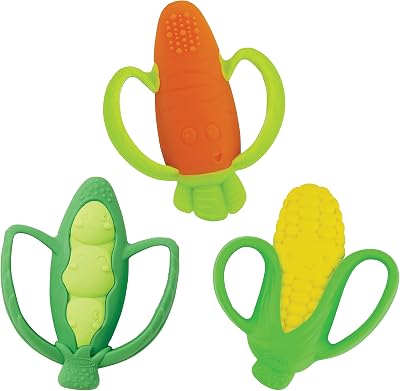
Infantino Lil' Nibbles Silicone Teether
100% food grade silicone in one molded piece, textured for gums, top rack dishwasher safe. No liquid, no gel, no plastic parts. No independent lab result published.
View →
Comotomo Silicone Baby Teether
One piece food grade silicone with no second part, simple to wash. Listed free of BPA, lead, nitrosamines, phthalates and plastic. No independent lab result published.
View →
Haakaa Silicone Teether Combo
Two one piece food grade silicone teethers, molded color, nothing added, listed free of BPA, PVC and phthalates. Sold for the freezer, but chill rather than freeze solid.
View →
Mushie Silicone Teether
One piece food grade silicone in a no drop sun shape. No plastic ring, clip or ribbon in the build. Boil to clean. No independent lab result published.
View →
Maple Landmark Solid Maple Teether
Solid hard maple, sanded smooth, with no oil, wax, glue, paint or cord. Made in Vermont. Harder than silicone or rubber, so some babies refuse it. Wipe clean, never soak.
View →
CaaOcho Sola the Goat Teether
Natural rubber, hollow body sealed with no hole. Careful: the food grade dyes on the face are not named. Contains latex. No independent lab result published.
View →The Infantino Lil' Nibbles leads because owner reviews choose the top pick among the products that clear our checks, and it has by far the largest base of happy owners of any plain silicone teether we looked at. Infantino also sells water filled teethers, which we do not recommend, so buy this one by name.
The Maple Landmark teether is for parents who would rather have no polymer in the mouth at all. Natural rubber was the hardest category to fill. The plain, unpainted rubber teethers we would have put first were sold out or could not be confirmed on sale when we checked, which is why the CaaOcho goat is here with its caveat stated: the rubber is well documented, but the maker does not name the dyes on its face.
The Picks Side by Side
| Teether | Material | Parts | Good for |
|---|---|---|---|
| Infantino Lil' Nibbles | Food grade silicone | One piece | Most babies |
| Comotomo | Food grade silicone | One piece | A plain, simple shape |
| Haakaa combo | Food grade silicone | Two one piece teethers | A spare while one is in the wash |
| Mushie | Food grade silicone | One piece | Babies who drop everything |
| Maple Landmark | Solid unfinished maple | One piece | No polymer at all |
| CaaOcho Sola | Natural rubber, dyed details | One sealed hollow piece | Natural rubber, no latex allergy |
Teethers We Did Not Pick
Liquid and gel filled teethers
Nuby's Ice Gel Keys and IcyBite, Frida's Not-Too-Cold-To-Hold, Infantino's Water Teethers, Bright Starts Chill and Teethe, the Green Sprouts Cooling Ring and the Sassy Flutterby all hold a sealed filling a baby can chew through. Health Canada found microbes in Nuby IcyBite Keys in January 2026 and in a Frida water filled teether in April, and its rule is plain: fillings must contain no living microorganisms. Several of these also do not name the plastic in the shell.
Sophie la Girafe
The rubber is sound, but the squeaker hole lets water into a cavity that cannot be dried, and parents documented mold inside from 2017. A maker's statement disputes that saliva caused it. German testing in 2011 and 2012 reported nitrosatable substances above the limit used for soothers, and we found no newer independent result. If you already own one, wipe it and never submerge it.
Manhattan Toy Winkel
To its credit, the maker states the tubing is polyurethane and contains no PVC, and it is loved by owners. But polyurethane is still a plastic chewed daily, and the rattle cube's material is not named.
HABA Rainbow Rattle
CPSC recall 26-719: the glued knot on the elastic can untie and release small pieces. Item 2012261001, batch 0925. Stop using it and claim the refund.
Painted natural rubber teethers
HEVEA's colored models, Oli & Carol and Natruba are natural rubber, and each describes its paint or pigments only as natural or food grade without saying what they are. On something a baby chews, the color should be named or absent.
| Teether | What it is | Why not | Verdict |
|---|---|---|---|
| Nuby Ice Gel Keys, IcyBite | Gel filled, shell not named | Filling undisclosed, Canadian recall | Careful |
| Frida Not-Too-Cold-To-Hold | Silicone with gel inserts | Gel not named on the maker's pages | Careful |
| Infantino Water Teethers | Water filled, polymer not named | Sealed water, recalled in Canada in 2022 | Careful |
| Bright Starts Chill and Teethe | Water filled, "plastic" | Polymer not named, sealed water | Careful |
| Green Sprouts Cooling Ring | EVA and water | Sealed water | Careful |
| Sassy Flutterby | Water filled, polymer not named | Polymer not named, sealed water | Careful |
| Sophie la Girafe | Natural rubber, squeaker | Cavity takes in water, old nitrosamine result | Careful |
| Manhattan Toy Winkel | Polyurethane tubing | Plastic in the mouth, cube not named | Careful |
| HABA Rainbow Rattle | Wood, plastic rings, elastic | Recalled for choking | Careful |
| HEVEA colored, Oli & Carol, Natruba | Natural rubber, colored | Pigments not named | Careful |
Teething Remedies to Leave on the Shelf
These are worse than any teether material
Benzocaine gels should not be used for teething. Homeopathic teething tablets were recalled in 2017 after the FDA found inconsistent belladonna. Amber, wood, marble and silicone teething necklaces carry a real strangulation and choking risk, and the FDA has reports of deaths.
Using and Cleaning a Teether
- Chill, do not freeze. The AAP advises against letting a baby chew on anything frozen solid, because hard objects can hurt tender gums. The fridge is enough.
- Choose one piece. A teether with no joints has nothing to come apart and nowhere for grime to sit.
- Silicone can take heat. Boil or steam it, or use the top rack, as the maker allows.
- Keep wood and rubber away from water. Wipe them with a damp cloth and dry them. Rubber ages, so throw it out at the first crack or stickiness.
- Inspect before every use. Discard anything torn, split or chewed through.
- A cold, damp washcloth works too. The AAP suggests one, knotted at one end for gnawing, for a sore afternoon when the teether is in the wash.
Frequently Asked Questions
Do teethers still contain phthalates?
US law has capped eight phthalates at 0.1 percent in teethers since April 2018, and we found no CPSC recall of a teether for phthalates. Older testing found teethers that were up to about half phthalates by weight, before the law. We could not find a recent published measurement that shows how the market looks today, so buying a teether made of a named material that needs no plasticizer is the simple way to avoid the question.
Are PVC teethers banned?
Not that we could find. Federal rules limit specific phthalates, and neither those rules nor any state law we could find ban PVC itself in a teether. A claim of PVC free is worth looking for. Materials that are never PVC, such as silicone, natural rubber, wood and cotton, avoid it entirely.
Is silicone a safe material for a teether?
Food grade silicone contains no phthalates and is the material we recommend for most babies. It can release very small amounts of leftover siloxanes from manufacturing, and studies have measured those at less than a nanogram per milliliter on average in saliva tests. Buy one piece designs from makers that name the material, and avoid silicone toys with pull strings.
Are natural rubber teethers safe?
The FDA itself suggests a firm teether made of rubber. Natural rubber has no PVC, but it is latex, so skip it with a latex allergy. The open question is nitrosamines, which form during curing and are limited in rubber bottle nipples but not in US teethers. Pick unpainted or lightly colored versions, keep them away from water, and replace them at the first crack.
Are wooden teethers safe?
Solid hardwood with no finish is one of the simplest materials a baby can chew. Choose one piece, with no paint, cord or glue, and keep it out of water so it does not crack. Wood is harder than silicone or rubber, so some babies do not take to it.
Are water filled or gel teethers safe?
The American Academy of Pediatrics lists liquid filled teethers as unsafe, and the FDA tells parents to choose one that is not liquid filled. They can leak or be chewed through, and Health Canada has repeatedly recalled them for microbes growing inside the filling, including in 2026.
Is BPA free enough on a teether label?
No. BPA free tells you about one chemical. In a 2016 study of 59 teethers, most labeled BPA free, other bisphenols, parabens and UV filters leached from intact surfaces. Look for the material the teether is actually made of.
Can I freeze a teether?
Chill it instead. The American Academy of Pediatrics warns against letting a baby chew on anything frozen solid, because hard objects can hurt tender gums. A silicone teether from the fridge gives the same relief.