Low Tox Mistakes That Hurt You More Than They Help (2026)
The 30 Second Summary
- DIY laundry detergent doesn't dissolve. It coats clothes in soap residue, traps body oils, and damages washing machines. Choose a fragrance free concentrate instead.
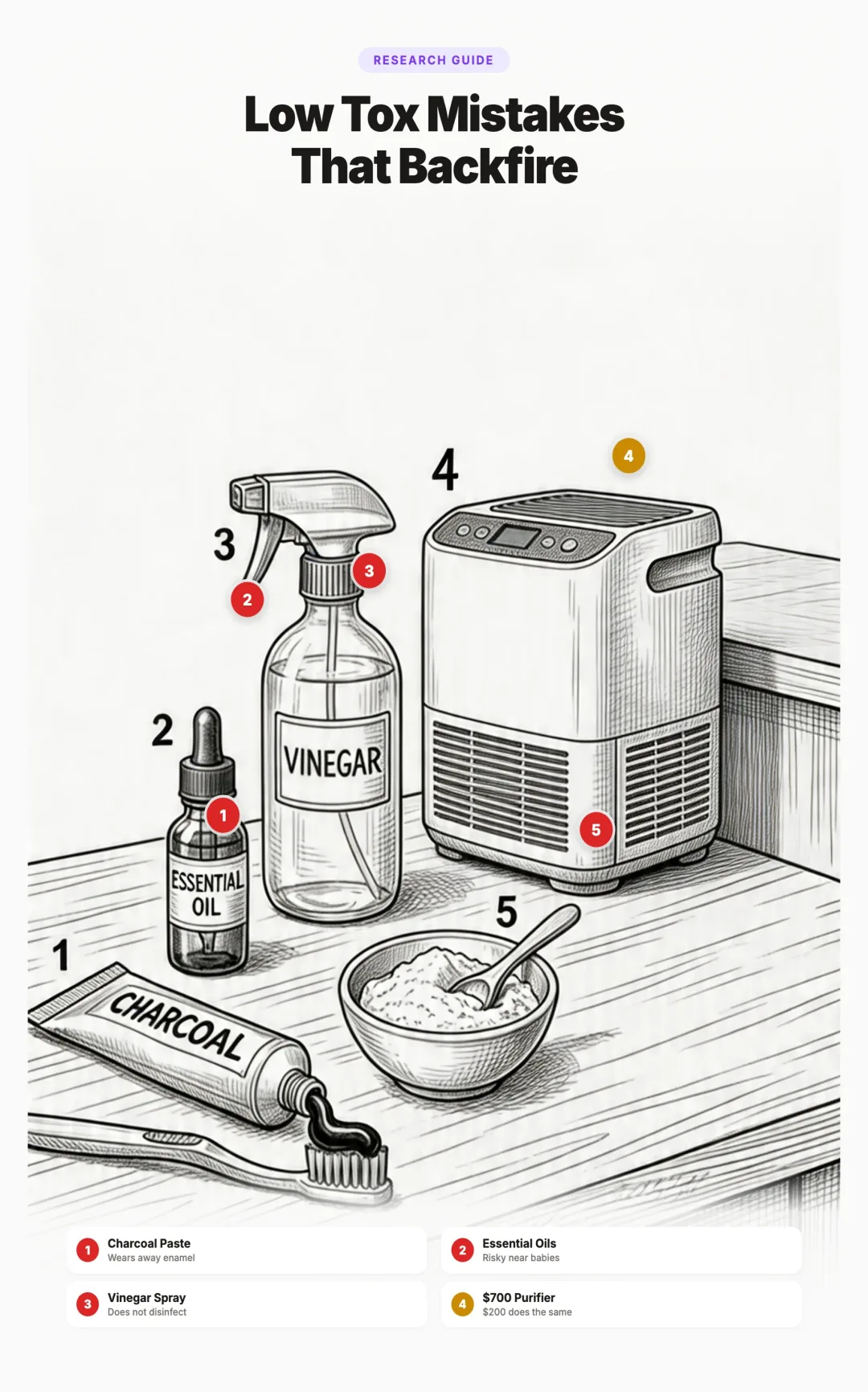
- Charcoal toothpaste wears down enamel. The abrasion is permanent, the whitening is short term, and there is no fluoride to compensate. Dentists are firm on this one.
- Vinegar is not a disinfectant. It does not kill enough bacteria or viruses to count as a kitchen or bathroom sanitizer. Use it for descaling, not for sanitizing.
- Homemade sunscreen has no measurable SPF. Coconut oil and zinc paste recipes test in the SPF 2 to 7 range. Buy a real mineral sunscreen.
- The $1,000 air purifier is a marketing problem. True HEPA filtration costs the same at $200 as it does at $1,000. The expensive units mostly buy you a nicer enclosure.
- Essential oils are not safe around babies and toddlers. Eucalyptus, peppermint, rosemary, and tea tree can trigger respiratory issues and seizures in young children, even diffused.
Reducing your exposure to harmful chemicals is one of the most important things you can do for your family's health. The science on endocrine disruptors, microplastics, and indoor air pollution is clear and getting clearer every year. This is real, and the instinct to do something about it is the right one.
But some of the most popular swaps in the low tox community do not actually work. A few of them make things worse. Not because the concern behind them is wrong, but because the specific solution misses the mark: a DIY detergent that does not clean, a charcoal toothpaste that wears down enamel, an air purifier that costs three times what it should for the same filtration.
This article is for people who are already committed to low tox living and want to make sure the changes they are making are actually doing what they think. It covers both swaps that backfire (DIY detergent, charcoal toothpaste, essential oils near babies) and places where conventional advice gets it wrong for a low tox household (why standard pitcher filters are not enough, why "natural" toothpaste needs more scrutiny than most people realize, and a priorities framework for where to focus your time and money first).
When Good Intentions Lead to Bad Swaps
If you are reading this, you probably already know that the system is not set up to protect you. The FDA does not pre approve cosmetic ingredients. The EPA has allowed chemicals like glyphosate and PFAS in our environment for decades. The US bans fewer than a dozen cosmetic ingredients while the EU bans over 1,300. "Meets federal standards" does not mean safe. It means legal.
You already know the exposure is real. Microplastics in human blood, placentas, and lung tissue. Endocrine disruptors in food packaging, personal care products, and household dust. Indoor air quality 2 to 5 times worse than outdoor air, according to EPA estimates. The instinct to change how you live in response to this is not paranoia. It is rational.
The problem is that some of the most shared advice in the low tox community leads to swaps that genuinely do not work, or that trade one problem for another. Clothes washed in DIY soap that look clean but harbor bacteria. Charcoal toothpaste that wears down enamel over time. Air purifiers that cost $700 for the same HEPA filtration you get at $200. Essential oils diffused in nurseries where they pose a real respiratory risk to infants.
This article covers 10 of those swaps. Not to talk you out of low tox living, but to help you do it better. Every section walks through what goes wrong, why, and what to do instead.
1. The 3 Ingredient Laundry Detergent Trap
The recipe is everywhere: grate a bar of Castile soap, add washing soda and borax, and you have a "natural" laundry detergent for pennies per load. The problem is that it does not clean your clothes.
Modern laundry detergents work because they contain surfactants, molecules with one end that binds to oil and dirt and another end that binds to water. Surfactants lift soil off fabric fibers and hold it suspended in water so it rinses away. Bar soap is not a surfactant. It is a fatty acid salt that reacts with hard water minerals to form soap scum, the same residue that builds up on shower walls.
This is well established surfactant chemistry: soap (a fatty acid salt) is not a surfactant. Surfactants have a molecular structure that lifts oil and soil from fabric fibers and holds them suspended in water for rinsing. Bar soap does not do this. Instead, it reacts with hard water minerals to form soap scum, the same residue that builds up on shower walls. On polyester and nylon, which make up the majority of modern clothing, soap based formulas leave residue that traps bacteria, body oils, and odor compounds that survive the wash cycle.
The result is clothes that look clean but are not. Over weeks and months, bacterial buildup can cause persistent odor, skin irritation, and in some cases contact dermatitis. Many people who switch to DIY detergent report that their towels stop absorbing water and their athletic wear develops a permanent smell. That is not a detox reaction. That is soap scum and bacteria accumulating in the fibers.
Washing soda (sodium carbonate) is alkaline and does help with mineral deposits, but it does not replace the cleaning action of surfactants. Borax has some disinfectant properties but is classified as a reproductive toxicant in the EU (Category 1B) and is restricted in consumer products there. The European Chemicals Agency considers it harmful to fertility at sustained high exposure levels, which is worth noting when it appears in formulas marketed as safer alternatives.
- Use a plant based detergent with real surfactants. Dirty Labs Free and Clear, Molly's Suds Unscented, and Meliora Unscented are all free of synthetic fragrances, dyes, and optical brighteners while still containing surfactants that actually work.
- If you have been using DIY detergent, run your towels and workout clothes through a hot wash with a proper detergent (or add a cup of white vinegar to a hot cycle) to strip the accumulated residue.
- Look for the EPA Safer Choice label, which certifies that every ingredient has been reviewed for human and environmental safety.
2. Charcoal Toothpaste and the Abrasiveness Problem
Activated charcoal toothpaste is marketed as a natural whitener that "detoxes" your mouth. It is one of the few low tox recommendations where the medical establishment is essentially unanimous in opposition.
A 2017 systematic review published in the Journal of the American Dental Association analyzed all available studies on charcoal dental products. The findings were unambiguous: charcoal toothpastes are significantly more abrasive than standard formulations, and none of the reviewed products had demonstrated either safety or efficacy for long term use. The ADA has not granted its Seal of Acceptance to any charcoal toothpaste.
The abrasiveness is the core issue. Tooth enamel is the hardest substance in the human body, but it does not regenerate. Once charcoal wears it away, it is permanently gone. The Relative Dentin Abrasivity (RDA) scale, developed by the ADA, rates standard toothpastes between 60 and 100. A 2023 study by Zoller et al. in the International Journal of Dental Hygiene tested 12 charcoal toothpastes and found RDA values ranging from 24 to 166, a wide and unpredictable range that makes it impossible to know how abrasive any given charcoal toothpaste is without lab testing.
Charcoal does adsorb surface stains temporarily, which creates a short term whitening effect. But because it is simultaneously removing enamel, the long term result is the opposite: thinner enamel exposes the naturally yellow dentin layer underneath, and teeth actually become more stained over time because rough, thinned enamel attracts new stains faster.
A 2019 British Dental Journal review added that most charcoal toothpastes also lack fluoride, meaning they provide no cavity protection. Some contain bentonite clay as an additional ingredient, which introduces heavy metal concerns (covered in section 9).
The 2017 JADA systematic review found insufficient evidence of safety or efficacy for charcoal toothpastes. A 2023 lab study found RDA values ranging from 24 to 166 across 12 charcoal products, meaning some are within safe ranges while others are well above the ADA recommended limit of 250. Without individual product RDA data (which most brands do not disclose), there is no way to know which end of that range your charcoal toothpaste falls on. Enamel loss from abrasive products is cumulative and irreversible.
- Use a regular toothpaste with an RDA under 100. Look for the ADA Seal of Acceptance.
- For whitening, hydrogen peroxide based whitening strips are clinically proven and do not damage enamel at recommended concentrations.
- If you have already been using charcoal toothpaste daily, see your dentist for an enamel assessment.
3. Vinegar as a Universal Cleaner
Vinegar has become the default recommendation in nearly every "non toxic cleaning" guide. It is cheap, widely available, and does work well for certain tasks. The problem is that it is presented as a universal replacement for all cleaning products, and it is not.
Where vinegar works: removing hard water deposits, cleaning glass, dissolving mineral buildup in kettles and coffee makers, and deodorizing (the acetic acid neutralizes alkaline odor molecules). For these jobs, a 1:1 vinegar and water spray is genuinely effective.
Where vinegar fails: disinfection, grease removal, and any surface that reacts with acid. A 2000 study by Rutala et al. published in Infection Control and Hospital Epidemiology evaluated the antimicrobial activity of common household products and found that household vinegar (5% acetic acid) was ineffective against E. coli, Salmonella, and Staphylococcus aureus under standard use conditions. Vinegar can reduce bacterial counts, but it does not meet the EPA threshold for disinfection.
This matters because "cleaning" and "disinfecting" are not the same thing. Cleaning removes visible dirt and some germs. Disinfecting kills specific pathogens on a surface. After handling raw chicken on a cutting board, vinegar will not reliably kill Salmonella. After a stomach virus goes through your household, vinegar will not eliminate norovirus from bathroom surfaces.
Vinegar also damages certain surfaces. It etches natural stone (marble, granite, slate) by dissolving the calcium carbonate in the stone. It can corrode grout over time. It strips the finish on hardwood floors. And it reacts with bleach to produce chlorine gas, which is genuinely dangerous.
- Use vinegar for what it is good at: glass, mineral deposits, deodorizing, and descaling appliances.
- For actual disinfection, use a product with an EPA registration number. Hydrogen peroxide based cleaners (3% concentration) are effective against most household pathogens and break down into water and oxygen.
- For grease, use a plant based detergent spray with surfactants. Branch Basics concentrate handles grease without synthetic fragrances.
- Never use vinegar on natural stone, and never mix it with bleach.
4. Homemade Sunscreen and Inadequate SPF
Sun protection is one of the most debated topics in the low tox space, and for good reason. Chemical UV filters like oxybenzone and octinoxate have been detected in breast milk and urine, and some studies have shown endocrine activity in laboratory settings. Avoiding them makes sense. What does not make sense is replacing them with nothing.
Homemade sunscreen recipes using coconut oil, shea butter, and zinc powder have become popular on social media, but none of these formulations provide adequate UV protection. Coconut oil has an SPF of roughly 1 to 7. Shea butter provides an SPF of about 3 to 4. A 2010 study by Kaur and Saraf in Pharmacognosy Research measured the UV blocking capacity of natural plant oils and found that none exceeded SPF 8, and most fell below SPF 5. Mixing zinc oxide powder into a homemade base does not guarantee even distribution or film thickness, which means protection will be inconsistent across the skin.
There are open questions in this area that deserve honest acknowledgment: UVB exposure is how your body synthesizes vitamin D, and widespread sunscreen use may contribute to the vitamin D deficiency now seen in a majority of adults. Daily high SPF application may not be necessary for people who spend most of their time indoors. And there is a meaningful difference between incidental sun exposure (a walk, a lunch outside) and prolonged UV exposure (a beach day, outdoor labor). These are worth thinking through for your own situation rather than following a blanket rule.
What is not debatable is that homemade sunscreen recipes do not provide reliable UV protection, and that prolonged unprotected sun exposure increases skin damage. If you are going to be in the sun for extended periods, you need actual protection, and mineral sunscreens with zinc oxide give you that without the chemical filters.
- For extended sun exposure, use a mineral sunscreen with zinc oxide as the active ingredient. Look for at least SPF 30 and broad spectrum protection.
- Avoid chemical filters like oxybenzone, octinoxate, and homosalate. Mineral sunscreens with zinc oxide and/or titanium dioxide are the low tox standard. Check out our mineral sunscreen guide for tested recommendations.
- Never rely on homemade sunscreen recipes. No DIY formulation has been tested for UV protection, and uneven zinc distribution means unreliable coverage.
- Clothing, hats, and shade are the simplest forms of sun protection with zero chemical exposure.
5. The $1,000 Air Purifier Problem
Indoor air quality is a legitimate concern. The EPA estimates that indoor air contains 2 to 5 times more pollutants than outdoor air. Particulate matter from cooking, volatile organic compounds from furniture and cleaning products, and microplastic fibers from textiles all contribute. A good air purifier genuinely reduces these exposures. The question is how much you need to spend.
The answer, based on independent testing, is far less than premium brands suggest. The Association of Home Appliance Manufacturers (AHAM) certifies air purifiers using a standardized Clean Air Delivery Rate (CADR) test. This number measures cubic feet per minute of filtered air for three particle types: smoke, dust, and pollen. Higher CADR means faster filtration. What makes AHAM Verifide different from "tested at a lab" is that AHAM randomly pulls units off the shelf to confirm the numbers hold. Brands that enroll are publicly committing to their claims. Brands that don't, aren't.
One caveat on the budget end that has changed recently. A wave of consumer class actions now alleges that several popular purifier brands do not meet the True HEPA standard they advertise, with Levoit, Winix, Blueair, Honeywell, Clorox and Hamilton Beach all named in filings through late 2025. The suits are unresolved and none is a safety recall, but the filtration number is the entire product, so we no longer point readers at a brand whose number is being litigated. Our air purifier guide covers who is affected and what we buy instead.
Wirecutter, Consumer Reports, and independent testing labs like Modern Castle have all reached the same basic conclusion: mid range HEPA purifiers in the $150 to $250 range deliver excellent particulate removal, and premium models rarely justify the price difference on actual filtration performance. What premium brands charge extra for is typically app integration, aesthetics, proprietary filter branding, and marketing budgets fueled by influencer partnerships.
The Molekule story is the clearest example. The original Molekule Air used a proprietary PECO (photo electrochemical oxidation) technology instead of HEPA, and was marketed as superior to HEPA filtration. Wirecutter tested it in 2019 and called it one of the worst air purifiers they had ever tested. Consumer Reports ranked it the third lowest scoring unit they had ever tested. The Better Business Bureau's National Advertising Division reviewed 26 of Molekule's marketing claims after a Dyson complaint and agreed with every challenge. In 2021, Molekule paid $2.7 million to settle false advertising litigation. In October 2023, the company filed for Chapter 11 bankruptcy.
Molekule has since restructured, merged with AeroClean, and now sells the Air Pro with a PECO-HEPA Tri-Power filter that adds true HEPA and activated carbon to the PECO stage. Independent lab testing by Tom's Guide measured the Air Pro's smoke CADR at 234 CFM, roughly equivalent to the $220 Coway Airmega. The current product does filter particles competently. It still costs around $980 at MSRP, with filter replacements at $175 every six months.
AirDoctor is a more nuanced case. The 3500i has a claimed smoke CADR of 336 CFM, tested at Intertek laboratory, and in Modern Castle's independent PM2.5 testing it performed well. But AirDoctor does not participate in the AHAM Verifide certification program, which means no third party is pulling their units off the shelf to confirm the numbers. It also uses proprietary filters that cost more to replace than standard filters. At around $610, you are paying a significant premium for performance that a $220 Coway can match on the metric that matters most for most homes: smoke CADR.
The actual performance ceiling for HEPA filtration is well understood: a true HEPA filter captures 99.97% of particles 0.3 microns and larger. Whether that filter sits in a $220 unit or a $980 one, the physics are the same. The differences that remain are fan speed (CADR), noise level, design, app features, and filter replacement cost, all of which can be evaluated without spending premium prices.
- Buy a HEPA purifier with an AHAM Verifide CADR rating appropriate for your room size. The Coway Airmega AP 1512HH has been Wirecutter's top pick for a decade running.
- Check annual filter replacement costs before buying. Some premium models use proprietary filters that cost $150 to $175 per replacement. The Coway uses standard replacement filters around $30 to $40.
- For more on air quality, read our guide on microplastics in indoor air.
6. Premium "Clean" Beauty That Is Not
The "clean beauty" market is projected to reach $22 billion by 2026, according to Grand View Research. Much of that growth is driven by a simple formula: take an existing product category, remove one or two ingredients that have become scary sounding, add the word "clean" or "non toxic" to the label, and charge two to three times the drugstore price.
The terms "clean," "non toxic," "natural," and "chemical free" have no legal or regulatory definition in cosmetics. The FDA does not define or regulate these claims. A $48 "clean" moisturizer and a $12 drugstore moisturizer can contain functionally identical formulations. In many cases, they do.
Fragrance free is one of the few meaningful label claims, as it indicates the product does not contain synthetic fragrance compounds (which can include undisclosed phthalates). But "fragrance free" products are widely available at every price point. You do not need to spend $48 on a "clean" moisturizer to avoid fragrance.
"Paraben free" is a common clean beauty claim. The science on paraben risk is contested, and for readers who want to avoid them, plenty of paraben free options exist at every price point. The bigger issue is that "paraben free" alone does not mean a product is free of fragrance, dyes, or other ingredients worth scrutinizing. Many products that lead with a "paraben free" label still contain synthetic fragrance, PEG compounds, or formaldehyde releasing preservatives. The label is a distraction from the full ingredient list.
The Environmental Working Group's Skin Deep database is a useful free tool for verifying ingredient lists yourself, but it is worth understanding that EWG's hazard ratings reflect theoretical concern, not demonstrated risk at real world exposure levels. Use it as a starting point to check what is actually in a product, not as a final verdict on safety.
- Focus on the claims that actually matter: fragrance free (to avoid undisclosed phthalates), dye free, and formaldehyde releaser free.
- Use EWG's Skin Deep database to verify ingredient lists yourself, not as a final verdict on safety.
- Look for affordable brands with genuinely short, clean ingredient lists rather than "clean" marketing on otherwise conventional formulas. Vanicream, The Ordinary, and Attitude all offer clean options at drugstore prices without parabens, fragrance, dyes, or formaldehyde releasers.
- For products with extended skin contact (daily moisturizers, deodorants, lip products), ingredient quality is the highest priority. Rinse off products like shampoo and body wash are lower priority but not zero: scalp absorption is real, and daily exposure to fragrance and sulfates in shampoo does contribute to systemic phthalate load.
7. Designer Water Filters vs. Filters That Actually Work
Water filtration is one of the most important swaps you can make. It is also a category where marketing claims and actual performance diverge sharply. Not every expensive filter is worth the money, and not every cheap filter does the job.
The first step is knowing what is in your water. Every public water system in the United States publishes an annual Consumer Confidence Report, available free from your utility or through the EPA's Consumer Confidence Report database. Cross reference it with the EWG Tap Water Database, which compares your local contaminant levels against health based (not just legal) limits. Federal standards are decades out of date for many contaminants, so "meets EPA standards" is not the same as "safe."
The contaminants most worth filtering in 2026:
- PFAS (forever chemicals). Linked to cancer, thyroid disease, and developmental effects. The EPA set its first enforceable limits in 2024, but utilities have until 2029 to comply. If you want PFAS out of your water now, you need to filter it yourself. Standard pitcher filters do not remove PFAS. Reverse osmosis and specific activated carbon blocks (certified to NSF/ANSI 53 for PFOA/PFOS specifically) do. See our PFAS and microplastics filtration guide.
- Microplastics and nanoplastics. Present in nearly all tap water, with some studies finding hundreds to thousands of particles per liter. Reverse osmosis removes essentially all of them. High quality carbon block filters remove most. Standard pitcher filters do not meaningfully reduce microplastic load. For more, see our microplastic water filter guide and our nanoplastic filtration guide.
- Lead. Particularly in homes built before 1986. An NSF 53 certified filter removes it. This is the one category where a good pitcher filter is genuinely sufficient.
- Chromium 6, nitrates, pharmaceuticals, and disinfection byproducts. Present in many municipal systems at levels above health based guidelines. Reverse osmosis is the most reliable removal method.
- Chlorine and chloramine. Safe at municipal levels but affect taste and can damage the skin microbiome. Any carbon filter handles these.
What actually works, matched to concern level:
For comprehensive protection (recommended for most households): Reverse osmosis. RO removes PFAS, microplastics, nanoplastics, heavy metals, fluoride, pharmaceuticals, and most dissolved contaminants. Under sink systems from brands like AquaTru, Waterdrop, or APEC run $300 to $600 and last years. A remineralization stage adds back beneficial minerals that RO strips out. This is the gold standard for microplastic and chemical reduction.
For targeted protection at lower cost: Bluevua countertop reverse osmosis needs no plumbing and fills a borosilicate glass carafe, so the filtered water is never stored in plastic.
What to skip:
- Standard Brita or PUR pitcher filters. They reduce chlorine and improve taste but do not meaningfully filter PFAS, microplastics, or most pharmaceuticals. Fine if taste is your only concern. Not adequate for a low tox household.
- Alkaline water machines. No credible evidence of health benefits. Your body maintains blood pH tightly regardless of what you drink. These are $500 to $2,000 for marketing, not filtration.
- "Structured water" or "hydrogen water" devices. Pseudoscience. Skip entirely.
- Berkey systems. Genuinely effective gravity filters, but they lost their NSF certification and face ongoing regulatory questions. If you already own one, it still filters effectively. New buyers should consider certified alternatives.
Well water exception: If you are on well water, get it independently tested before choosing any system. Common well contaminants (arsenic, nitrates, bacteria) require specific treatment and are not addressed by general purpose filters.
- Read your local water quality report and cross reference with the EWG Tap Water Database. "Meets federal standards" does not mean free of PFAS, microplastics, or pharmaceuticals.
- For most households serious about reducing chemical and microplastic exposure, reverse osmosis is the gold standard. Under sink RO systems in the $300 to $600 range are a one time investment that lasts years.
- If under sink RO is out of budget, Bluevua's countertop reverse osmosis needs no plumbing, and the LifeStraw Home glass pitcher is the cheapest step up.
- Skip standard Brita/PUR for anything beyond taste. Skip alkaline water machines, structured water devices, and anything without NSF/ANSI certification.
8. Essential Oils Around Babies and Toddlers
Essential oils are concentrated plant extracts that contain biologically active compounds. They are not inherently safe just because they are "natural." Cyanide is natural. Arsenic is natural. The relevant question is always dose and route of exposure, and for infants and young children, the margins are dangerously thin.
America's Poison Centers (formerly AAPCC) tracks thousands of essential oil exposure cases in children each year through its National Poison Data System. These include ingestion, skin application, and inhalation incidents. Essential oils are among the fastest growing categories of pediatric poisoning calls.
Specific oils with documented pediatric risks:
- Peppermint oil contains menthol, which can cause apnea (breathing cessation) in infants. The AAP and multiple children's hospitals warn against peppermint oil exposure in children under 2.
- Eucalyptus oil contains 1,8 cineole, which can cause respiratory distress and central nervous system depression in young children. Cases of seizures have been reported following ingestion of small amounts.
- Tea tree oil is toxic when ingested. Even small amounts (less than 10 mL) can cause ataxia, drowsiness, and disorientation in children. Published case reports from the NSW Poisons Information Centre and individual clinical cases have documented these effects, including one 4 year old who required intubation after ingesting a small quantity.
- Wintergreen oil contains methyl salicylate. A single teaspoon of wintergreen oil contains the equivalent of approximately 21 adult aspirin tablets. Ingestion by a child can cause salicylate poisoning, which can be fatal.
- Camphor can cause seizures within minutes of ingestion. Clinical literature considers 1 gram a concerning dose in children under 6, with documented cases of serious toxicity and death at similar amounts.
Diffusing essential oils in a nursery is not the same as having a houseplant in the room. A diffuser aerosolizes volatile organic compounds that an infant breathes continuously. Even oils considered "safe" for adults (like lavender) have not been studied for safety in continuous inhalation by infants. The Children's Hospital of Philadelphia recommends against water based diffusers for children, noting that overexposure to aerosolized essential oils can irritate the lungs, eyes, and skin of young children.
Never apply undiluted essential oils to a baby or toddler's skin. Never diffuse essential oils in a nursery or enclosed room where an infant sleeps. Never leave essential oil bottles where children can reach them. If a child ingests essential oil, call Poison Control immediately: 1 800 222 1222.
- For calming a nursery: ventilation (open windows), white noise, and appropriate temperature control. No diffuser needed.
- For nasal congestion in infants: saline drops and a bulb syringe. Not eucalyptus or peppermint vapor.
- If you use essential oils for yourself as an adult, store them in a locked cabinet and use them in rooms your child does not sleep in.
- For more on safe baby products, see our non toxic baby and toddler guide.
9. Bentonite Clay Toothpaste and Heavy Metal Testing
Bentonite clay is a common ingredient in "natural" toothpastes, marketed for its mineral content and supposed detoxifying properties. The concern is not theoretical: independent lab tests have found elevated levels of lead and arsenic in some clay based oral products.
A 2016 FDA safety alert warned consumers about a specific bentonite clay product ("Best Bentonite Clay") that contained elevated levels of lead. The FDA stated that "lead can cause serious health effects, particularly in young children and pregnant women." While this was one product, the underlying issue applies to the entire category: bentonite clay is a naturally occurring mineral that can contain heavy metals as geological contaminants, and "natural" does not mean "tested for heavy metal content."
A 2020 study published in the Journal of the American Association for Laboratory Animal Science tested commercially available healing clays (sold for topical use, not specifically oral products) and found elevated concentrations of both arsenic and lead across all three brands tested, with average lead concentrations of 21,457 ppb, 44,633 ppb, and 54,754 ppb respectively. All three exceeded the US Pharmacopoeia limit for lead in pharmaceutical products. While these clays were marketed for skin application, they are the same bentonite and green clay materials used in many "natural" toothpastes. The concentrations varied significantly between brands and batches, which is characteristic of products sourced from natural mineral deposits without standardized purity testing.
The oral exposure route is particularly concerning because clay toothpaste is used in the mouth, where absorption through mucous membranes is more efficient than through skin. Children who may swallow toothpaste are at higher risk. And because clay toothpastes are used daily, even low level heavy metal exposure accumulates over time.
Like charcoal toothpaste, most clay based formulas also lack fluoride and have not been tested for cavity prevention efficacy. They share the same abrasiveness concerns: clay particles can score enamel depending on particle size and hardness, though generally less aggressively than activated charcoal.
- If you want a "natural" toothpaste, look for one that is ADA tested and skip the clay.
- If you are already using a clay toothpaste, look for brands that publish independent third party heavy metal testing results. If the brand does not test or will not share results, switch.
- For children especially, stick with toothpastes that have been clinically tested and certified by the ADA or equivalent regulatory body.
10. Where to Focus When You Cannot Do Everything at Once
Low tox living is not a single swap. It is a long term shift across every part of your home, your kitchen, your bathroom, your bedroom, what you eat, and what you put on your skin. If you are early in that process, trying to do everything at once leads to burnout and overspending. A priority framework helps.
The categories below are ordered by exposure volume and duration: how much of the substance enters your body, and for how long. This is not a complete list of everything that matters. It is a starting point for people who need to know where to begin.
This is not an exhaustive list of everything that matters. Cookware, mattresses, produce quality, clothing, and laundry all deserve their own deep dives, and we have written separate guides on many of these. The point is that if you are feeling overwhelmed, starting at the top of this list and working down will get you further, faster, than trying to change everything at once.
This framework also helps with budgeting. Instead of spreading $500 across a dozen small upgrades, concentrate it where exposure volume is highest: a reverse osmosis water filter, a set of glass food storage containers, and a HEPA air purifier for your bedroom.
Conclusion: Do It Better, Not Less
You are not wrong to question what is in your water, your food packaging, your cleaning products, or your kids' toothpaste. You are not wrong to distrust regulatory agencies that have been slow to act on chemicals that were known to be harmful. You are not wrong to want better for your family than what the conventional system offers by default.
The point of this article is not to talk you out of any of that. It is to make sure the specific swaps you choose are doing what you think they are doing. A DIY detergent that leaves your clothes dirtier. A charcoal toothpaste that wears down enamel. An air purifier that charges three times the price for the same HEPA filter. An essential oil diffuser running next to a sleeping baby. These are not low tox wins. They are well intentioned mistakes that can be fixed.
Low tox living is a long game. It is not about achieving a perfectly clean home by next Tuesday. It is about making one better choice at a time, starting with the exposures that matter most, and building from there. Filter your water. Get plastic away from heat. Clean up your indoor air. Switch to genuinely clean personal care. Choose cookware, bedding, and produce that reduce your family's cumulative exposure over years, not just for a single Instagram post.
Keep questioning. Keep reading ingredient lists. Keep pushing for better. Just make sure the answers you land on actually hold up.
FAQ
Is DIY laundry detergent actually bad?
Most DIY laundry detergent recipes use grated bar soap, washing soda, and borax. Bar soap is not a surfactant. Surfactants lift oil and soil from fabric and suspend them in water for rinsing. Soap reacts with hard water minerals to form soap scum, which builds up on synthetic fabrics over time, trapping bacteria and body oils. This is well established surfactant chemistry. Plant based detergents from brands like Dirty Labs or Molly's Suds contain real surfactants and clean effectively without the chemicals people are trying to avoid.
Is charcoal toothpaste safe to use daily?
The ADA has not approved any charcoal toothpaste product. A 2017 JADA systematic review found insufficient evidence of safety or efficacy, and a 2023 lab study found abrasiveness (RDA) values ranging from 24 to 166 across 12 charcoal products, meaning some fall within safe ranges while others are well above recommended daily use levels. Without individual product RDA data, which most brands do not disclose, there is no way to know how abrasive your charcoal toothpaste is. Enamel loss from abrasive products is cumulative and irreversible.
Are essential oils safe around babies?
Many essential oils are not safe around infants and young children. Peppermint and eucalyptus oils contain compounds like menthol and 1,8 cineole that can cause respiratory distress and apnea in babies. Tea tree oil is toxic if ingested, and ingestion cases in young children are among the most common essential oil poison control calls. America's Poison Centers tracks thousands of essential oil exposure cases in children each year. The Children's Hospital of Philadelphia recommends against water based diffusers for children. Never diffuse essential oils in a nursery or apply them to a child under 2 without explicit guidance from a pediatrician.
Do I really need an expensive air purifier?
No. Independent testing by organizations like Wirecutter, Consumer Reports, and the Association of Home Appliance Manufacturers consistently shows that mid range HEPA purifiers in the $150 to $250 range perform as well or better than premium models costing $600 or more on actual particulate removal. The Coway Airmega AP 1512HH is the one we point to, and it has been an independent top pick for a decade. Several other budget names that used to sit alongside it are now defending class actions over whether their filters meet the True HEPA standard they advertise, so we no longer list them. What you are paying for with premium brands is often marketing, app features, and design, not better air cleaning.
Is it worth switching everything from plastic to glass?
Not everything. The exposure risk from plastic depends on temperature, fat content, acidity, and contact time. Switching matters most for food storage that involves heat (microwave containers, hot food storage), baby bottles and sippy cups, and anything holding acidic or fatty liquids for extended periods. For room temperature dry goods like rice, pasta, cereal, or flour, the leaching risk from a plastic container is negligible. Focus your money on the swaps that reduce the most exposure. For the heat and liquid cases, choose glass food storage containers with glass lids.
Does vinegar actually disinfect surfaces?
Vinegar is a cleaner, not a disinfectant. A 2000 study published in Infection Control and Hospital Epidemiology found that household vinegar (5% acetic acid) failed to eliminate E. coli, Salmonella, and Staphylococcus aureus at concentrations required for disinfection. Vinegar works well for removing mineral deposits, cleaning glass, and cutting light grease. But for surfaces that need actual disinfection, like kitchen counters after handling raw meat or bathroom surfaces, you need a product with an EPA registration number.
Related Articles
- Free Ways to Reduce Plastic Exposure (2026)
Once you know which low tox swaps to skip, here are the free changes that actually move the needle. - Low Tox Myths, Debunked: What Is Actually Worth Worrying About (2026)
27 common claims ranked by actual evidence. Quick reference verdicts for kitchen, food, personal care, and baby concerns. - How to Start Reducing Plastic Exposure: A Practical Priority Guide (2026)
A step by step framework for reducing microplastic exposure, starting with what matters most. - Best Mineral Sunscreen Guide (2026)
Tested mineral sunscreens with adequate SPF and no chemical UV filters. - Microplastics in Indoor Air (2026)
Your bedroom air contains thousands of microplastic fibers. What purifiers and strategies actually reduce them. - Non Toxic Baby and Toddler Products Guide (2026)
Research backed guide to bottles, sippy cups, plates, pacifiers, and more.