Best Non Toxic Kids Multivitamins: What Two Labs Found, and the Number Nobody Prints (2026)
The 30 Second Summary
- Most children do not need a multivitamin at all. Doctors recommend them to close a specific gap, not as a daily habit. If your child eats reasonably well, the one supplement worth giving is vitamin D.
- The lead headlines are half the story. Labs did find lead in most children's vitamins. But the amount a child actually swallows in a daily serving stayed under the level California uses to require a warning label, in every product tested. Worth knowing about, not worth panic.
- What is worth avoiding never appears on the label. Plastic softeners get into vitamins from factory tubing and packaging, and the gap between brands is enormous: five products had none the lab could find, while the worst had nearly six times more than the next worst. No ingredient list will tell you, because nobody adds them on purpose.
- If you do want one, buy MegaFood Kids One Daily. It is the only children's vitamin we found that came back clean on everything it was tested for: no plastic softeners, no PFAS, no pesticides, no weed killer and no heavy metals the lab could detect. Short ingredient list, and nothing added to make it sweet.
- For ages one to three, MaryRuth's Organic Toddler Drops with Iron. A liquid in a glass bottle rather than a chewable, and the only toddler multivitamin that tested clean for lead, cadmium, mercury and arsenic.
First, Does Your Child Need One
This is a buying guide that starts by arguing against the purchase, because the honest answer for most families is no. Pediatric guidance does not recommend a routine multivitamin for a healthy child eating a varied diet. It names specific gaps instead: vitamin D for every infant from the first days of life, iron where a blood test finds it short, and closer attention where a diet is restricted, a child is a genuinely selective eater, or a condition affects absorption. A multivitamin supplies twenty nutrients to solve a problem that is usually one nutrient wide.
That matters more here than in most categories, because everything below is about contamination, and the cleanest possible product still carries whatever risk it carries for no benefit if the gap was not there. If a doctor has named the gap, or your child's eating makes one likely, read on. If the honest answer is that the gummies are easier than the argument about vegetables, the better buy is vitamin D on its own, which is the one supplement pediatricians do ask every family to give.
Two Labs, Two Different Questions
Search this category and you will find two sets of numbers that seem to describe different worlds. In one, nine of twelve children's vitamins tested positive for lead, with arsenic running to 310 parts per billion. In the other, every product screened came in comfortably under the level California uses to trigger a warning label. Both sets are real, both come from accredited laboratories, and several of the same products appear in each. The difference is not the chemistry. It is the question.
Lead Safe Mama reports concentration: how much metal there is in a gram of tablet, in parts per billion by weight. It flags anything above about 5 ppb, which is near the limit of what a commercial panel can see. Mamavation reports dose: how much metal a child actually swallows at the serving on the label, in micrograms a day. A concentration tells you what the product is made of. A dose tells you what goes into the child. Neither is wrong, and a parent reading only one of them will reach the wrong conclusion.
Converting between the two needs the weight of a tablet, which almost no brand publishes, so the arithmetic is not something a parent can do at the shelf. What you can do is notice which question a headline is answering. A number in parts per billion is a concentration and tells you nothing on its own about the dose. A number in micrograms a day is a dose and tells you nothing about how concentrated the product is. We record both, and our verdicts judge the concentration, because that is the figure that stays true whatever the serving size says.
The Number Nobody Prints
The metals argument is the one this category has in public, and it is not the one that changed our verdicts. Alongside the metals, nine children's multivitamins went through a screen for fourteen phthalates, forty PFAS compounds, glyphosate and 587 pesticides. The pesticides came back empty in all nine. The glyphosate came back empty in all nine. One product carried a quantified PFAS result. And the phthalates separated the shelf more sharply than anything else measured.
A phthalate softens plastic, and it migrates into whatever the plastic touches. It is not in a recipe, so no manufacturer adds it and no label declares it. It arrives from processing tubing, a gasket, a conveyor belt or the bottle. That is precisely why it is worth knowing: it is the one contaminant a careful parent cannot read their way to, and the only route to it is somebody measuring the finished product.
Nothing about a plasticizer in a supplement is regulated, so there is no limit to be over and no warning anyone was required to print. What the spread shows is that it is avoidable: five manufacturers making the same kind of product got a non detect, which means the result is about how a product is made rather than something inherent to vitamins. A measured phthalate now holds a product at caution in our database, on that product alone, because the mechanism is a factory's own equipment and a number cannot tell us which part of it.
Every brand named here has a Product Check record with the measurements, the laboratory and the legal history behind the verdict, so you can see the evidence rather than take the conclusion.
The Picks
Two products clear all four checks, and the small number is the finding rather than a gap in our research. Nine products went through the broad contaminant screen and twelve through the metals panel, which is not a large shelf to choose from, and a pick here has to pass the formula, the packaging, the independent testing and the legal record rather than any one of them. A third name would mean moving the bar.
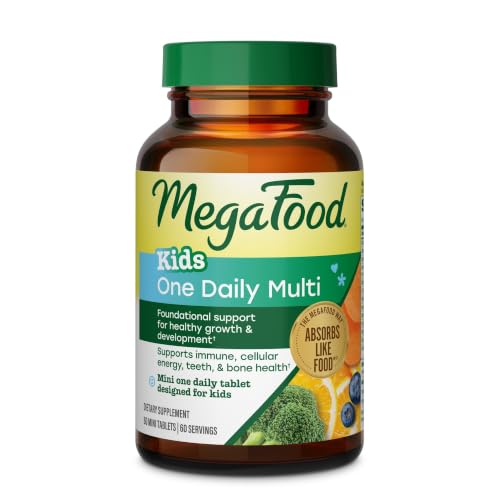
MegaFood Kids One Daily
One mini tablet daily, 21 nutrients on a fermented mineral base with an 83 mg food blend. Every ingredient named, no added sweetener, flavouring or colouring. 4.6 stars across 2,013 ratings.

MaryRuth's Organic Toddler Drops with Iron
Liquid drops in glass on a glycerin and water base, USDA Organic, 2 mL daily. Twelve nutrients including iron. The flavour line names orange and vanilla. 4.6 stars across 2,357 ratings.
Why MegaFood Kids One Daily
It is the only product in the screen where every panel came back empty. No PFAS across forty analytes, no phthalates across fourteen, no glyphosate, nothing across 587 pesticides, arsenic, cadmium and mercury non detect and lead below the laboratory's reporting limit. Eight other children's multivitamins went through the same laboratories and every one of them had something quantified. That is a manufacturing result as much as a formula result, and it is the single strongest piece of evidence in this category.
The label holds up to the same reading. Twenty one nutrients, each named with its form, on a base of microcrystalline cellulose, silicon dioxide, ferment media, rice protein, stearic acid, autolyzed yeast extract and hypromellose. There is no natural flavour, no proprietary blend and no umbrella term anywhere on it, and the maker adds no sweetener, flavouring or colouring at all, which is unusual in an aisle built on making things taste like candy. The trade is that a mini tablet is not a sweet, and a child who refuses it will refuse it.
The brand needed the hardest look of anything here. MegaFood's parent company was the subject of a California Proposition 65 notice over lead that went all the way to a judgment, which normally ends a brand's candidacy on the spot. Reading the notice itself rather than a summary of it changes the picture: it names eleven products, and they are adult formulas, the Baby & Me prenatal and the Alpha-Teen multivitamin. Kids One Daily is not among them. The brand's prenatal remains a product we would not buy, which is why its Product Check entry opens by saying the verdict depends on the product.
Why MaryRuth's Organic Toddler Drops for the younger ages
A one year old cannot chew a tablet, and the toddler end of this aisle is almost entirely gummies and powders. The drops are the one multivitamin in the twelve product metals panel that came back non detect for lead, cadmium, mercury and arsenic. That matters only because the limits were low enough to mean something: a non detect at a high limit says nothing at all, and these were at 5 parts per billion or below, which sits at or under every bar we judge an ingested product against.
The format is doing the work. A liquid is a solvent, a vitamin and a flavour, where a chewable tablet is all of that plus binders, bulking agents, sweeteners and whatever minerals the formula carries, each with its own supply chain. The drops are also the rare case where the container is glass rather than a moulded bottle nobody names the resin of. The dropper assembly is plastic, which we note rather than count against it, because the liquid sits in glass between doses and the dropper touches it for a second.
Two honest caveats. This product contains iron, which is the right call for the age it is made for and also the reason the bottle must stay out of reach, since iron supplements are a leading cause of poisoning deaths in young children. And the brand is not uniformly clean: its prenatal and postnatal liquid tested positive for lead in the same programme that cleared the toddler drops. A favourable result belongs to the product that earned it and travels no further, which is why the brand sits at careful while this row does not.
All Nine, Side by Side
Every product screened in July 2025, with what each panel returned. Lead is given as the dose at the labelled serving, which is how that laboratory reported it; California's warning level for comparison is 0.5 micrograms a day.
| Product | Phthalates | PFAS | Lead dose | Verdict |
|---|---|---|---|---|
| MegaFood Kids One Daily | non detect | non detect | below limit | Good |
| MaryRuth's Organic Kids Gummies | non detect | non detect | 0.005 | See note |
| SmartyPants Organic Kids Multi & Omegas | non detect | non detect | 0.028 | Careful |
| Llama Naturals Plant-Based Kids Multi | non detect | below limit | 0.022 to 0.033 | Careful |
| Seeking Health Kids Multivitamin Chewable | non detect | non detect | 0.05 | Careful |
| Pure Encapsulations Junior Nutrients | 39 | 0.184 PFPeA | 0.026 | Careful |
| Hiya Kids Daily Multivitamin | 144 | below limit | 0.042 | Careful |
| Garden of Life mykind Organics Kids Multi | 222 | below limit | 0.056 | Careful |
| Life Extension Children's Formula | 1,264 | non detect | 0.027 | Careful |
Phthalates and PFAS in parts per billion, lead in micrograms a day. Glyphosate and 587 pesticides were non detect in all nine. "Below limit" means the laboratory saw something it could not quantify, which is a detection rather than a measurement and sets no verdict on its own. The MaryRuth's gummy that was screened carries its own complication: it is the USDA Organic version, whose listing has had no buy box, and a clean result does not transfer to the brand's other gummies, so we point to the toddler drops instead.
The Twelve Product Metals Panel
The other dataset is older, larger on metals and narrower on everything else. Twelve children's vitamins went to a laboratory in 2024 and were reported as concentrations: nine positive for lead, five for cadmium, seven for arsenic, none for mercury. These are the numbers that travel around parenting forums, and they are the ones our verdicts judge, because a concentration stays true no matter what the serving size on the label says.
| Product | Lead | Cadmium | Arsenic |
|---|---|---|---|
| Flintstones Chewable plus Extra Iron | 60 | non detect | 30 |
| EllaOla Toddlers' Multivitamin | 50 | 20 | 120 |
| Hiya Kids Daily Multivitamin | 30 | 20 | 310 |
| Seeking Health Kids Multivitamin Chewable | 24 | 25 | 62 |
| Pure Encapsulations Junior Nutrients | 23 | 102 | 20 |
| VitaKlenz for Kidz | 23 | non detect | 39 |
| Renzo's Picky Eater Multi with Iron | 21 | 9 | non detect |
| Nordic Naturals Children's DHA | 14 | non detect | non detect |
| SmartyPants Kids Multi & Omegas | 6.54 | non detect | non detect |
| NovaFerrum liquid iron for children | non detect | non detect | 43 |
| MaryRuth's Organic Toddler Multivitamin | non detect | non detect | non detect |
| Baby Ddrops Organic vitamin D3 | non detect | non detect | non detect |
All figures in parts per billion by weight. Two products came back clean on all four metals and both were liquids, and one of those is a single nutrient vitamin D drop rather than a multivitamin. Look at the top of the table and a pattern shows: the two highest lead results, Flintstones and EllaOla, sit beside Renzo's in being iron bearing or mineral dense formulas. Iron and calcium are mined, and a formula carrying a lot of them carries whatever the ore carried. That is a better predictor than whether a product is a gummy.
None of these figures is over a legal limit, because no regulator publishes one for metals in a dietary supplement. The 5 parts per billion line we judge against comes from levels proposed in a bill that never passed, which is why a result above it is a caution in our database and never a failure, however far above it sits.
Products We Did Not Pick
Each of these has a measurement behind it rather than a general suspicion, and several are better than their reputation in one direction while being worse in another. None is unsafe in the sense of being over a legal limit, because no limit exists to be over.
Life Extension Children's Formula
By far the highest plasticizer result in the screen, and the reason this article exists in the shape it does. Everything else about it read well: PFAS, glyphosate and 587 pesticides non detect, and metal doses among the lower half. The label is unusually long but it names its three flavours rather than hiding behind the word.
The brand carries the longest run of lead notices in this round, eight California Proposition 65 filings between 2010 and 2025. The most recent settled in April 2026 over a plant protein powder, and none of them names this children's chewable.
Hiya Kids Daily Multivitamin
The most marketed children's vitamin there is, and the one the data disagrees about most. A 2024 panel measured 310 parts per billion of arsenic, the highest in that set, with 30 lead and 20 cadmium. Ten months later a different laboratory reported arsenic non detect in the same product, with lead at 0.042 micrograms a day. Lot to lot variation in a mineral and botanical supply chain is the likeliest explanation, and neither result cancels the other.
Hiya disputes the 2024 finding and points to its own testing, and it became Clean Label Project Certified in May 2025, which publishes a pass rather than numbers. Separately, 144 parts per billion of phthalates were measured in it. No notice and no recall names the brand.
Pure Encapsulations Junior Nutrients
PFPeA at 0.184 nanograms per gram, which makes it the one product in the screen where a PFAS compound was measured rather than merely glimpsed below a reporting limit, plus 39 parts per billion of phthalates. The 2024 metals panel put its cadmium at 102 parts per billion, the highest cadmium of the twelve, alongside 23 lead and 20 arsenic.
Two Proposition 65 notices name the company over lead, both about a Klean Athlete pre-workout powder rather than this product, and neither has gone to complaint or settlement.
Seeking Health Kids Multivitamin Chewable
A good illustration of why we report both measures. The broad screen put it in its best tier, with phthalates, PFAS, glyphosate and pesticides all non detect and lead at 0.05 micrograms a day. The metals panel measured 24 parts per billion of lead, 25 of cadmium and 62 of arsenic by weight, all above the bars we judge an ingested product against.
The brand settled a Proposition 65 lead case in July 2025 with reformulation and warnings, over its Optimal Prenatal with Collagen rather than this product, and has one closed recall from 2022 on an adult chewable whose copper content did not match its label.
Llama Naturals Plant-Based Kids Multi
The contamination results were among the better ones: phthalates, glyphosate and 587 pesticides non detect, with only very small metal doses found. The problem is the label. The ingredient line reads "Organic Flavor" and stops there, which is an umbrella term, and organic certification governs how a flavour was grown and extracted rather than what is in it.
No Proposition 65 notice and no recall names the brand. If the maker published what the flavour is, this would be a straightforward recommendation.
Garden of Life mykind Organics Kids Multi
The whole food label is genuine, built on organic fruit and a long vegetable blend, and the flavour is named as peach rather than hidden. Against that, 222 parts per billion of phthalates and 0.056 micrograms of lead a day, which was the highest lead dose of the nine although still about a ninth of California's warning level.
The brand's recall history is all closed and none of it concerns a children's multivitamin, though it includes two serious events: a salmonella recall on meal powders in 2016 and a baby probiotic withdrawn in 2017 over a choking risk.
SmartyPants Organic Kids Multi & Omegas
This one is close. Phthalates, PFAS, glyphosate and pesticides all non detect, and a lead dose of 0.028 micrograms a day. What holds it back is 6.54 parts per billion of lead by weight, the lowest of the nine products in the metals panel that detected any, but still over the 5 part per billion line we judge against. A bar is only worth having if it applies to the product that just crosses it.
Its single Proposition 65 notice names the company's prenatal rather than this product and has drawn no complaint or settlement. A 2018 recall over foreign objects in bottles of kids gummies is closed and eight years old.
What to Read on the Label
Nothing on a label will tell you what a laboratory found, which is the honest limit of this section. What a label does tell you is how much a manufacturer is willing to say, and that turns out to correlate with how the testing goes. The product that screened cleanest here is also the one whose label names every ingredient and its form, adds no sweetener, flavouring or colouring, and uses no umbrella term anywhere.
So read for the words that stand in for a list. "Natural flavors" is a category that can run to hundreds of undeclared ingredients. "Organic Flavor" is the same gap with a certification in front of it. "Proprietary blend" hides the amounts. None of those is evidence of harm and none of them makes a product bad, but each one is a place where you have been asked to trust rather than shown, and in a product a child takes every morning there is usually a version that does not ask.
Then look at what the formula is carrying. A multivitamin heavy in iron, calcium and trace minerals is pulling from mined raw materials, and that is where the metals in every panel we have read concentrate. If a doctor has asked for iron, that is the right reason to accept it. If nobody has, a formula without it has fewer places for a contaminant to ride in.
Frequently Asked Questions
Do children actually need a multivitamin?
Most healthy children eating a varied diet do not. Pediatric guidance does not recommend a routine multivitamin for a child who eats well, and names specific gaps instead: vitamin D for every infant, iron where a doctor finds it short, and more care where a diet is restricted, a child is a very selective eater, or a condition affects absorption. That matters here because the cleanest multivitamin is still a product you may not need. Ask your pediatrician which nutrient is actually missing before buying something that supplies twenty.
Does a lead result mean the vitamin is unsafe?
It means something was measured, and the number you were shown decides how frightening it sounds. One laboratory reports concentration, parts per billion by weight of the tablet, and flags anything it can detect. The other reports the dose at the labelled serving, in micrograms a day. Of the nine products in that second screen, the highest lead dose was Garden of Life at 0.056 micrograms a day, about a ninth of the 0.5 micrograms California sets as the level that triggers a warning. Both measurements are real. They answer different questions.
What is a phthalate doing in a vitamin?
Not being an ingredient. Phthalates soften plastic, and they migrate into what the plastic touches, so they arrive from processing tubing, a gasket, a conveyor belt or the packaging rather than from a recipe. That is exactly why no label will tell you: a manufacturer does not add it and does not have to declare it. The only way to know is for somebody to measure the finished product, which is what makes the spread in this screen useful, from non detect in five products to 1,264 parts per billion in one.
Are gummies worse than tablets?
Not reliably, and the two screens here disagree about it. In the children's vitamin panel the cleanest results were liquids and the highest were chewables and powders, which suggests format matters. But in testing of prenatal vitamins the pattern ran the other way, with pills about ten times dirtier on metals than gummies. The thing both findings share is mineral load. A formula carrying a lot of iron, calcium and trace minerals carries whatever the ore carried, and the two highest lead results in the children's panel were both products with added iron.
Is Clean Label Project certification enough on its own?
It is real, and it is not a number. Clean Label Project tests and certifies, but it publishes a pass rather than per product figures, so when a certified product also has a published measurement against it there is nothing to set beside the measurement. Hiya is the case in point: it became certified in May 2025 with a Purity Award on its daily multivitamin, and it disputes the 2024 result that measured 310 parts per billion of arsenic. We report both, because that is what the record holds.
Why are there only two picks?
Because the screens were small and the bar is specific. Nine children's multivitamins went through the broad contaminant screen and twelve through the metals panel, which is not many products, and a pick here has to clear four separate checks rather than one. MegaFood Kids One Daily is the only product where every panel came back empty or below the laboratory's limit. MaryRuth's toddler drops are the only multivitamin in the metals panel that came back non detect on all four metals. Naming a third would mean lowering the bar rather than finding one.
What about Flintstones and the other supermarket brands?
Flintstones Chewable plus Extra Iron carried the highest lead figure in the metals panel at 60 parts per billion by weight, and arsenic at 30. It is also one of the two products in that panel with added iron, which is the pattern worth noticing rather than the brand. No Proposition 65 notice names it and no recall is on record, so the finding is the measurement and nothing else.
How should I store a children's vitamin?
Away from heat and out of reach, and the second one is not a throwaway. Iron containing supplements are a leading cause of poisoning deaths in children under six, which is why American labels carry a warning and why child resistant packaging rules reach them. A bottle of sweet chewable tablets that a child can open is a bigger and more immediate risk than anything measured in this article. Keep it high, keep the cap on, and treat a gummy vitamin as medicine rather than a snack.
Related Articles
- Best Non Toxic Vitamin D for Babies and Kids
The one supplement pediatricians do ask every family to give, and the dose the dropper holds. - Microplastics in Supplements
Why the form a supplement comes in changes what rides in with it. - The Cleanest Prenatal Vitamins
The same two measurements argued out in the supplement a mother takes. - Best Non Toxic Toothpaste for Kids
The other thing a child swallows a little of every single day. - Baby and Kids 101
The step by step detox for families, ranked by impact. - Microplastics in Baby Food
Where the particles in a child's diet actually come from.